


Zeebrugge - Andrew and Roy
- 1987
Gent and Brugge and Damme - Andrew -
2000
Dinant and Oostende - Andrew -
2001
Antwerp -
Andrew, Jacqui and her Mum - 2023


Click here for more detailed map
***
Belgium is a country with an undeserved reputation for being 'boring'. This is simply not true, it has some of northern Europe's most beautiful and unspoilt towns and the south of the country has the dramatic Ardennes landscape full of Castles and river valleys.
The capital is Brussels, renowned as one of the centres of the European Union and these days one of the three termini for the Eurostar Channel Tunnel Train.
Belgium is split into the Flemish speaking north and the French speaking "Wallonia" in the south with Brussels acting as a kind of junction between the two. Together with The Netherlands and Luxembourg, Belgium is one of the three Benelux countries.
***
Zeebrugge - Andrew and Roy - 1997

Roy and Andrew on the Zeebrugge Ferry
Our trip to Belgium in 1987 was a second try at the "cross the Channel for £1" offers in one of the Daily Newspapers (see Boulogne 1, France). As before we had to be up at an obscenely early time in the morning ... Folkestone that early in the morning is not a bustling place!
We got onto our ferry and relaxed for the 3 and a bit hours on the Channel. At one stage a very drunken Scotsman came up to us and said something along the lines of "dyawan meetutak ye pidger fyuz?" It tooks us a while but we eventually worked out he was asking if we wanted him to take our picture. We said "Yes" and he took the photo above.

Grey dawn on the Channel
Eventually the sun rose over the English Channel and we went for a look outside. Sea, of course, in all directions. Not sure what else we would have been expecting!
A few days before we went to Zeebrugge the "Herald of Free Enterprise" had capsized with great loss of life just outside the Harbour. We were travelling on her sister ship (very reassuring) and as we crawled slowly into Zeebrugge we were greeted with the not particularly welcome sight of the drowned bulk of the Free Enterprise languishing in the water like some great dead red whale.

Roy on the Dunes in Zeebrugge
Possibly partly because of the terrible disaster which had recently befallen the Herald of Free Enterprise, Zeebrugge was like a ghost town. The shops were all shut and, as it was well before the tourist season, the beaches which are large and magnificent were all totally empty. This enabled us to get some excellent photos - most notably the one below of Andrew.

Huge Beach in Zeebrugge
As a town Zeebrugge is of relatively limited interest. It has no great historic buildings, only a fairly modern shopping area, and sadly not much character. Not a great deal to say "You are in Belgium". We were on a limited time and weren't quite ready to stay overnight in a foreign country yet, so we couldn't get further than Zeebrugge. So went for a wander around the Port.

In the Port of Zeebrugge
The Port was soon exhausted for ideas, so we went and sat on the Dunes for a while. Then went to try and find a cup of something warm - which we managed a little better than when we were in Boulogne, which was something at least.

Roy in the Dunes at Zeebrugge
All in all we had a good a day as would be possible in Zeebrugge, and our memories are fond ones. Hindsight perhaps tells us we should have opted for Oostende or Dunkerque, both of which were also on offer that year, but somehow going to somewhere which started with a "Z" seemed kind of cool.

Bizarre photo from Zeebrugge
Gent and Brugge - Andrew - 2000
I arrived in Gent (Ghent or Gand) some while later than I was supposed to due to delays on the train from Lille, but arrive I eventually did. I had had something of a struggle through France and was hoping that life would be a touch easier now I had reached Belgium.

The Biggest Aspidistra in the World!! The Gent Hangt
After taking a tram into town and booking into my digs I went off for a walk around. On the way to my digs I had seen what appeared to be a massive pile of scaffolding slap bang in the centre of the square. Oh great, I had thought, bloody scaffolding. This turned out to be not scaffolding in the "fixing a building" sense, but scaffolding in the "supporting" role. Hanging in the centre of the scaffolding was the Gent Hangt, the world's largest hanging basket - an incredible 10.5 metre wide display containing some 32,000 plants! It can be viewed from a walkway around the top of the scaffolding as well as from underneath and is truly staggering, and my first example of Belgians doing things in a slightly odd way. Incredibly there was even a lift up to the walkway!

The Bridge by the Korenlei, Gent
My wanderings then took me down to the River Leie and along past the beautiful old merchants buildings on the Korenlei and Graslei to Het Gravensteen (The Castle of the Counts), a massively solid Castle, somewhat restored but still hugely impressive. Inside there are the usual collection of rooms. a dungeon, undercroft and so forth. Some superb views back towards the town centre can be had from the top of the keep.

View of Gent from Het Gravensteen
I spent a good while exploring the chambers of the Castle and getting blown around by the wind which was whipping around its roof with some vengeance, the good weather I had enjoyed in France having changed to a more moist and windy variety.

Het Gravensteen, Gent
To read more about Het Gravensteen, see Castles of Europe.
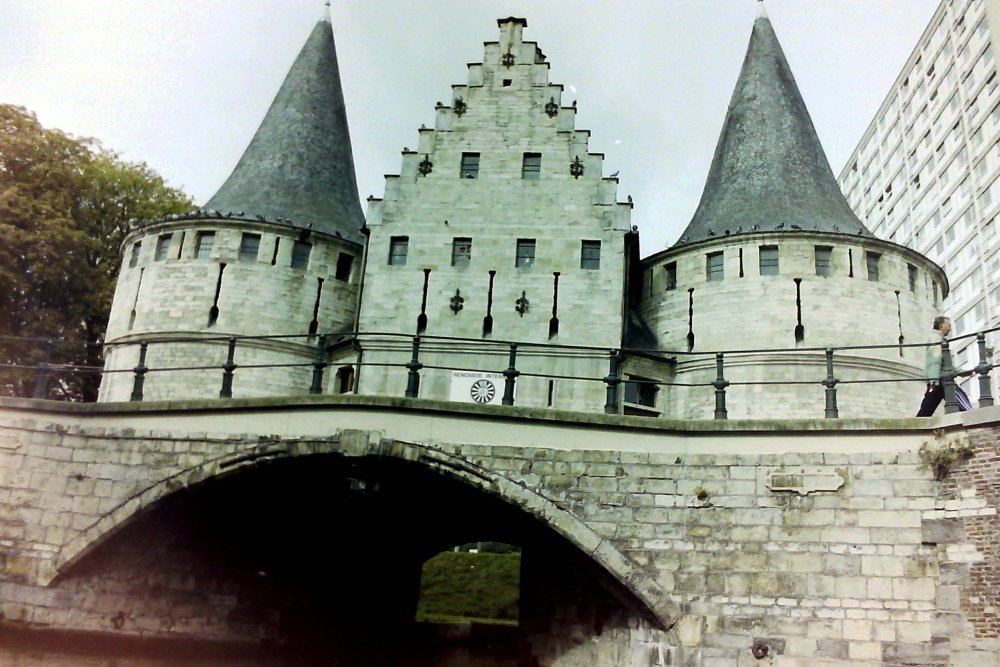
The Rabot Gate, Gent
Once I left the Castle I went to find some food, this was to be my re-introduction to Poffertjes - tiny pancakes eaten with whatsoever you may want on them. This time I had chocolate sauce, cream and coconuts with advocaat sauce. I have to admit it was a bit overly sweet for me and next time I will stick to the traditional butter and sugar option I think. I also had a stunningly gorgeous kiwi fruit milkshake.

Floodlighting in Gent
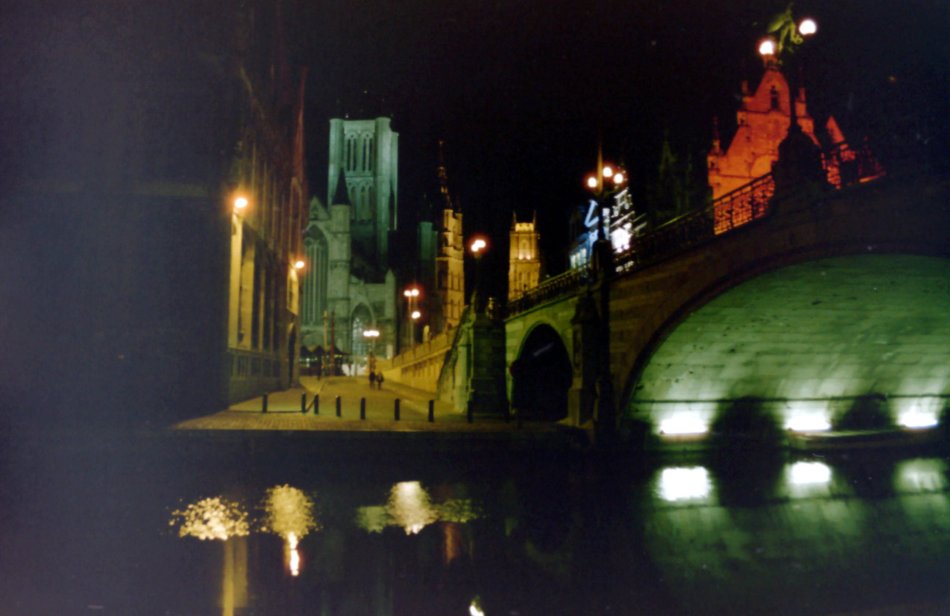
Gent at Night
I decided to merely wander around the rest of this day and photograph all the wonderful medieval buildings of the City (of which there are many). Then the heaven's opened and I made my way swiftly to a hostelry for more food before retiring to my hotel. Once darkness had fallen I emerged vampire-like to do my nighttime walk. Gent is superbly floodlit, with the Castle and Belfort dominating. It was, oddly, at night that I got my first view of the typical picture of Gent, from St. Michael's Bridge looking up to the famed "Three Towers of Gent", from closest to nearest the tower of St. Nikolaas Church, the Belfort (Belfry) and the tower of St. Bavo's Cathedral.

The Three Towers of Gent
The following day was a bit sunnier so I took some more pictures of the Castle and some of the other buildings before the clouds returned once more. I made for the River Leie - or possibly a canal, it is quite hard to tell in these parts. Here I got on one of the little open top boats for a trip around the waterways of Gent. This was enjoyable and was done entirely in English - a pleasant change from France where nothing much was in English at all. One of the oddest, but most striking, buildings you see on the boat trip is the "wobbly" building, a typical tall thin, gabled house whose waterfront has been covered by a plastic facsimile which has been deliberately warped to make it look like a reflection in the canal ... those odd Belgians again - no wonder Magritte left, it was all probably too weird for him.

Wibbly-wobbly Building, Gent
After the boat trip I went to have some French Fries - sorry, Belgian Fries - naturally with a big dollop of mayonnaise, an idea which once horrified me but which has since this time been almost an addiction. They were the nicest fries I'd ever tasted, those God-awful things served in fast food chains bear no relationship at all to these crispy snacks.
It was time to tackle the Three Towers of Gent. I decided to do them in order from the River upwards, so it was first into St. Nikolaas Church. St. Nikolaas is a Roman Catholic church and as such has suffered a certain amount of bad luck since the Protestants became dominant in Flanders. The Church dates back to the 13th century, but was last heavily restored in the 19th Century and then a major restoration plan was started in 1960 which is still underway today. The church is impressively stark for a Roman Catholic church with some wonderful statuary and a massive altar piece dating from the late 17th century.

The Graslei from the Korenlei, Gent

Old Buildings in Gent
The second of the Three Towers is the Belfort (Belfry) and is the only one of the Towers you can go up. It is a very Flemish thing to build Belfrys containing carillons of bells to ring every quarter hour. The gentle tinkle of the bells had been following me around Gent, but now I got a chance to be right next to the bells when they chimed - and they are a lot LESS gentle when you're right next to them believe me! Of course, the other good reason for ascending the Belfry (and there is a lift most of the way up) is for the views across Gent. You realise just how many medieval buildings are left in this beautiful little City.
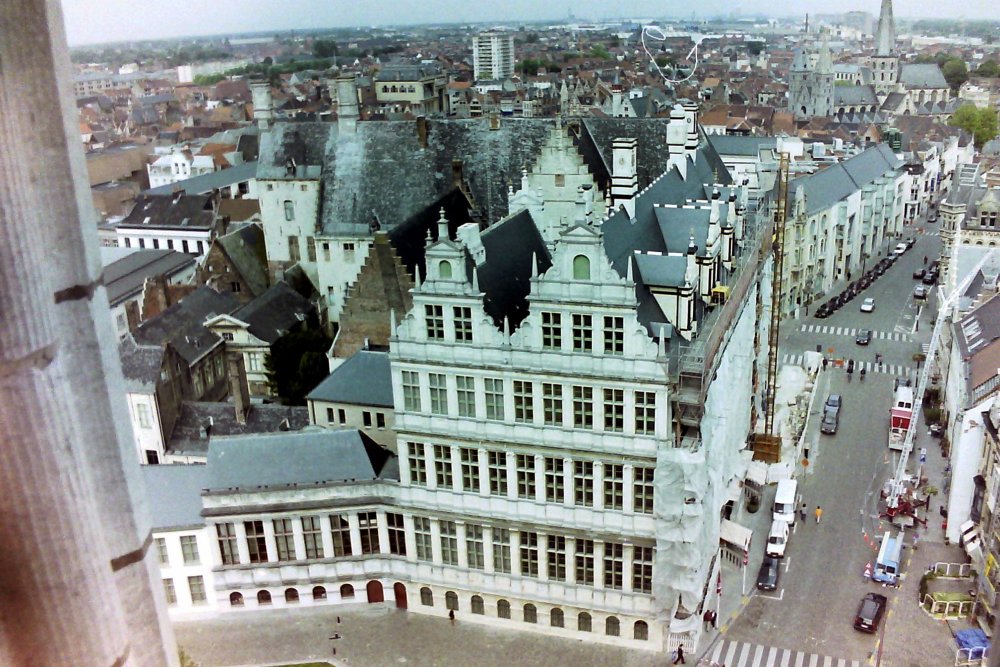
View of Gent from the Belfry
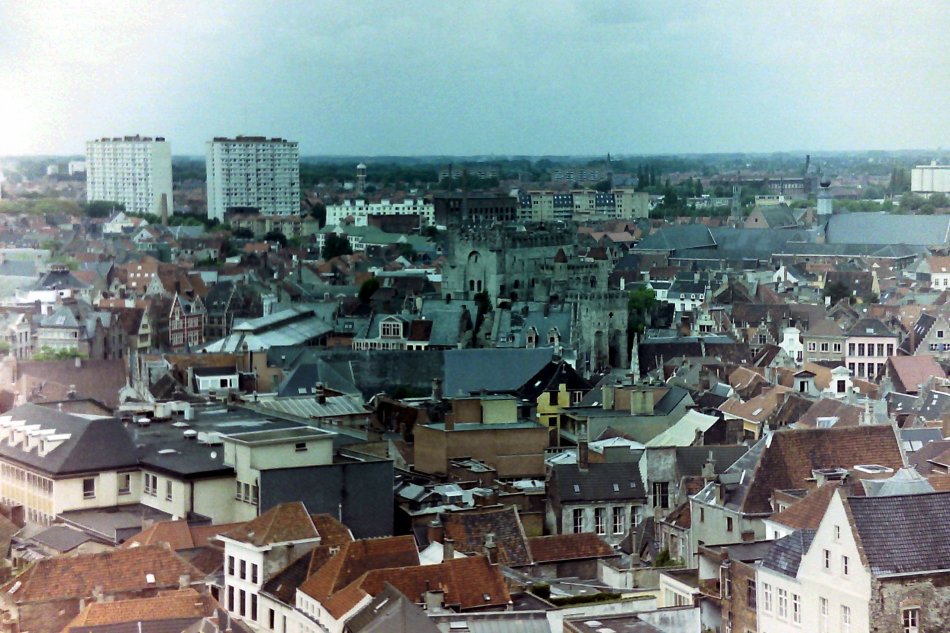
Another view of Gent from the Belfry
Once you've descended, keep an eye out for the sculpture of a woman suckling a grown man on the rear of the building, in fact a separate but attached structure known as the Mammelokker which derives from the Flemish for the sculpture. The somewhat weird piece of art has its origins in the Roman legend of Cimon who was left to starve in jail and only survived by suckling off his daughter. Quite why this should be placed on the Belfry is a bit of a mystery!
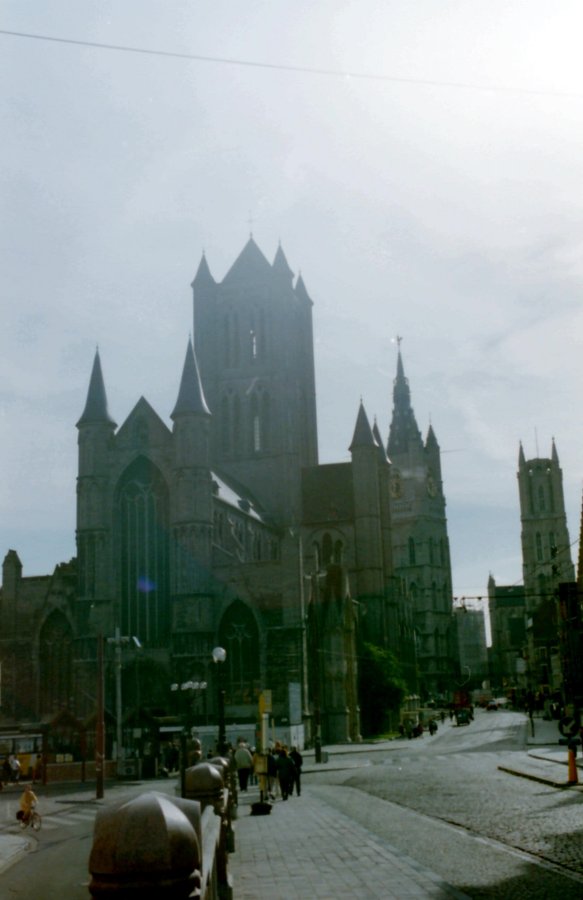
St. Bavo's Cathedral, Gent

Interior of St. Bavo's Cathedral, Gent
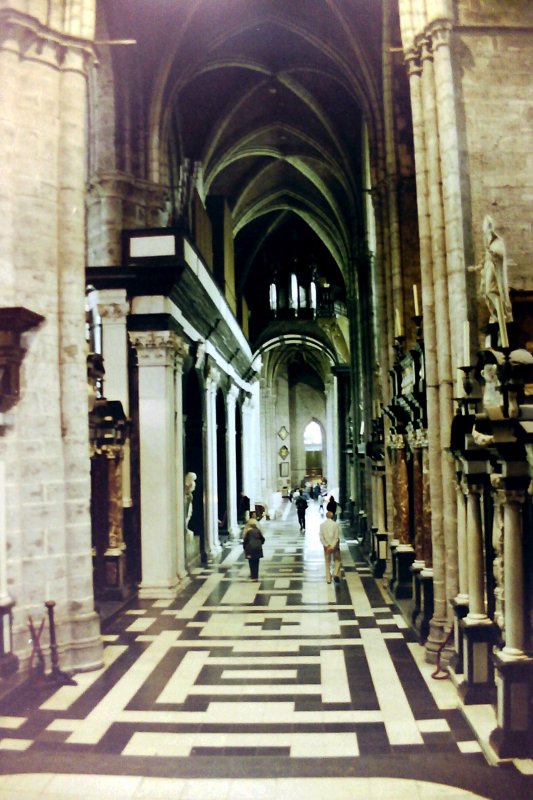
Another interior of St. Bavo's Cathedral, Gent
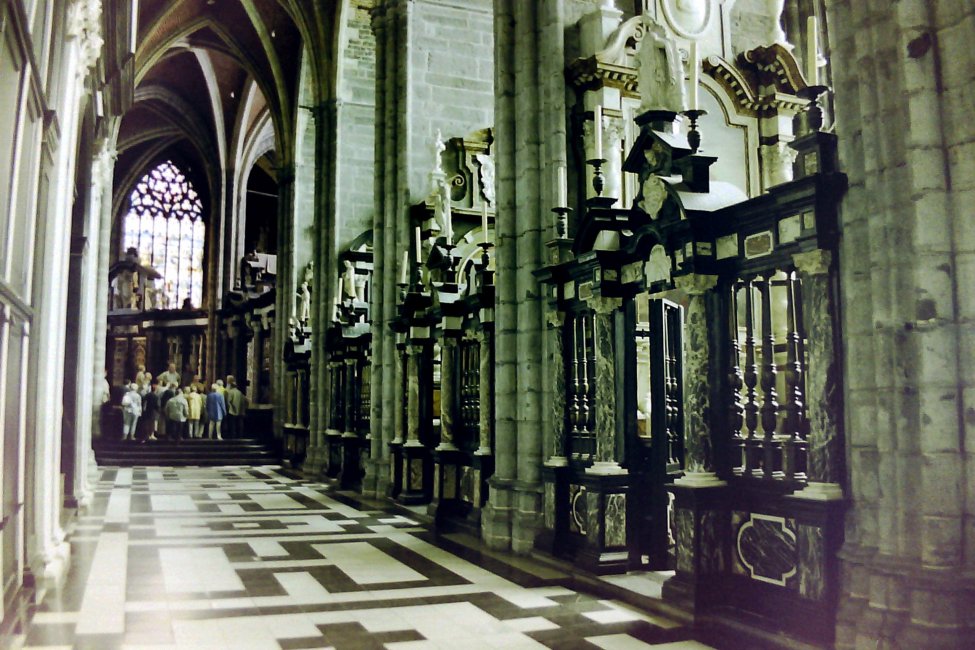
Dramatic Monochrome Interiors, St. Bavo's Cathedral, Gent
The last of the Three Towers is the tower of St. Bavo's Cathedral. A very "English perpendicular" looking church. It was first built around 1150, but nothing remains from any earlier than 1300-1353, the last major sections being added in the mid 1500s. The interior of the Cathedral has a very strange black and white look, all chequer boards and zig-zags making it kind of monochrome psychedelic in some places. It also drove the meter on my camera completely do-lally!

The Adoration Of The Lamb by Jan and Peter van Eyck, Gent Cathedral
The major attraction inside the Cathedral, though, is a painting, the massive and hugely important tryptych "The Adoration of the Mystical Lamb" by Jan and Peter van Eyck (painted in 1432). Over the centuries this has been a rather active painting, having been nearly destroyed in 1566, taken to Austria by Nazis in World Ward II after it had been sent to Paris for safekeeping, one panel was stolen in 1934 and had to be replaced with a copy. It is now sequestered in the de Villachapel at the west end of the Cathedral and can be viewed behind glass with "walkie-talkie" style commentary in numerous languages available. As is often the case a charge is made to see the painting, but unlike many other paintings this does not disappoint, the figures of Adam and Eve are after all life-size (although in the 19th century they had fig-leaves painted on to hide their ludeness!). The painting was so impressive I bought a small cardboard version - my first religious souvenir ever.

Gent Cathedral
A little way from the Cathedral is the other Castle of Gent, the all-but-forgotten Geraard de Duivelsteen (Gerard the Devil's Castle). It too was heavily restored in the 19th century, but unlike the work done on the Gravensteen it has made the Castle almost unrecognisable as such. To read as much as I can find about the history of the Duivelsteen, see Castles of Europe.
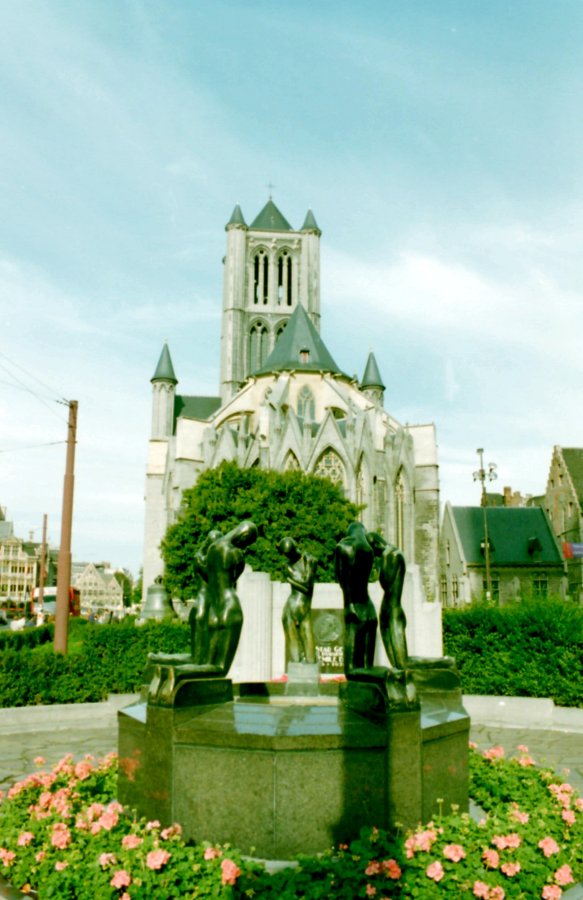
Fontein der Geknielden and Gent Cathedral, Gent
My last stop in Gent was Brasserie de Jacob on the Vrijdagmarkt (Friday Market Square). I had an excellent meal in the pleasant restaurant, but was most interested to read the place mat (of all things) which was as usual in English as well as Flemish and French. It told of Jacob van Artevelde whose statue stood outside and from whom the Brasserie took its name. He was the famous "Wise Man of Gent" who allied the Flemish with the English King Edward III against the French, setting up battlelines between Catholic and Protestant realms which still are noticeable today (although mostly without the battles). I was also interested to note that John of Gaunt was born here (John of Gent, of course!) - a man who had followed me and Roy around England's Castles for seven years (see Castles of England Pages, he turns up all over the place!). Jacob's statue points towards England - so I followed his gesture thinking that this man was showing me the way back home. In fact I only got as far as my hotel.
All in all Gent was a superb antidote to the disappointment of Lille and the struggle I had had with the public transport in Picardy. So it was, on the next day, that I left much happier and headed for Brugge, a place I had been interested in visiting for ages and one which would not disappoint at all.

Andrew at the Rozenhoedkaai in Brugge
Brugge didn't start off particularly enticingly, but stations are stations everywhere - even here. I was soon deposited in the Markt and things just got better and better from thereon in.

The Belfort and Ancient Wooden House, Brugge
Brugge (don't call it Bruges unless you're a Frenchman or a Walloon, they don't speak French here) calls itself one of Europe's best preserved medieval cities. It is not lying. With the possible exception of Prague I don't think I've ever seen such a concentration of medieval buildings in such superb condition anywhere else in Europe (so far).

Statue of Jan van Eyck, Brugge
It all centres around the massive Markt Square, the main town square with two sides made up of medieval town houses (now mostly housing cafes), one side has the elaborate Town Hall and the other is dominated by the feature that dominates the whole city, the UNESCO-listed Belfort (Belfry) which is an astonishing 88 metres tall - more of which later.
My digs were in Oude Burg, just next to the Belfort, which was pretty cool. Once rid of all my baggage I headed first of all for the corner known as Rozenhoedkaai (Rosary Quay), the most famous view of Brugge of them all and even in this City of beautiful views one which sticks in the mind.

On The Brugge Canals Boat Trip - a typical view
It is from here than (some of) the many boat trips around this City of water depart. I got on one with a mixture of Europeans from all over and incredibly the pilot of the boat did the commentary in English, Flemish, French, German, Italian and Spanish! It was one of the most entertaining boat rides I've ever done, mostly because said pilot was more than slightly mad. But he did come up with some interesting comments, decrying the high cost of living in the City Centre but defending the "name a famous Belgian" thing by mentioning that no-less than Audrey Hepburn was born in Brugge! (Who needs worry about needing famous people in a country which produced the Waffle, the French Fry and the best chocolates in the universe! And besides there is Adolphe Sax (of Saxophone fame), René Magritte, Jean Claude van Damme....)

The International Clog House - a restaurant in Brugge

Boat Trip in Brugge
Anyway, back to the story. After the very enjoyable boat trip I decided to recreate some of it on foot. I walked along the canal to the Museum housed in the Gruuthuse (Great House) which is a very picturesque ivy-clad building under the shadow of the tower of the Church of Our Lady. From here I happened upon the Minnewater (Lake of Love) which was once the main landing port of Brugge but was blocked off and turned into a big oblong lake with swans which have a similar effect to the ravens in the Tower of London if they leave, apparently. From here I found myself at the Begijnhof, like the one in Amsterdam, it is an old Nunnery, but it isn't nearly as impressive and was one of the few things in Brugge which proved slightly disappointing.

Horse Ride, Brugge
Up to this point I had avoided heading for the main squares, but I did so now, first visiting Burg, the smaller square with the weird Holy Blood Basilica. Inside I happened upon one of the ceremonies when the phial of Holy Blood (supposedly that of Jesus Christ brought back from Istanbul in the 12th century) is paraded before the worshippers. This was lucky as the church is normally not open to tourists during these services. Outside a slightly mad Belgian serenaded one and all on his barrel organ.

Barrel Organist outside the Holy Blood Basilica in the Burg Square, Brugge
From here it is a tiny walk to the Belfort dominated Markt. I crossed the Markt and headed off towards the edge of town where there are five windmills on the ramparts of the old city walls (not much wall left now alas). From here you can look back over the roofs towards the City. Descending from the walls I happened upon one of the City Gates. Walking back into town I bought myself some more Belgian Fries and headed back to base as a very contented bunny indeed. Brugge was everything it had promised to be, one of the most beautiful places in the world.

Medieval Houses in the Markt Square, Brugge

The 88 metre high Belfort (Belfry) of Brugge
The following day I breakfasted in my hotel, where all the condiments were curiously hidden in a big chest of drawers! Then suitably fortified I headed for the Belfort to climb it's 366 steps (no lift here alas) to the bells up at the top. I quite deliberately planned to get there for 10 am, which I did and was treated to the most astonishing noise - some 47 bells chiming their little tune followed by 10 massive rings on the time bell. Throughout the previous day I had been accompanied by the musical chiming carillon every 15 minutes and now it was ringing very directly in my ears!

View from the Belfort of the Markt Square, Brugge

Bells of the Belfort, Brugge

Burg Square from the Belfort, Brugge
The view from the Belfort must be absolutely astonishing on a clear day. I didn't have a clear day, but the views were still pretty good.
Once back down to ground level I decided to feed the more base instincts and headed for the chocolate shops. Oh boy! What chocolate shops, I've never seen anything like it. The most amazing, beautiful and bloody tasty chocolates in the world and so wonderfully displayed in the shop windows. I bought some truffles. Then I bought some moeder babelutte (a Brugge speciality it said), then some more truffles, oh and then some ... You could spend painfully large amounts of money on chocolates here and never get the same thing twice. Wonderful.

Mmmm....chocolates (so irresistable I couldn't help eating a bit of the picture!)
For those with more artistic shopping interests there are also wonderful selections of lace and embroidery throughout Belgium but very noticeably here in Brugge.

Ezelpoort (Donkey's Gate), Brugge

Windmills in Brugge

The Lamme Goedzak paddle steamer which took me to Damme

Napoleonkanaal, between Brugge and Damme
A walk away from Markt took me to another of the City Gates and from here to the outskirts of Brugge where I arrived at the Napoleonkanaal (Napoleon Canal) and waited, reading, for the Lamme Goedzak to arrive. The Lamme Goedzak is a paddle-steamer which chugs the 5 km or so up to Damme, the old port of Brugge. The Canal trip was very restful, it was a misty and still day and I got some very evocative photos of the straight tree-lined canal.

The Main Sqaure in Damme
Just as I arrived at Damme the heaven's decided it was well-passed time they opened and chucked rain down with avengeance. I ducked into the shelter of the tourist information place, then into a cafe, then finally into the church. Once inside I found I had stumbled upon a wedding and was suddenly stuck inside when the bride arrived. Mentally shrugging my shoulders I hiked out my video camera and started filming. I managed to escape before the ceremony proper got underway, just dodging out of the doors before they closed behind me.

Chruch of Our Lady, Damme
Once outside the rain had slowed to a drizzle so I looked around the tiny town a little more closely. Every building is medieval, although there are only about 20 in all. Most of these seem to be restaurants, saving the Stadhuis which is kind of a mini version of the one in Brugge. Also not a restaurant is the Schellemolle (a windmill) by the side of the canal. Damme was a pretty little place (and would have been prettier if the weather had been more clement) but after the spectacle of Brugge it lost out a little.

The Schellemolle at Damme plus Napoleonkanaal

The Lamme Goedzak awaiting the return to Brugge
I wanted to get back to Brugge for that evening was to be my floodlit walk, and an extra special one at that.

The Belfort Floodlit#, Brugge
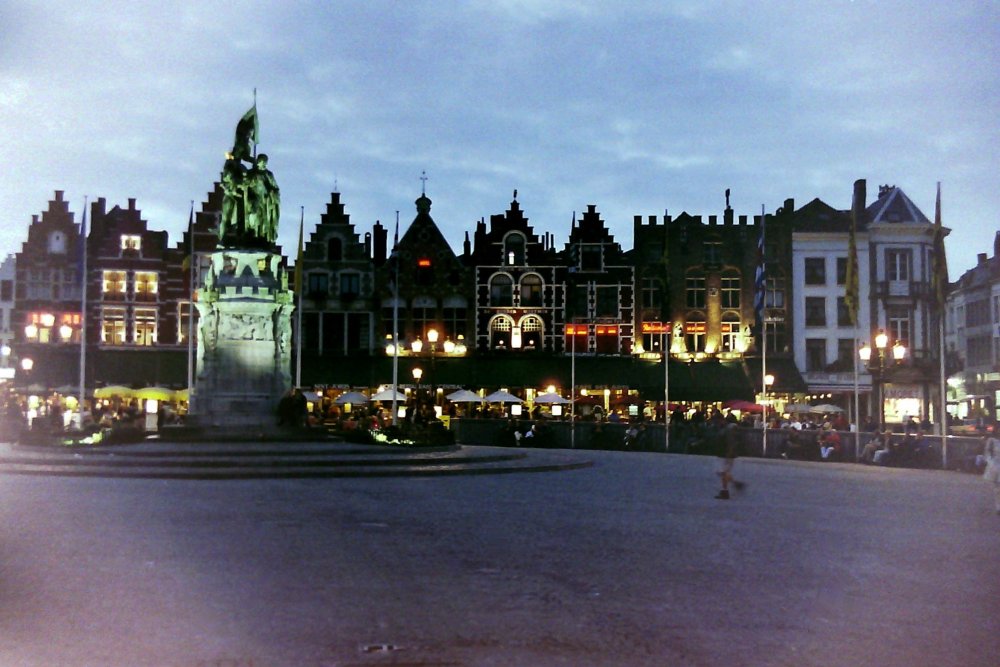
Markt Square at Night, Brugge
I had a superb meal and then sat on the Markt as the sun which had just about shown itself, slowly set behind the Belfort. Then at 9 pm the carillon concert began. The bells of the Belfort were being played by hand. The concert lasted an hour and accompanied me throughout my nighttime wander echoing off the buildings and down the alleys setting up reverbs and eerily seeming to come at you from all kinds of directions.

The Rozenhoedkaai by Night, Brugge
My floodlit walk ended up at Rozenhoedkaai where my visit to Brugge had begun. I headed off to my hotel a few minutes before the concert ended, and I could hear it quite clearly from my room.
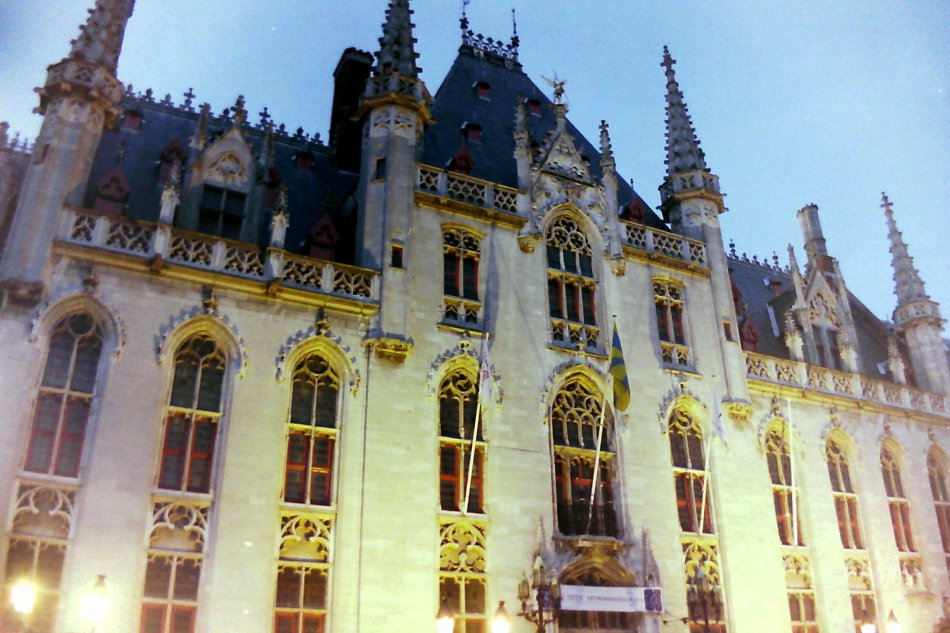
Brugge Town Hall Floodlit
The following morning I woke and played "seek the jam" in the drawers of the breakfast room, before packing up and heading out into a chilly and foggy morning. The ranks of horse drawn carriages waited in the Markt for the day's customers to start arriving, breathing clouds of horsey breath into the air. As I waited for the bus back to the station the top of the Belfort began to vanish into the mist. By the time I was on the train the fog was thick.

Horses Waiting in the Early Morning Mist, Brugge

The Belfort in the Morning Mist, Brugge

Beautiful Misty Morning in Brugge
It had all burnt away when I got to Oostende though and throughout the trip home on the Catamaran (ironically the very form of transport which ousted the Hovercraft on which I had started this holiday - even more ironically one of them passed me as I approached Dover!) I stayed on the tiny deck catching some late summer sun.
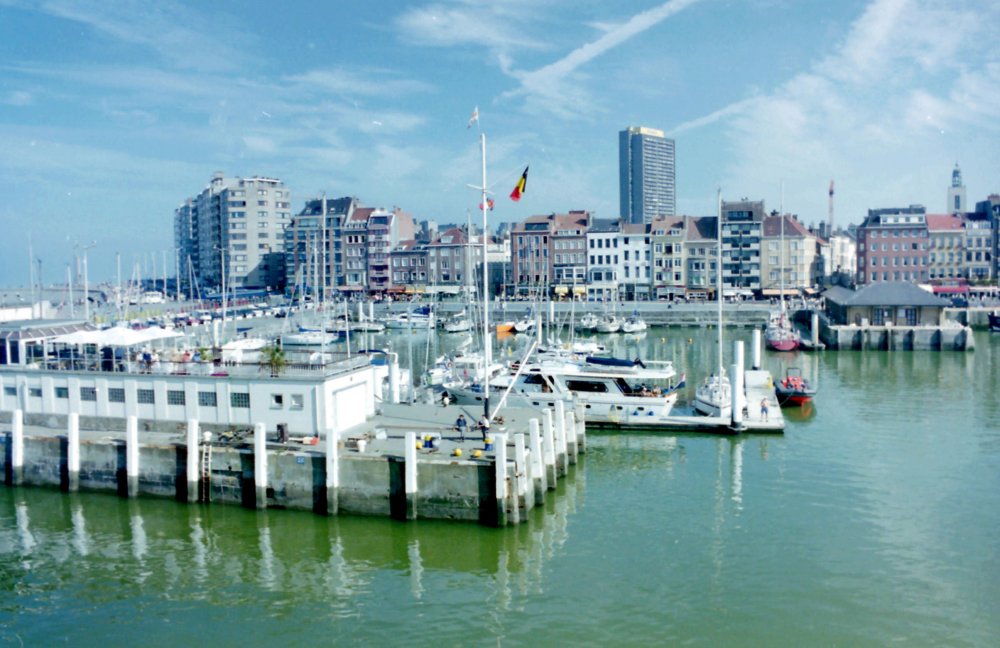
Leaving Oostende Port

Oostende and Belgkium disappears into the Distance

Boat near Oostende
Before I knew it the White Cliffs of Dover were emerging from the seamist that seemed to gather as I neared Britain by the time I had docked it was in glorious sunshine.

The Hovercraft passes me by the White Cliffs of Dover


© Text copyright - Raving Loony
Productions,
Andrew J. Müller and
Roy Barton
© Photos and Artwork - Andrew J. Müller and Roy Barton
© Web Design and Layout - Andrew J. Müller
2026


