

PAGE TWO
Dinant and Oostende - Andrew - 2001
I had been browsing through brochures on Belgium whilst planning my previous trip to the country (see Gent and Brugge). Whilst looking through one leaflet I saw an arresting photograph of a massive church with a cliff looming behind it and a fortress sitting atop the cliff whilst a sight-seeing boat ploughed through a wide river in front. This turned out to be the really quite small town of Dinant in the Belgian Ardennes. It was too far out of my way for the Gent/Brugge trip but it stuck in my mind.
I began planning a "by boat" trip for the August Bank Holiday of 2001 and Belgium was inevitably my destination, Dinant sprang to mind and I decided that, if at all possible by public transport, that was where I would be going.

St. Peter and St. Paul's Church, Oostende
And so I found myself at Dover Docks once more, boarding the catamaran to Oostende. The crossing was quick and smooth as a millpond (just how I like my sea crossings) and we arrived in Oostende good and early. The next train to Brussels (where I would have to change) was not for about 45 minutes and so I took the opportunity to have a quick look at Oostende. Having passed it by many times before I had always been impressed by the bulky presence of St. Peter and St. Paul's Church towering above the houses.
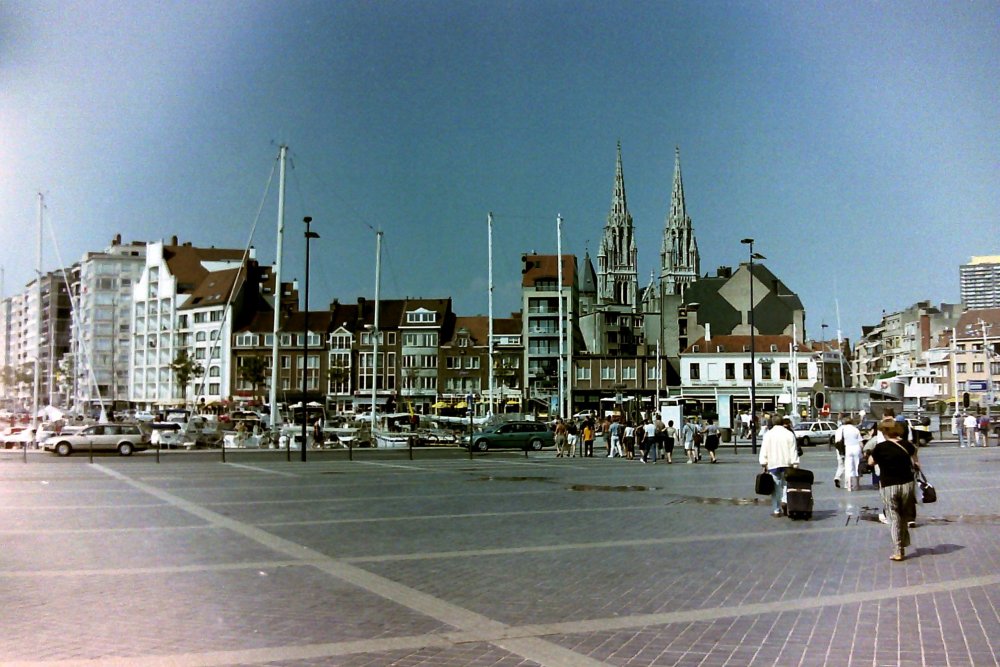
Arriving in Oostende
Although the church looks for all the world like a great gothic cathedral it was, in fact, built early in the 20th Century (and is a lesson to other modern church builders of how it should be done). Behind it stands the 16th Century remnants of it's predecessor. The church, like Oostende itself, has been given a considerable scrub up in recent years and now positively gleamed in the bright sun of a day that was shaping up to be roasting. I wandered along the Quay from where the ferries dock and had my first fries and mayo of the trip (not the last though having got thoroughly addicted the previous year). Then I wandered back to the station and boarded my train.
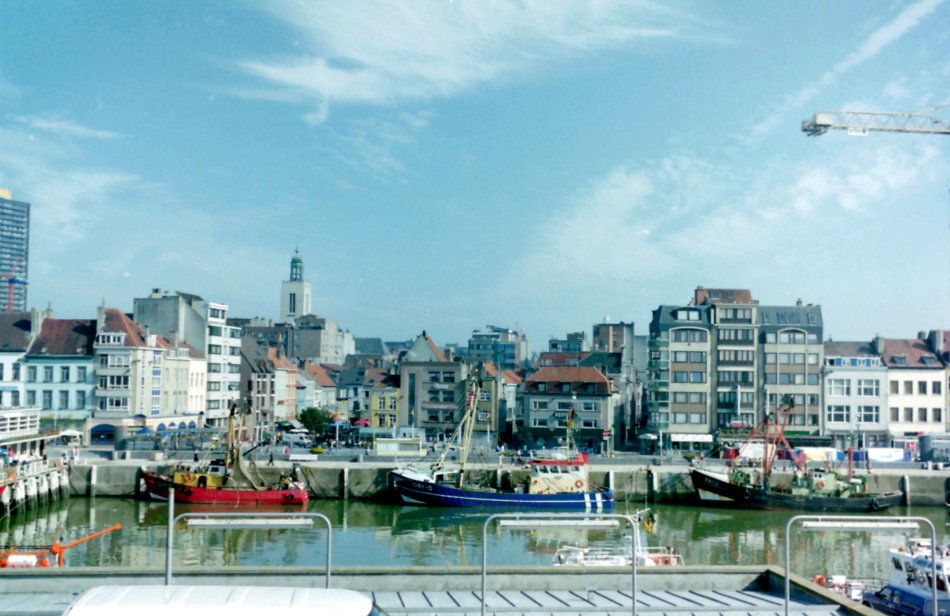
Quayside, Oostende
I had a sense of déjà vu as the train passed through Gent and Brugge, then before I knew it I had arrived at Brussels. Coming into Brussels by train doesn't show it up very nicely at all, the area around the Midi Station looks particularly grim and the only recognisable thing I could see was the Atomium gleaming away on a hill God knows how many miles across town. Brussels Centrale Station was only marginally nicer than Midi had looked. For the moment this was as much of a view of Brussels as I was going to get. I had another wait for the train south into Wallonia (French-speaking Belgium) my first trip to that part of the country.
Whereas the trip to Brussels seemed to pass really quickly, the trip south seemed to take forever and stop at places in the middle of nowhere which seemed merely to have been wished into existence so a railway station could be built there. Things began to look up when the train arrived at Namur (Namen) which I knew was not far from Dinant. Below Namur the train started following the valley of the River Meuse which I knew led straight to Dinant where the train terminated.
Eventually I arrived, at something like 4:30 at Dinant Station. As the train pulled into town I was greeted with that same view that had inspired me to seek out this small town a long way from anywhere. The massive church with it's rock and fort bathed in glorious afternoon sunlight. I was aching to go and look at it. Unfortunately reasonable accommodation didn't seem to exist in Dinant (or at least I had not been able to find it from home) and so I had booked into the next village downriver, Anseremme.
I had an hour to wait at Dinant station for the train to Anseremme. I toyed with the idea of getting a taxi and then remembered my Calais-Boulogne taxi from the previous year and thought again. So I bought a coke and waited. Eventually the tiny, noisy, rattly train arrived and it began to bump and jerk slowly southward. About 8 minutes later it drew up at what passed for Anseremme Station. I got off and looked back in the direction I had come and concluded that it hardly seemed worth the wait when I could have walked it in about 20 minutes.
I was staying in the "Aquatel" at Anseremme which turned out to be the only place you could stay in Anseremme. It exists almost entirely to service people kayaking up and down the River Lesse which meets the Meuse here. The Lesse is apparently kayaking paradise (as indeed is much of the Ardennes) and the place was positively heaving with soggy kayakers drawing up for the evening. I was tired after all that travelling so I holed up and decided to call it a night. I was asleep before I knew it.
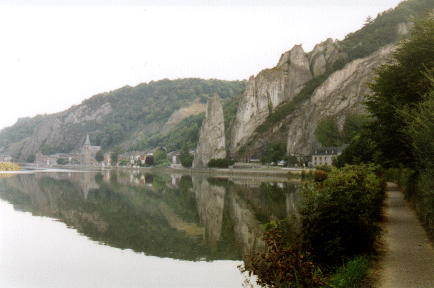
Bayard Rocks and the River Meuse between Anseremme and Dinant
The next day was Sunday and would be the only day I would spend not basically travelling so I had quite a lot to squeeze in. Dinant has a remarkable amount to offer (despite what my Rough Guide says about it "unless you're passing there's little reason to stop"... what fatuous rubbish, just because it is a bit too touristy for their 'back-packers rule' tastes). This is a tiny town with a Cathedral, Citadel, Theme Park, two Cable Cars, some Caves, River Trips and even manages to be the birthplace of one of those elusive famous Belgians, Adolphe Sax (inventor of the saxophone).
Having waited an age for an eight minute train ride the day before I decided that I would walk into Dinant along the bank of the Meuse. The walk passes by the Bayard Rocks, two separated parts of a flat outcrop of rock which is typical of the Ardennes landscape. A road passes between the two sections with the split away section looking dramatic when reflected in the river. You also pass under a massive road bridge.

Houses reflected in the Meuse, Dinant
On the edges of town I passed a small church (whose name I never did discover) that was ringing it's bells enthusiastically, it was Sunday morning after all, and they were echoing back across the river from the hills opposite creating a kind of overlap effect.
I arrived in town at about 9:45, at which time very little was open. The first building of note I arrived at was the Hotel de Ville whose tower mimics the larger version on the Cathedral, with it's distinctive bulbous spire (more about which a little later). Around the back of the Hotel de Ville was an impressive piece of statuary commemorating those killed in World Wars I and II in the town which saw a lot of terrible fighting.

War Memorial Statue outside Hotel de Ville, Dinant
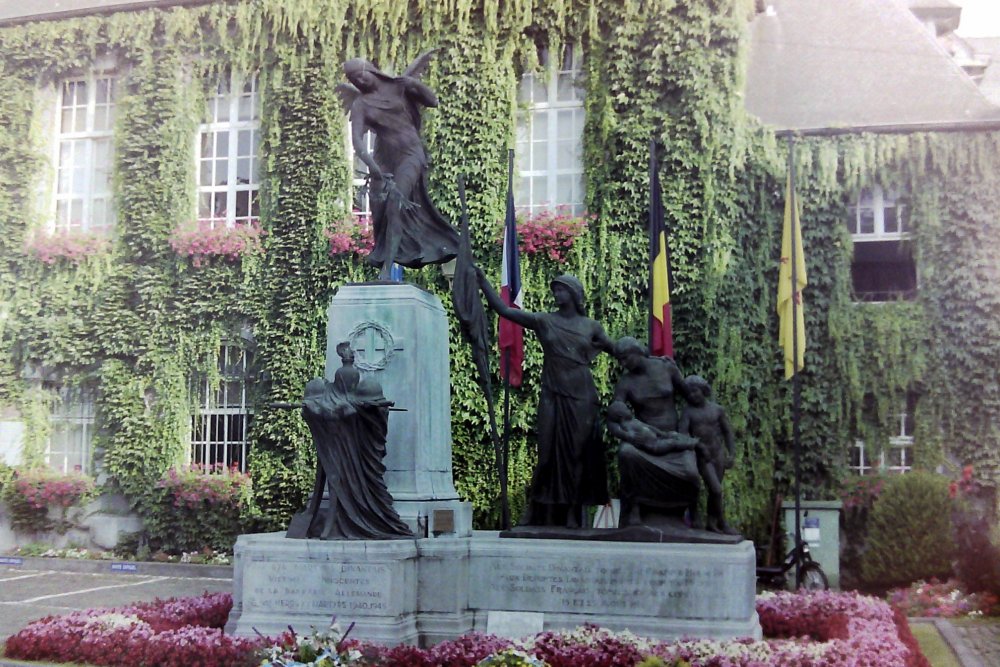
Closer view of the War Memorial, Dinant
I fished around for a while in the one or two souvenir shops which were already opened waiting for the Citadel to open at 10:00. The Citadel, for such is the fortification on top of the hill called, replaced a medieval Castle and was built by the Dutch between 1818 and 1821. There are two ways to reach the Citadel. You can climb the 408 steps cut into the rock (which interestingly pre-date the Citadel by some centuries having been cut in 1577). Alternatively sensible people can take the Téléférique (cable car) up the rock instead. I was joined in my little cable car cabin by four Americans one of whom was nervous to the point of hysteria as the thing rumbled up the rock face and juddered to a halt at the top.

View of Dinant including Cathedral, Citadel and Cable Car

Gatehouse, Dinant Citadel
From the cable car station you get some of the best views of the Citadel and of the Cathedral at the foot of the rock a very long way below you. The Citadel is only visitable as part of a guided tour, which unfortunately only operates in French and Flemish (neither of which I am fluent in). So I had to make do with the somewhat scanty information in the guidebook. Nevertheless there were some nice tunnels and the like, plus a spectacular view from the main bastion at the front of the Citadel which allowed you to look up and down the Meuse Valley and gave some superb views of the town way below.
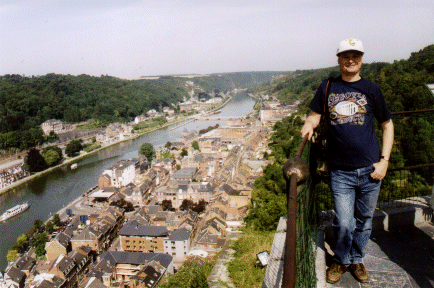
Andrew during the tour of the Citadel, Dinant
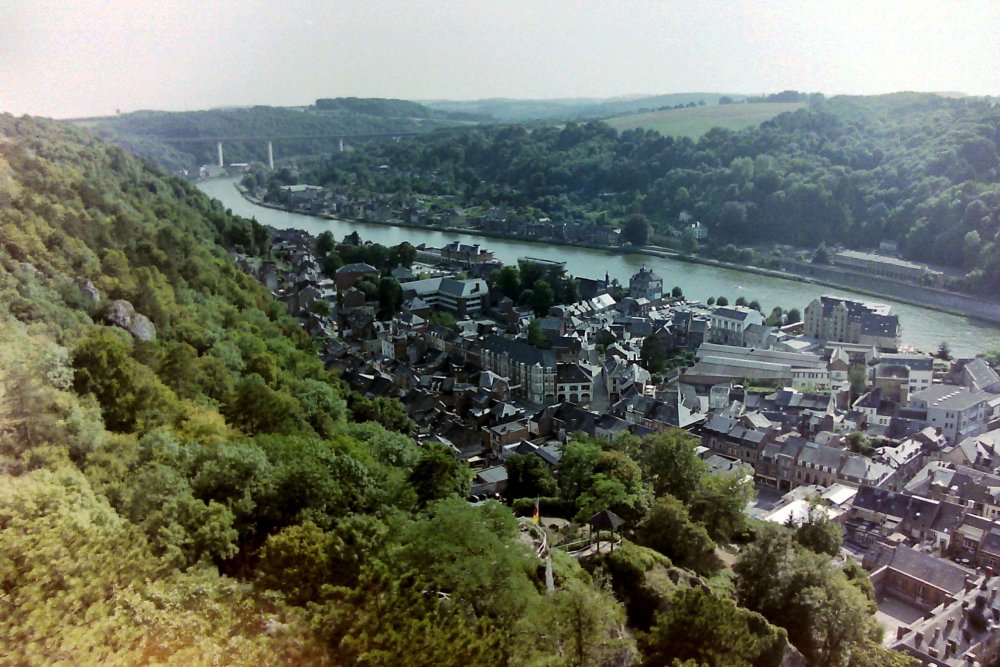
View from Dinant Citadel
The Germans occupied the Citadel in 1914. The French forces (including one Lieutenant Charles de Gaulle) tried to take back the town, however, they failed and the Germans shot 674 inhabitants of Dinant and set the town on fire. During the German counter-attack a group of French soldiers were trapped inside one of the tunnels of the Citadel and hand-to-hand fighting took place (all 58 French soldiers were killed and 12 Germans). In 1940 the Germans were back again and this time it was the Americans who tried to take the Citadel, they also failed and ended up crossing the River further south causing the SS troops inside the Citadel to flee.
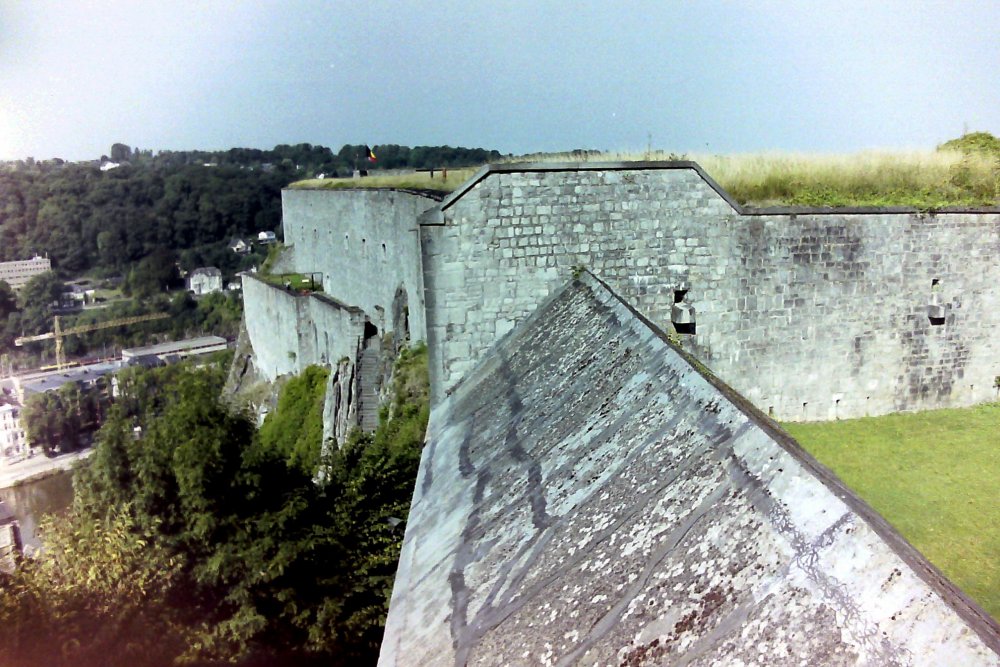
Citadel Walls, Dinant
To read more about the Citadelle de Dinant, see Castles of Europe pages.
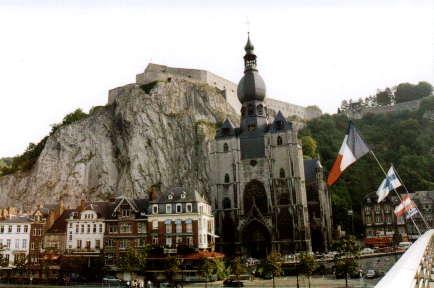
The Cathedral and Citadel, Dinant
After the tour I descended in the cable car and went to look at the Cathedral. The most impressive thing about the Cathedral (apart from it's size compared to the size of the town) is the peculiar bulbous spire. The bottom half looks like a fairly regular gothic-style Cathedral, but then part way up the spire it bulges out into a massive rugby ball-shaped bump before carrying on to a normal spire-type point. Although this is a rebuild (it was destroyed by the Germans in World War I) the bulge was always there, the church dating back to the 12th Century. The best views of Dinant can be had from the other side of the Meuse where you get not only the Cathedral, but the rock and the Citadel and the bridge which has the flags of the countries of the European Union on it (except for some reason Sweden which is on the opposite bank, guess that's what comes of having an odd number of member states!). The bridge these days is named after Charles de Gaulle (in honour of his part in the World War I attempt to free the town).

Dinant, Belgium - like the picture that inspired me to visit!
This was the view I had seen in the brochure and it was certainly not disappointing when seen in real life.
The interior of the Cathedral was surprisingly sparse and a little disappointing considering the sumptuousness of the exterior, but then most of the interior was rebuilt after World War I by which time Dinant was a small town and less well-off. So perhaps they couldn't afford to deck the interior out in masses of ornamentation.

Ukrainian Folk Group in Dinant
As I left the Cathedral a bunch of brightly dressed young ladies went past carrying various musical instruments. These turned out to be a touring troupe of Ukrainian folk musicians. They made a colourful spectacle crossing the bridge.
It was getting on for lunch time and I decided to break for a meal, this was in an Italian restaurant by the river and was pretty good. Full, I crossed the Charles de Gaulle Bridge again and headed towards the train station. The bridge, apart from having the EU flags on it, seemed also to have attracted every spider in Belgium to make it's home along the ballustrades, I don't think I've ever seen so many spiderwebs in any one place.
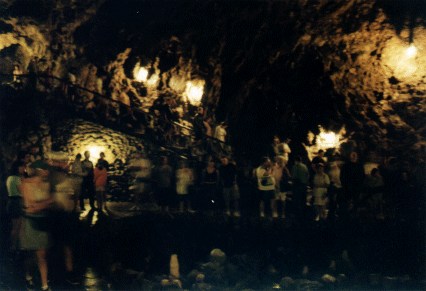
The La Merveilleuse Caves, Dinant
Once across the bridge the road forks, one way to the station, the other up what turned out to be a very steep hill. About a kilometre outside town is the entrance to the Grotte de Dinant, known as "La Merveilleuse". These are caves, like the many which pepper the Ardennes.
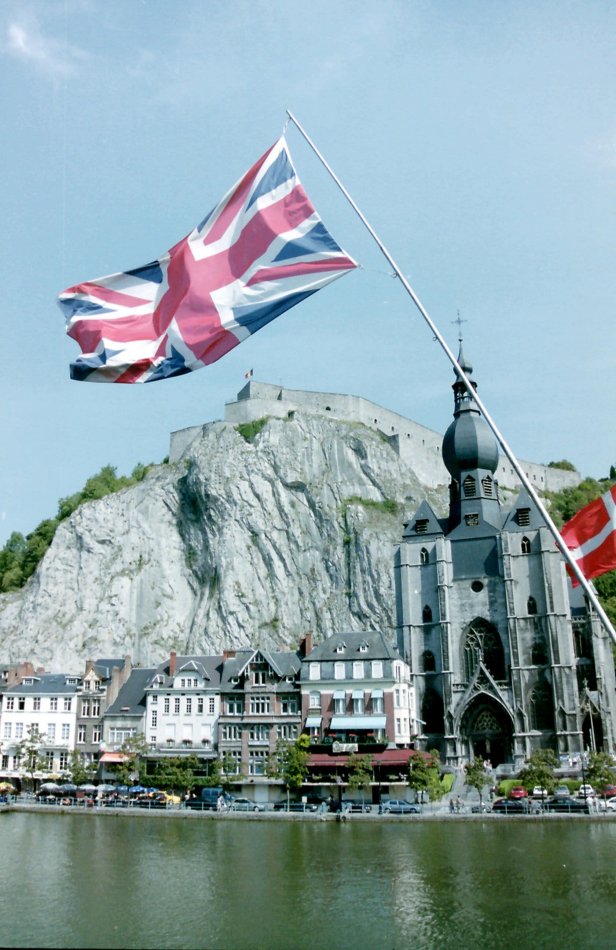
Dinant from across the River Meuse
Again, guidebooks were lying to me. They said the caves were disappointing. Although I have been in better they were still quite interesting and one chamber was larger than any other cave I have visited. The rock formations in La Merveilleuse are notable (according to the guide) for their translucent white colour, and it was true that the stalagmites and stalagtites seemed to glow in the faint lighting. These were also the first caves I've been in with bats flying around inside.

Grand View of Dinant
At the end of the tour the weather, which was already hot, had reached scorching and the walk back down into town was a hot one. As the road snaked around a bend a marvellous vista of the town opened up before me with the river glinting in the early afternoon sun with the bridge cutting across it to the backdrop of the Cathedral and Citadel.
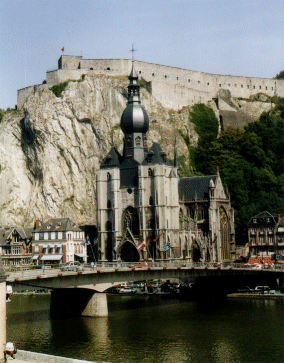
View of Dinant
Back on the other side of the river I made for a café for refreshment and then wandered down Rue Adolphe Sax, named after the man himself, which was where he was born. A small and rather grubby little picture window is the only thing that marks the house, Number 35. Two doors down there is a small square with a crappy modern statue (not of Sax) in it. I found it rather odd that the town's celebrated son had no better memorial when such a perfect square existed so close to his birthplace and it had been polluted by a pretty poor example of modern art.
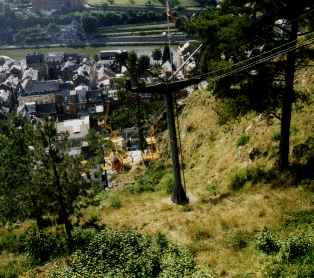
The Télésiège to Parc Mont Fat, Dinant
Up the back of town, behind the Hotel de Ville and other municipal buildings is the télésiège, a chair lift of the kind you would normally associate with ski resorts. This goes up to the Parc Mont Fat, a theme park of sorts, based around a Tower and some more caves. Again it is possible to walk up the hill to the Parc, but I gritted my teeth and fought back my dislike of heights and stood waiting for the chair to slam into the back of my knees. Once up in the air and away from the mechanics it is oddly quiet as you trundle slowly up the hill. When you reach the top you have to get off the chair very promptly or it will sweep you back down again!
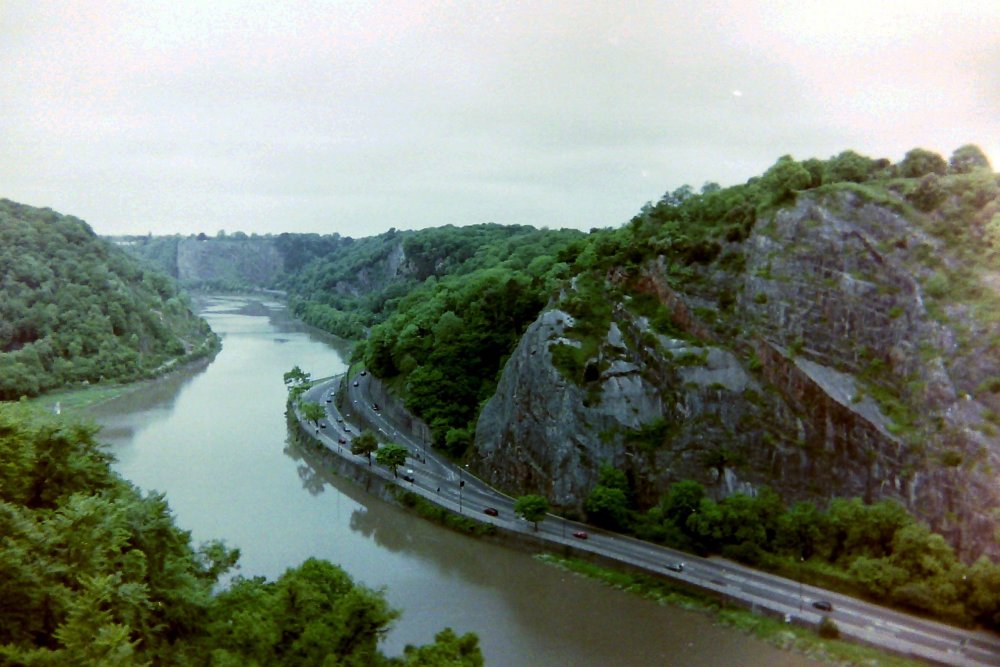
View from Mont Fat, Dinant
The two chief attractions of the Parc Mont Fat are the Tower and the Souterroscope. A second Castle once stood on the cliffs here and some traces of masonry work are still dotted around (Mont Fat comes from Mont Fort). The Tower, however, despite looking like a Castle tower is nothing of the sort, being a pure 100% folly, built in the 1800s. The view from the top is quite stunning, back upstream to the Citadel and Cathedral and downstream towards Anseremme. Having been to the top you go back down the steps, but unless you're awake, you don't notice that you are descending further than you ascended.

Entrance to the Mont Fat Caves through the roof!
You have entered the Souterroscope without even knowing it. The steps continue on down, until eventually you find yourself in a subterranean tunnel. This leads to a spiral staircase which goes down a shaft sunk into the floor of the tunnel. This leads to another tunnel and then another spiral staircase, but this one is obviously coming into the top of a large cave (and is a little leg-wobbling with it's drop into the darkness). I have to admit it's the first time I've ever entered a cave from the roof!
The caves, which were occupied during prehistoric times, are not that interesting to look at, although the roof of one has caved in leaving a great circular hole open to the sky. You emerge, blinking, halfway down the side of the hill. Here is an old bastion of the fortress that once stood here which is another excellent view point. Then, before you know it, you are walking down the hill which the télésiège took you up earlier. Oddly I was met by two goats making their way back up the hill.
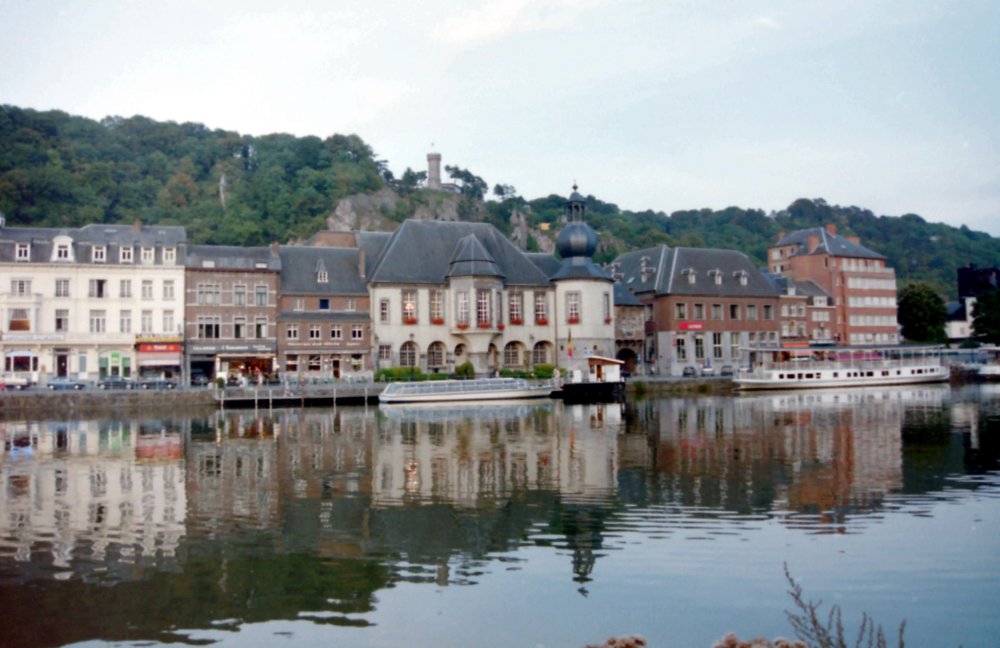
Calm Waters of the Meuse with Mont Fat Tower in the backgroubd, Dinant
There was no only one thing left on my itinerary for Dinant - a boat trip. There are a number of trips heading in different directions from Dinant. One goes up to Namur, but that takes the whole day. I opted for a trip down the Meuse to the south.
The boat was packed out and I managed to back a seat by the side. The first few things we passed I had seen on my walk from Anseremme in the morning. It was only after we entered the lock at Anseremme that I started to see things I hadn't seen before. Although there wasn't much specific for most of the journey save for attractive wooded hills piling down to the wide river with the occasional jutting chunk of rock soaring toward the sky. One of the highest of these is Rocher Freyr which is used by a climbing school. Tiny little figures sat atop the rock as we passed. People were swimming in the river, including one cheeky man who mooned us.

The Bayard Rocks from the boat trip
Not far from the Rocher Freyr is the Château de Freyr, an 18th Century building with vague fortifications, but mostly an attractive manor with extensive gardens sprawling up the gentle slope away from the River with vineyards in the background. A very French-looking scene.
Not far after the Château the boat turns around and winds it's way back into Dinant.
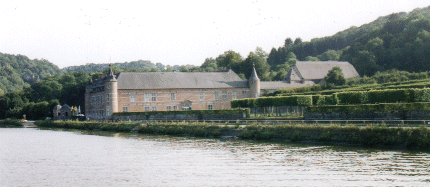
Château de Freyr
To read more about the Château de Freyr, see Castles of Europe pages.

A last view of Dinant's waterfront
I had decided to wait around to get some floodlit shots of the town and had a few hours yet to go until the daylight faded, so I went to find myself some fries and mayo and sat by the river. Night was a long time coming, it being August, and I had a bit of a read and allowed myself to sink into a trance-like state of mind. Eventually darkness did arrive but much to my frustration there was no sign of any flood-lighting. At about 10:15 I gave up, I still had to walk back to Anseremme (the last train having gone at 8). So I packed up my camera and walked back across the bridge and discovered why the spiders were attracted here. Underneath the handrail ran lights, the lights attracted insects and the insects attracted the spiders. With the bridge the only thing lit up the spiders concentrated here. The gossamer webs were irridescent in the bright light and made me get my camera back out again.
I walked back to Anseremme along the riverbank as I had arrived in the morning. By the time I reached the Bayard Rocks they were lit up. I wondered if Dinant was all brightly lit behind me, but I wasn't about to go back to find out.
The next morning I had to get up really early to catch my train. I had hoped to maybe get an early breakfast, but even the hotel reception was shut (I had to post my key through the letterbox). So I went to sit at the station. I was the only person around and was delighted to see many birds flying around the station including a number of nuthatchs (which I'd never seen before). Eventually the tranquility was broken by the noisy arrival of the train to Dinant. At Dinant the train to Brussels was waiting and the transfer was immediate. At Brussels I had a 15 minute wait. Consequently I arrived in Oostende the best part of an hour and a half before the boat was due to leave.
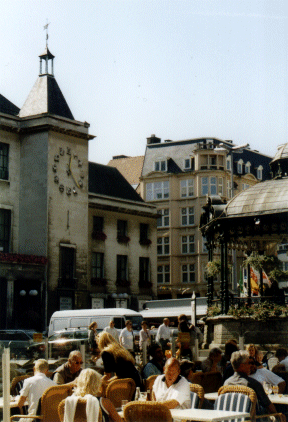
Wapenplein, Oostende
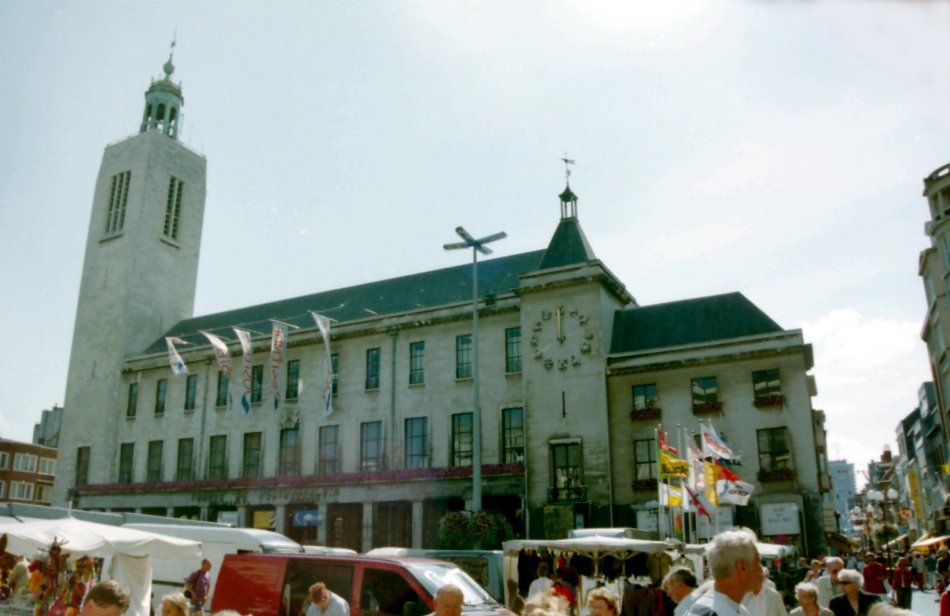
Feest-en Kultuurpaleis, Oostende

Bandstand on Wapenplein, Oostende
There was some symmetry in finishing the trip with a wander around Oostende. This time I got further than the church, right up into the centre of town where I had a waffle overlooking the bustling market on Wapenplein with the impressive building of the Feest-en Kultuurpaleis (Festival and Culture Hall). From here I walked up to the seafront promenade with it's impressive memorial to all the sailors of Oostende who have lost their lives at sea.

Seafront Promenade, Oostende
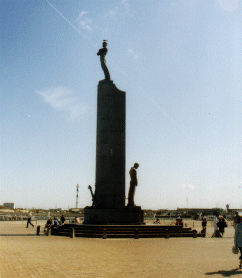
The Monument to those Lost at Sea, Oostende
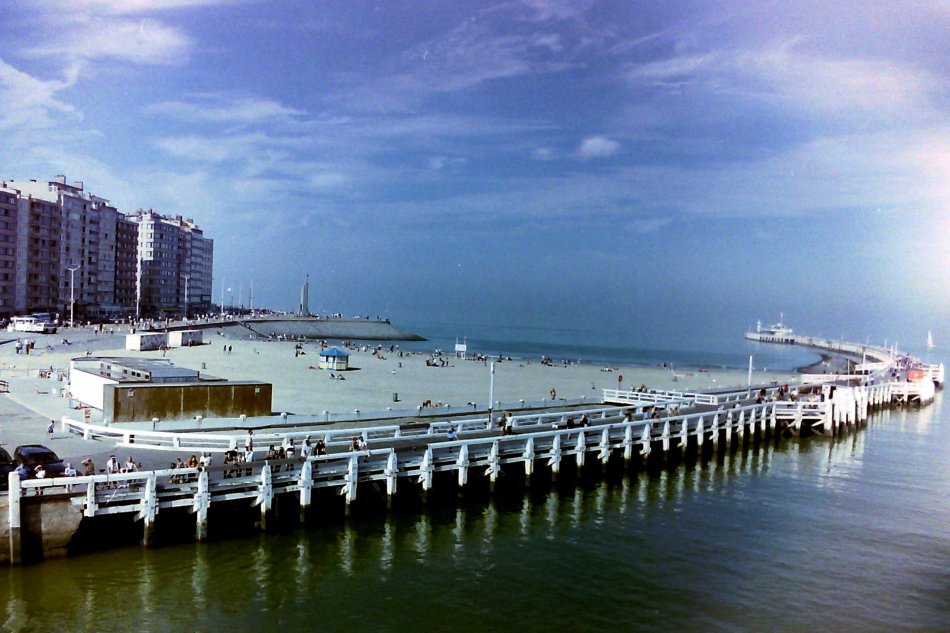
The Seafront at Oostende
I followed this route down the harbour entrance where I stumbled upon the same fritture who had served me fries and mayo a couple of days ago. So to top and tail the whole trip I had some more and then headed for the Port and my boat back to Britain.


©
Text copyright - Raving Loony Productions, Andrew J. Müller
and
Roy Barton
© Photos and Artwork - Andrew J. Müller and Roy
Barton
© Web Design and Layout - Andrew J. Müller
2023


