
KENILWORTH CASTLE
Warwickshire
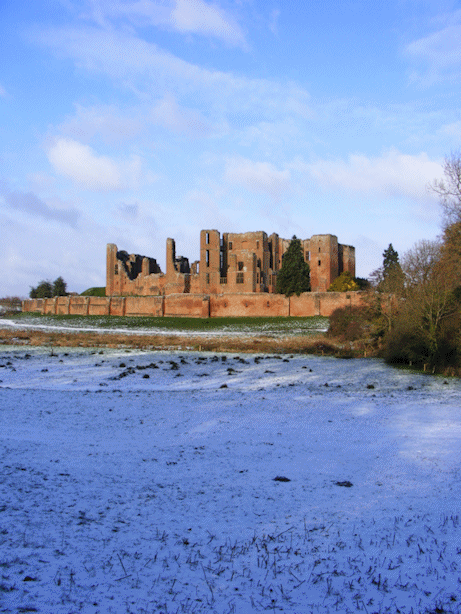
Kenilworth would in many other counties be the top Castle - but its neighbour, just 4 miles away, at Warwick steals that honour. The two together form an excellent contrast of just how fate can deal out different destinies to two buildings of a very similar kind.
Kenilworth's origins date to around 1130 when a motte and bailey Castle was built at the north of the land owned by Geoffrey de Clinton; like at Maxstoke the south end of his land was given over to monks of the Augustinian Order.
Whilst his sons were rebelling in 1173 Henry II took over the Castle, having no others in Warwickshire, and the Castle remained in Royal hands for some centuries. The great keep was probably built by Henry in the 1180s and it follows a very similar layout to his other keeps at Dover and Canterbury.
King John liked Kenilworth Castle very much and spent large sums of money improving the Castle and creating the dam which formed a lake (known as "the Mere") to the north of the Castle, now sadly gone. The King was supposed to have ceded the Castle under the terms of Magna Carta, but as it was garrisoned for him during the 1216 rebellion it seems unlikely he did so.
Henry III was less of a fan of Kenilworth and the keep fell into disrepair until it was given to his sister, Eleanor. She married Simon de Montfort in 1238 and together they had Kenilworth re-fortified. In 1254 de Montfort led a rebellion against Henry III, capturing him at the Battle of Lewes and holding his son, Edward, as surety of the King's good behaviour. Edward, however, had other ideas and escaped from the Castle in 1265 and led an attack on Kenilworth. Simon de Montfort junior, the other's son, only escaped capture by swimming the mere in his nightshirt to the safety of the Castle. A few months later the de Montfort rebellion was crushed at the Battle of Evesham and the elder de Montfort was killed. The younger left the sanctuary of Kenilworth and ordered his men to follow suit. They refused and held out until December 1266.
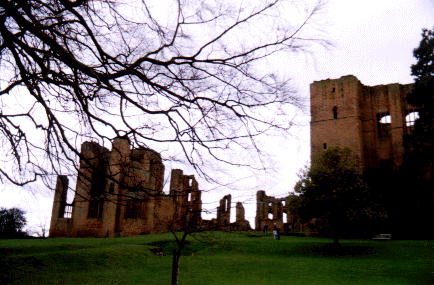
The siege was long and strenuous. When the Archbishop of Canterbury arrived to excommunicate the garrison inside one of the men climbed onto the battlements in a long white shirt and excommunicated the Bishop in turn! Eventually the siege was broken and the garrison surrendered on honourable terms.
In 1361 the Castle came into the ownership of John of Gaunt, one of the unsung heroes of English history, and he made great changes to the building. It was under his instructions that the great halls were added which made Kenilworth Castle possibly the most luxurious Castle in England. His son, Henry IV, and grandson, Henry V, both liked Kenilworth; and it passed into the Tudor age with no violence.
Henry VIII also liked Kenilworth and built yet more palatial buildings. It passed to John Dudley, Duke of Northumberland (see also Astley Castle, Dudley Castle, Framlingham Castle), and it was one of the few properties his family kept after his execution when he put Lady Jane Grey on the English throne.
It is incredible to think that after all this history Kenilworth was only just about to enjoy its greatest moments...!
Robert Dudley, the son of John, was a great favourite of Elizabeth I and she made him Earl of Leicester and granted him Kenilworth Castle. The Queen stayed at Kenilworth three times, the last time in 1575 when she stayed for 18 days of hunting and revelling. It was the glory days for Kenilworth. With the accession of James I the Castle passed back to Royal hands, but remained a firm favourite with visiting Monarchs.
The end for Kenilworth, though, was in site. In 1642 King Charles I withdrew his garrison with scarcely a fight and one of the saddest of all Civil War slightings took place. One wall of the keep was smashed open, the mere was drained and the remainder of the buildings ruined.
Sir Walter Scott wrote his book "Kenilworth" in 1821 and the Castle became one of the first to become a tourist attraction, a role it still plays today with the aplomb with which it once entertained England's greatest Monarchs.
The Castle is owned by English Heritage and open all year.

Back to Castles of Warwickshire Page
© Text copyright - Raving Loony
Productions, Andrew J. Müller and
Roy Barton
© Photos and Artwork - Andrew J. Müller and Roy Barton
© Web Design and Layout - Andrew J. Müller
2018


