
DOVER CASTLE
Kent
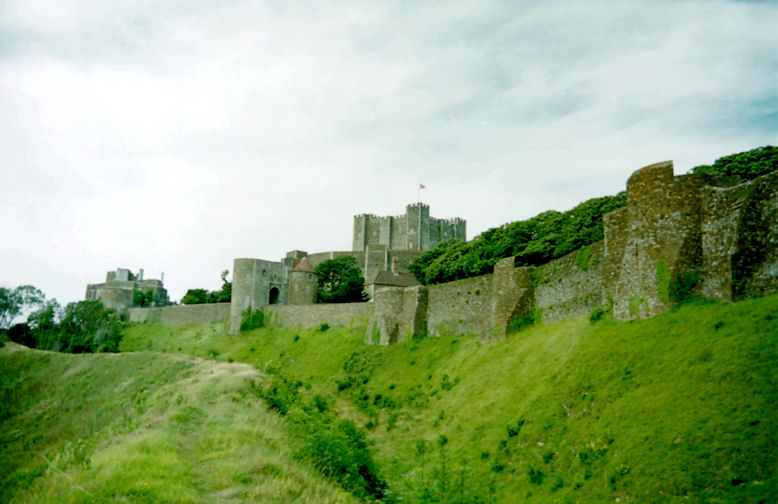
There has been a defensive fortification on the hill overlooking the English Channel since the Iron Age, since when the original Hill Fort has been adapted over time until you see the huge fortress that exists today. The military only moved out in 1958 and as such it holds the record for the longest continuous use as a fortress.
Allow some time to explore some of those original Iron Age banks and ditches, before moving on to the Roman lighthouse and the Saxon Church before fully visiting the Castle. It helps you to get some idea of the sheer scale of this place.
The first stone Castle was built here during the reign of Henry II (1100-1135). Though the Castle was always adapting to the new technologies of warfare and was, perhaps, one of the most advanced defensive structures in the World; the keep was one of the last of its kind built in England.
Although it was more luxurious than most towers built before it's defences were much more elaborate. Along the inner bailey surrounding the keep are 14 towers able to cover all angles. The Kings' Gate and Palace Gate at the north and south walls were the first gatehouses built to the design used. Furthermore, a massive outer curtain wall, punctuated by numerous towers was added during King John's reign.
Shortly afterwards the Castle saw its only major siege. After King John set his seal to Magna Carta he broke many of the promises laid down and by October of 1215 the country broke out into Civil War. Prince Louis of France was invited over to take control and in May 1216 he landed with an army on the south coast. By July he was laying siege to Dover. When King John died in October the War ended and Dover, along with Windsor, was the only Castle not taken.
The following Spring an understandably annoyed Louis attacked again, but was repelled. However, his attacks did show up some weaknesses in the Castle's defenses, particularly on the landward side.
Hubert de Burgh, the Constable, and the defender of the Castle during Louis' sieges, decided to overhaul the defences, adding the magnificent Constable's Gate and resiting the entrance and also adding the underground passages and the 'redoubt' on the landward side of the Castle.
For many years afterwards the Castle lost much of its strategic value. Henry VIII built his great chain of fortresses along the south coast and the town of Dover began to develop into a port.
The Civil War and an invasion scare in the 1740s brought Dover Castle back to life and over the following decade new barracks and batteries were added. By the Napoleonic Wars (1793-1815) all the towers had been shortened or removed by British artillerymen to enable the use of large, bastion-mounted guns.
The last major phase of military activity was in the Second World War when the maze of tunnels underneath the Castle were extended and it became the command centre for the whole of the defence of southern England. Incredibly, Dover Castle was only decommissioned in 1958.
Take a whole day to visit Dover Castle - there is more to see here than at almost any other Castle in the land.
English Heritage own the Castle and the underground tunnels - dubbed "Hellfire Corner" - and both are open all year on a joint admission ticket.

Back to Castles of Kent Page
This text is based around one which first appeared in "In Front" Magazine in March 1999.
© Text copyright - Raving Loony
Productions,
Andrew J. Müller and
Roy Barton
© Photos and Artwork - Andrew J. Müller and Roy Barton
© Web Design and Layout - Andrew J. Müller
2018


