

PAGE THREE
Granada - Jacqui and Andrew - 2005
Andrew and Jacqui were looking for a place in Spain to visit for a few days in summer 2005. Initially, we looked at Sevilla, but a good deal came up to visit Granada instead and Andrew, knowing a little about these things, knew it was a fine place to visit.
We arrived on a gloriously warm afternoon and walked down the little alley to our hotel close to the Plaza del Carmen. That evening we went for a quick explore and found the best pasta restaurant ever, Gallio, on the Plaza de Bib-Rambla – with it’s wonderful signature dish spaghetti al siete aromas (Spaghetti with seven flavours) a great combination of pasta, olive oil and herbs which was so good we had it again a couple of nights later.

The Plaza del Carmen, Granada
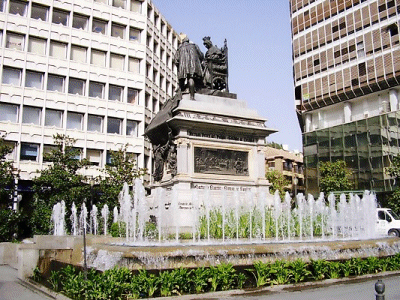
Fountain in Granada
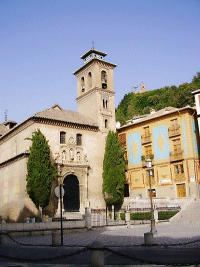
Santa Ana, Granada
The next day we headed out into the City, crossing the main road into the old Arab Quarter which still shows its origins as a bazaar with tiny alley ways, arched arcades and little shops. Here and there you find yourself coming out onto tree lined squares or sudden large shopping streets.
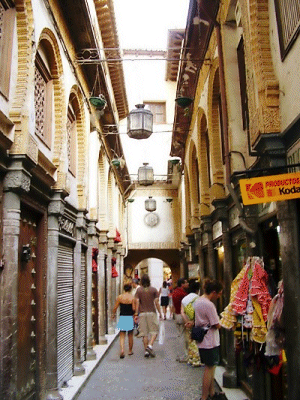
The Old Arab Market, Granada
Turning a corner we suddenly found ourselves confronted with Granada’s Cathedral which, like so much else in this City, owes its existence to the Moors who built it as a Mosque around 1270. After the Reconquista it was converted by Isabella and Ferdinand into a church – but when you walk inside amongst its pillars the Cathedral's origins become more obvious – there’s no main aisle here, but rather a sequence of spaces common in old mosques. Isabella and Ferdinand took Granada very much to their hearts and had built on the outside of the Cathedral the Capilla Real (Royal Chapel) in which they are buried.
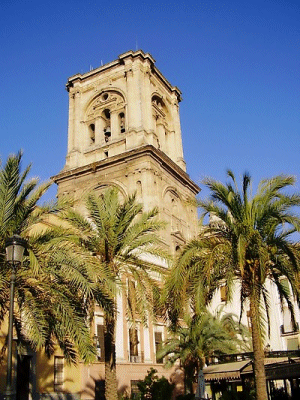
Granada Cathedral
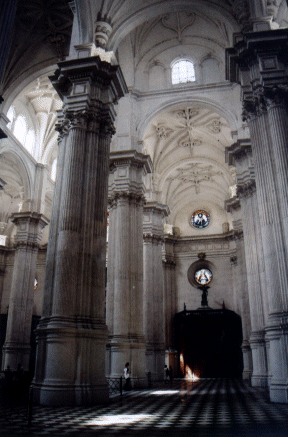
Interior of Granada Cathedral
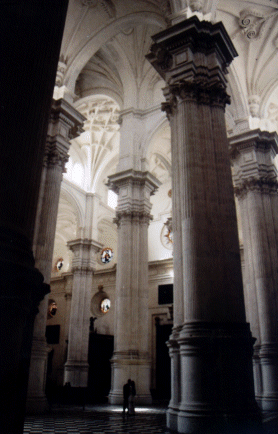
Interior of Granada Cathedral
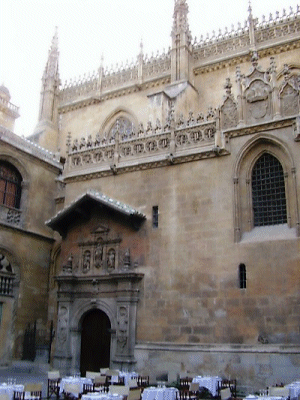
Capilla Real, Granada
Although Granada’s City Centre is a fantastic place to wander, there is one main attraction in this place – Spain’s premier tourist attraction as it happens – The Alhambra de Granada.
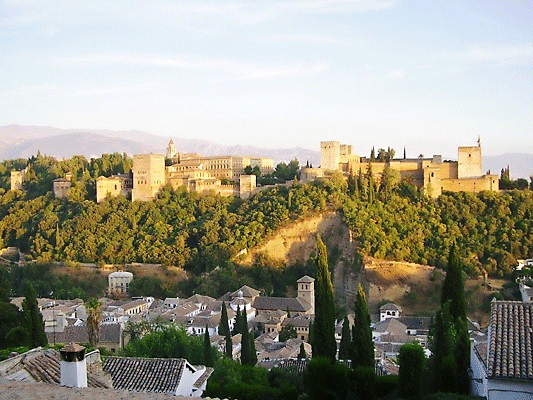
The Alhambra from the Mirador San Nicolas, Granada
You become aware of the Alhambra from pretty much the moment you arrive in Granada. It can be seen up on its hill from various places, and often, unexpectedly you’ll see it perched above you or in the distance. By far the best view can be had from the Mirador San Nicolas in the Sacromonte district – the oldest part of Granada where the gypsy population still dominate and still live in caves cut into the soft rock. This looks directly across the valley of the Darro river which forms the city centre to the Alhambra and from here you can see just how extensive the complex is.

Mirador San Nicolas plus Alhambra, Granada

Strange man in a hat!
Few buildings in the world have the magical air that the Alhambra has. It is far beyond ‘just’ a castle, but represents everything that has influenced and made Spain the country it is today.
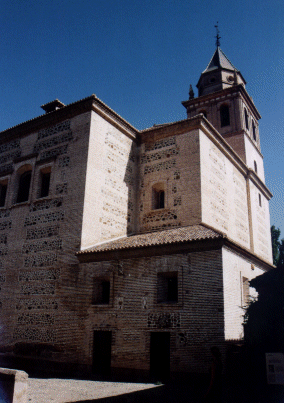
The Church inside the Alhambra, Granada
During the long Muslim occupation of Iberia, Granada (named after the Arabic for Pomegranate), became one of the main power bases. The earliest reference to a castle on the site is from 889 when Sawwar ben Hamdun had to seek refuge in the castle here, meaning it must have already been built.
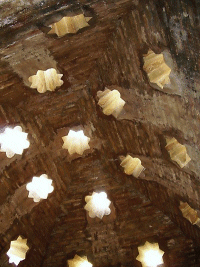
Ceiling inside the Turkish Baths, Alhambra, Granada
The first Nazarene King, Alhamar, had this taken down and work was begun on a new fortress. This new castle dwarfed the previous one in scale. The earliest surviving section is the Torre de la Vela constructed by Alhamar in 1238 using the original old castle buildings. He followed it by building the great gateway which now separates the Alcazaba (the castle section) from the palaces. The structure gained the name Al Qal'a al-Hamra – or the “Red Fort”.

The Gatehouse of the Castle of the Alhambra, Granada
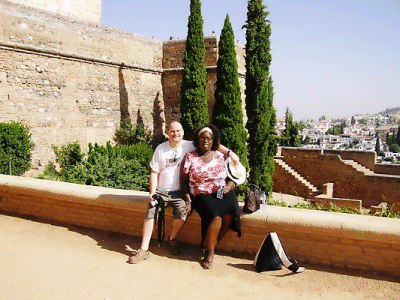
By the "Castle" bit of the Alhambra, Granada
The palaces which stand across from the Alcazaba are mostly the work of the later Nazarene Princes, Yusuf I and Mohammed V. Yusuf ascended to the Throne in 1328 and had one suite of palaces built to celebrate this and Mohammed scored a famous victory in Algeciras in 1369 and built a second set.
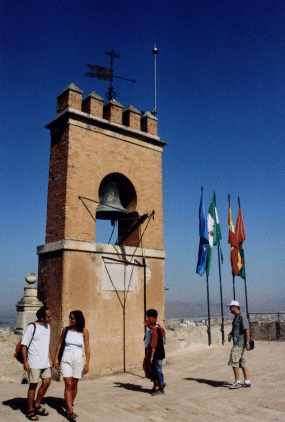
At the top of the Alhambra, Granada

View of Granada from the Alhambra
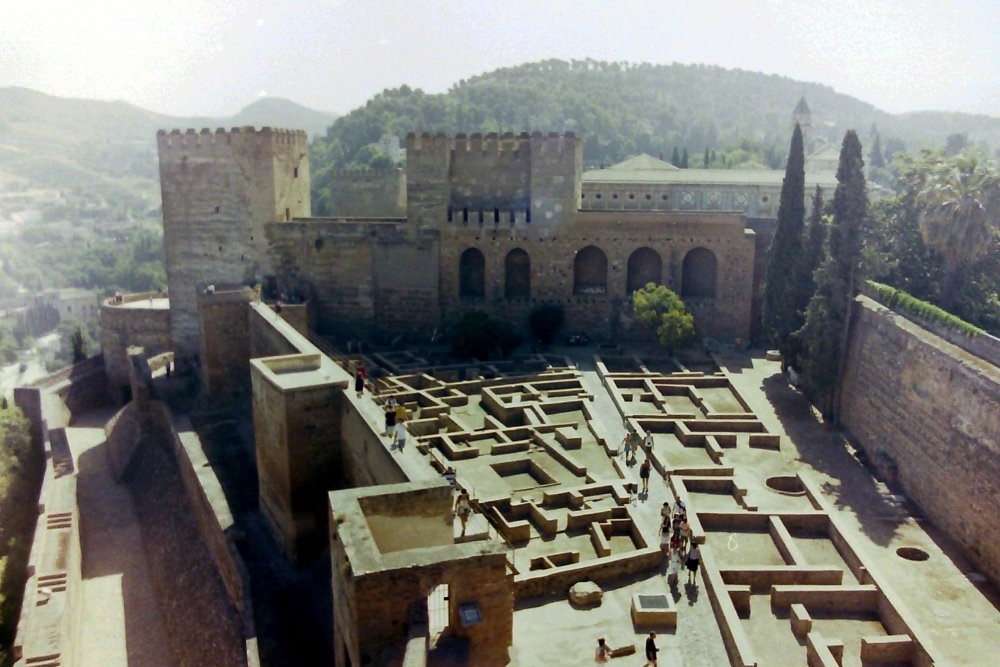
The Inner Courtyard of the Castle of the Alhambra, Granada
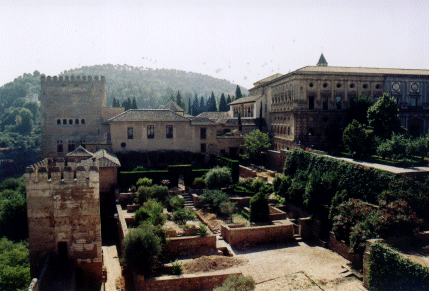
The Nazrin Palaces from the Castle, Alhambra, Granada
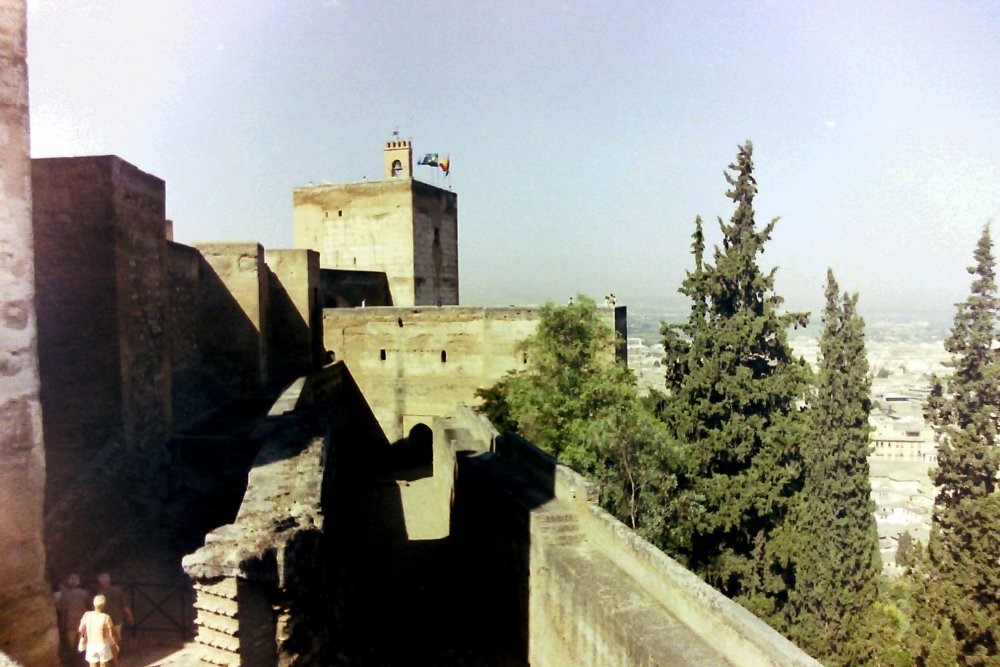
Castle Walls of the Alhambra, Granada
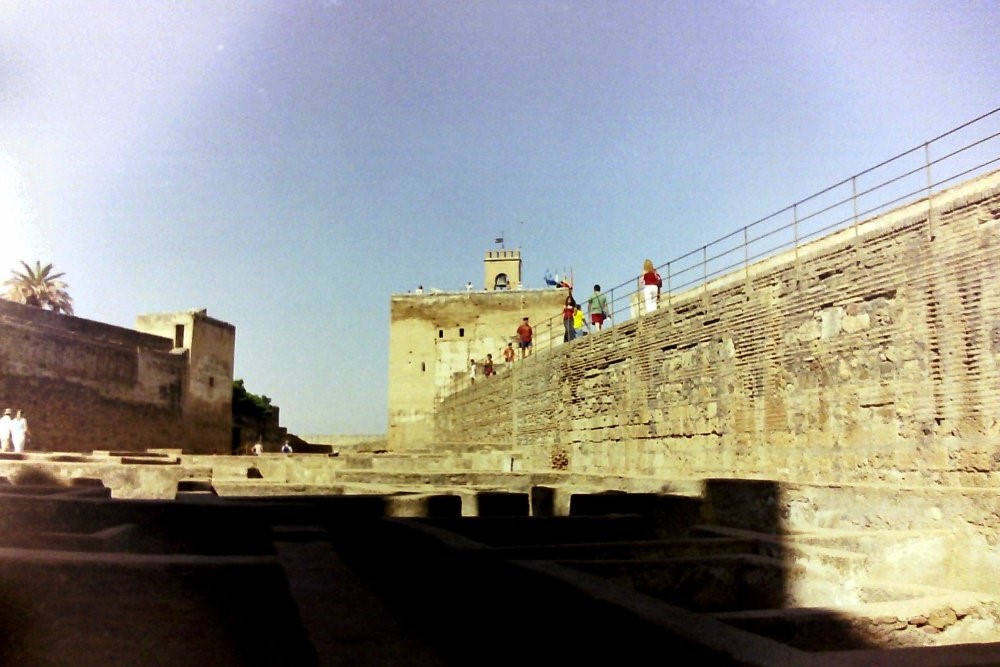
Another view of the Alhambra, Granada
In 1492 the Castillian Spanish under Ferdinand and Isabella finally ousted the last Moorish invaders from Spain. Granada was the very last town to fall. The Calif, Boabdil, rather than see his beloved Alhambra destroyed agreed to surrender it. There is the famous story of him leaving the City and glancing back and breaking down into tears. His mother, who accompanied him, said “do not weep like a woman for what you could not fight for like a man.”

Inside the Nazrin Palaces, The Alhambra, Granada

Moorish Arch, the Alhambra, Granada
The Alhambra was not taken by force until Napoleon I invaded in the early 1800s. In 1812 when they were forced out they tried to dynamite the complex – fortunately a crippled soldier had been left behind who removed all the fuses before this gross act of vandalism could be completed.
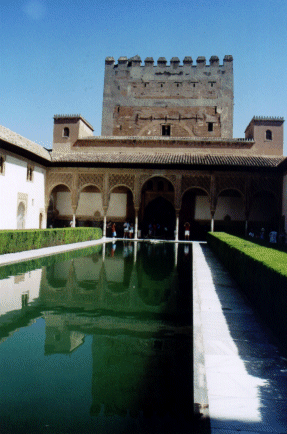
Patio de las mirtes, Alhambra, Granada
Entering the Palaces your breath is immediately taken away by the first chamber you enter; the Sala de Mexuar which was transformed into a Chapel by Carlos V but still maintains its basic Muslim look – as you proceed around the Palaces you begin to realise that this is a mere appetiser for what is to come.

Detail of decorations in the Alhambra, Granada

Patio de los Leones, Alhambra, Granada
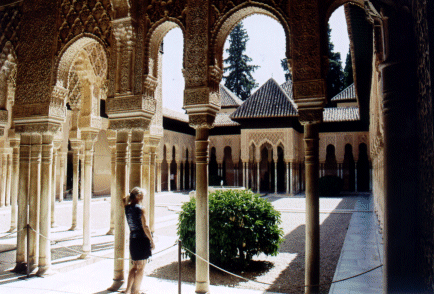
Still in the Patio de los Leones, the Alhambra, Granada

Amazing Arches, The Alhambra, Granada
A succession of ever more elaborate chambers takes you to the Patio de los Arrayanes (Courtyard of the Myrtles) which is the first of three main courtyards, each more glorious than the next. So far you have only encountered the work of Yusuf I. As you pass now through the Sala de los Mocárabes you find yourself in the fabled Patio de los Leones (Patio of the Lions), a courtyard of columns, arches and fountains centred around the Lion Fountain that has become the unofficial symbol of Granada. This is all the work of Mohammed V. Off this courtyard are a number of chambers and rooms with intricate and beautiful designs which eventually lead you to the final courtyard the Patio de Lindaraja which overlooks the old Arab quarter of Granada. Then you pass through a garden and suddenly you are outside in the shadow of Carlos V’s palace.

Astonishing ceilings of the Alhambra, Granada

The Beautiful Alhambra Gardens, Granada
As if this was not enough, higher up the hill is the Generalife Palace, an extension built to the Alhambra for the hotter days of summer by Mohammed V which is most famous for its glorious gardens and fountains.

Generalife Gardens, Granada
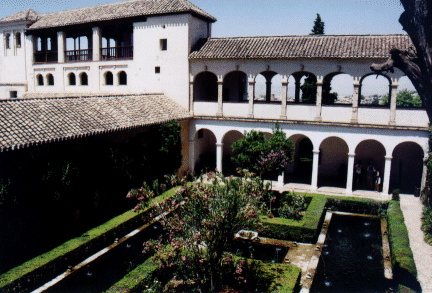
Courtyard of the Generalife, Granada
By the time we’d walked around the Alhambra it was midday – so the walk up the hill to the Generalife was almost too much for us. We were sweating copiously and spent most of our visit to the gardens sitting on one bench or another. Eventually we got together enough energy to get back to the main entrance to the Alhambra where the bus stop was.
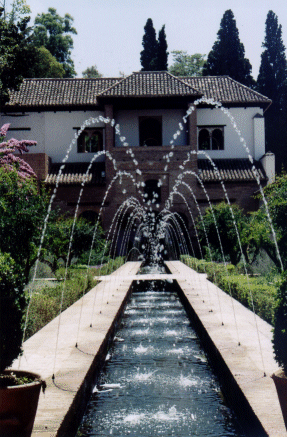
Beautiful fountains in the Generalife, Granada
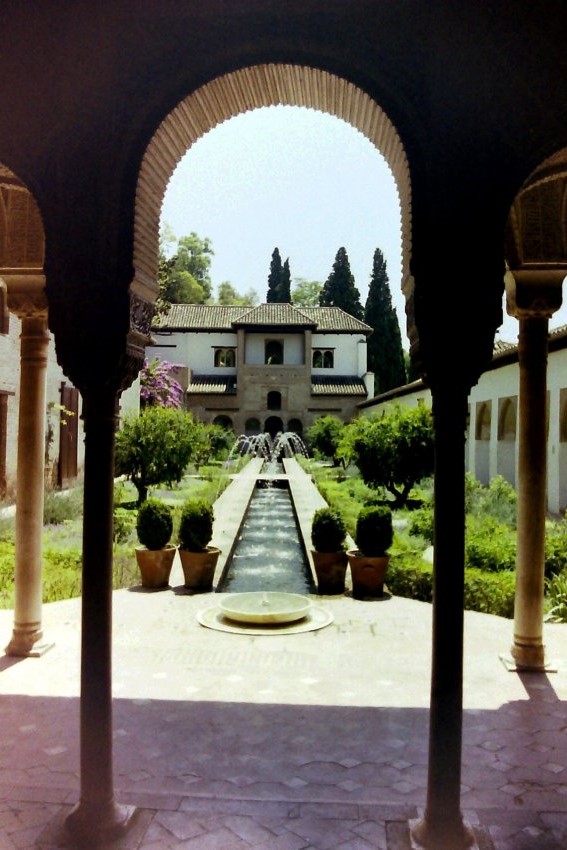
Another view of the Generalife Gardens, Granada
Our visit to the Alhambra complex was, without a doubt, one of the best days sightseeing I’ve ever had. The whole place is amazing, as is Granada in general, and it is without doubt amongst Europe’s top ten places to see.
The next day we went to a market on the edge of town – which was quite large and we picked up some good bargains (no photos of this though!).
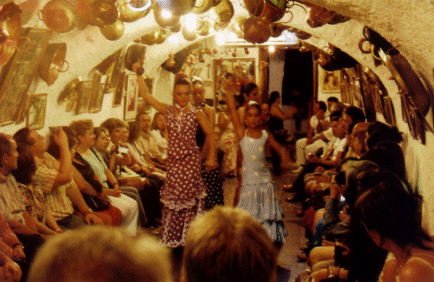
La Rocio - Zambra Gitana -
Gypsy Flamenco show in a cave in Sacromonte
On our last evening in Granada we had booked to go and see a flamenco show in one of the caves in Sacromonte. This was, literally, in a cave – the walls lined with brass cooking utensils and seating. We were then treated to series of neatly executed and typically passionate flamenco. The show went on for approximately an hour – wine and snacks were consumed.
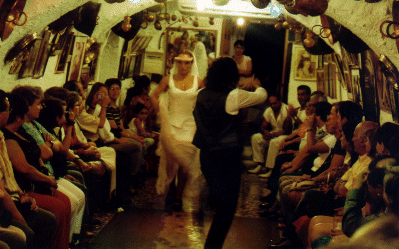
More Flamendo, Granada
Afterwards we stood out on the terrace in the cool for a little while and reflected on how nice Granada was. Not only was it truly beautiful, full of history and interest, but it was also a proper working town with people living normal lives. We decided it would be a fantastic place to live.

A blur of movement
Granada 2 - Andrew and Jacqui and her Mum and her friend - 2005
Having decided that Granada would be a great place to live, we returned later in the year with Jacqui’s Mum and her friend in tow. The idea was to look at potential places for a holiday home on the coast near here.
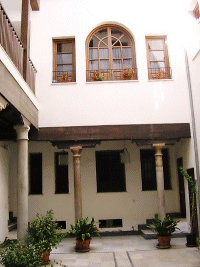
Our apartment in Granada
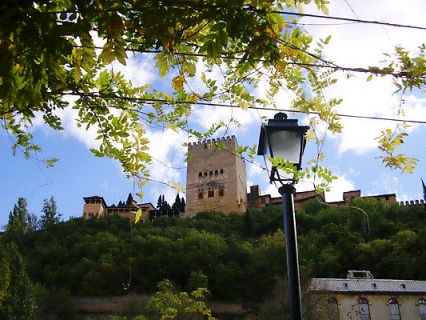
The Alhambra from near our apartment, Granada
We were staying this time in an apartment on the Carrera del Darro – a tiny road which runs next to the river at the foot of the Alhambra and Sacromonte areas. From the outside the apartment looked like, well, nothing much really. Inside it was grouped around a pristine little courtyard and was actually quite fine.
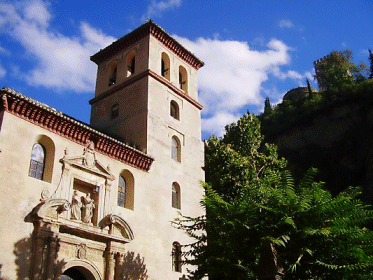
Church in the shadow of the Alhambra, Granada
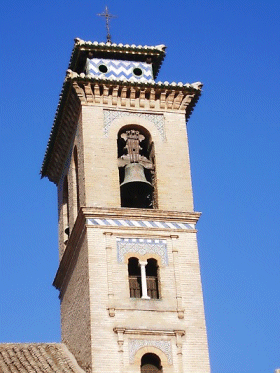
Tower of Santa Ana Church, Granada
It was also dead central for everything you might want in the City. The Alhambra on one side, the Sacromonte on the other and down the road it opened out into the Plaza Nueva over looked by the Santa Ana Church which is the closest thing Granada has to an actual main square.
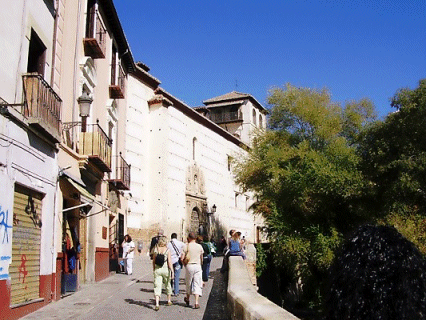
Carrera del Darro, Granada

Another view of the Carrera del Darro, Granada

Small street next to our apartment, Granada

Fountain in the Plaza Nueva, Granada
Although the time spent in Granada was good, the trip didn’t quite go as planned regarding finding a holiday home. We were shown a couple of frankly horrible places; both in a flea pit of a town whose name has been wiped from my memory in the way that one blots out such horrors. We then had a grim lunch in the equally flyblown town where the estate agents were based before limping back to Granada having wasted a day, hired an expensive car and not had a good time at all.

Shopping in Granada
It was a relief to spend the next day in and around Granada, mostly shopping in the Old Arab Quarter and also going out to the market we had found last time.
One advantage of staying so close to the Alhambra is that you could look up to its walls, brightly floodlit of an evening and even have dinner al fresco by the banks of the Darro River.

The Alhambra at Night, Granada
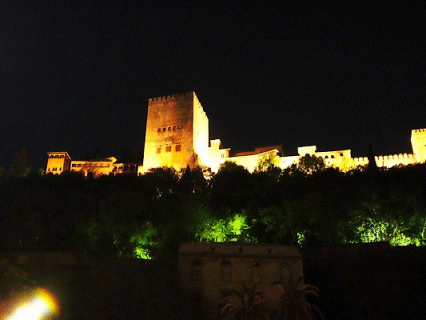
Another view of the Alhambra at night, Granada
Granada is still a brilliant city – but this was not our most successful jaunt ever!
Go
to Spain Page One
Go to Spain Page Two
Go to Spain Page Four


© Text copyright - Raving
Loony Productions and Andrew J.
Müller, Jacqui Harris, Roy Barton and
Shaun and Alison Runham
© Photos and Artwork - Andrew J. Müller, Jacqui Harris, Roy Barton
and
Shaun and Alison Runham
© Web Design and Layout - Andrew J. Müller
2024


