
ALHAMBRA de GRANADA
Granada, Spain
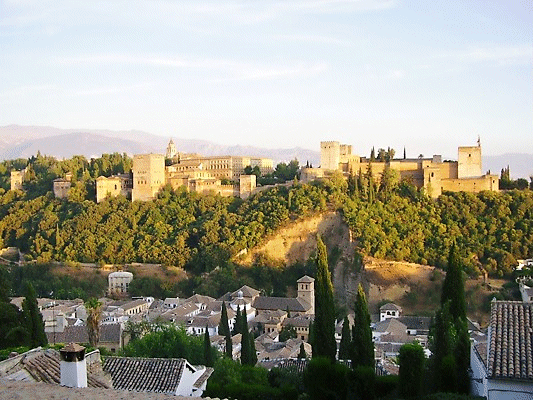
Few buildings in the world have the magical air that the Alhambra in Granada has. It is far beyond ‘just’ a castle, but represents everything that has influenced and made Spain the country it is today.
During the long Muslim occupation of Iberia, Granada (named after the Arabic for Pomegranate), became one of the main power bases. The earliest reference to a castle on the site is from 889 when Sawwar ben Hamdun had to seek refuge in the castle here, meaning it must have already been built.
The first Nazarene King, Alhamar, decided to move his power base from the ancient Arabic settlement on the Albaicín hill across the Darro valley to the opposite hill. The year was 1238. On this site there already existed the structure known as the Bermejo Castle dating back to the 9th Century building referred to above. Alhamar had this taken down and work was begun on a new fortress. This new castle dwarfed the previous one in scale. Alhamar’s successors continued the work adding initially towers and walls and gates, and then subsequently palaces and gardens.
The earliest surviving section is the Torre de la Vela constructed by Alhamar in 1238 using the original old castle buildings. He followed it by building the great gateway which now separates the Alcazaba (the castle section) from the palaces.
The structure gained the name Al Qal'a al-Hamra – or the “Red Fort” because of the colour of stone used in its construction. This name is the source of ‘Alhambra’.
Alhamar undertook to supply his new fortress with water from the River Darro nearly 8 km below at the foot of the hill. An astonishing feat of engineering which allowed subsequent rulers to install fountains and glorious gardens on what would otherwise be an arid hillside.
The palaces which stand across from the Alcazaba are mostly the work of the later Nazarene Princes, Yusuf I and Mohammed V. Yusuf ascended to the Throne in 1328 and had one suite of palaces built to celebrate this and Mohammed scored a famous victory in Algeciras in 1369 and built a second set.
In 1492 the Castillian Spanish under Ferdinand and Isabella finally ousted the last Moorish invaders from Spain. Granada was the very last town to fall. The Calif, Boabdil, rather than see his beloved Alhambra destroyed agreed to surrender it. There is the famous story of him leaving the City and glancing back and breaking down into tears. His mother, who accompanied him, said “do not weep like a woman for what you could not fight for like a man.”
Ferdinand and Isabella lived briefly in the Alhambra and converted the mosque into a church. Their son, Carlos V, also lived here, but he demolished a whole chunk of the buildings and inserted a large, square and not particularly sympathetic palace right in the centre of the complex.
Ironically, his son and all their successors ignored the Alhambra completely and used it as a prison. In 1808 Napoleon became the first military commander to take the Alhambra by force. His troops looted and destroyed and when they were forced from the city in 1812 they tried to dynamite the whole complex. This gross act of vandalism was prevented by one crippled soldier whom they had abandoned who removed all the fuses before the explosions could take place.
In the 1850s the American writer Washington Irving sparked a renewed interest in the buildings and restoration began. Today it is Spain’s most treasured building and not without good reason.
To try to sum up the glories of the Alhambra in words is an impossible task. The castle section is solid and imposing and today towers over the old town of Granada. But it is the Nazarene Palaces which are the real selling point. Nowhere else can you find such a concentration of glorious Muslim art. Entering the Palaces your breath is immediately taken away by the first chamber you enter; the Sala de Mexuar which was transformed into a Chapel by Carlos V but still maintains its basic Muslim look – as you proceed around the Palaces you begin to realise that this is a mere appetiser for what is to come.
A succession of ever more elaborate chambers takes you to the Patio de los Arrayanes (Courtyard of the Myrtles) which is the first of three main courtyards, each more glorious than the next. So far you have only encountered the work of Yusuf I. As you pass now through the Sala de los Mocárabes you find yourself in the fabled Patio de los Leones (Patio of the Lions), a courtyard of columns, arches and fountains centred around the Lion Fountain that has become the unofficial symbol of Granada. This is all the work of Mohammed V. Off this courtyard are a number of chambers and rooms with intricate and beautiful designs which eventually lead you to the final courtyard the Patio de Lindaraja which overlooks the old Arab quarter of Granada. Then you pass through a garden and suddenly you are outside in the shadow of Carlos V’s palace.
As if this was not enough, higher up the hill is the Generalife Palace, an extension built to the Alhambra for the hotter days of summer by Mohammed V which is most famous for its glorious gardens and fountains.
In order to do the Alhambra justice a day needs to be sacrificed not only to see everything but just to sit amongst its courtyards and gardens and admire the unparalleled work that has survived the centuries. Words cannot really explain this place, only a visit is sufficient to take it all in.
Granada is a wonderful holiday destination and I’d urge anyone who loves good architecture, good food and friendly people to visit. If you are going to visit the Alhambra is is advisable to (a) pre-book and (b) arrive as early as you can.

© Text copyright - Raving Loony
Productions and Andrew J. Müller
© Photos and Artwork - Andrew J. Müller and Jacqui Harris
© Web Design and Layout - Andrew J. Müller
2018


