
BAMBURGH CASTLE
Northumberland
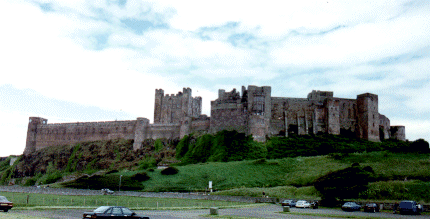
Bamburgh Castle is one of the most impressive buildings in Britain, standing on its rocky crag by the wild sand-dune beach at Bamburgh with views out towards Lindisfarne and the Farne Islands, it is a windswept, amazing place crowned by one of the England's most solid looking and huge Castles.
The Castle may have been built as early as 1070 by William I, the possible site of a motte has been identified at the north end of the outer ward of today's Castle. In 1076 the Castle was passed to Bishop Walcher of Durham, and they subsequently passed to Robert de Mowbray in 1086. De Mowbray rebelled against the King in 1095 and was imprisoned at Windsor Castle until his death in 1125. The Castle at this point was still a wooden one and it was most likely Eustace FitzJohn of Alnwick who commenced stone construction around 1129.
King Stephen, with unusual shrewdness, realised that Eustace wasn't entirely trustworthy and took the Castle from him. The Castle remained Royal until 1307 and during this period Henry II had the great keep built, along with the western gate, which was superceded by a larger gatehouse a few centuries later.
In 1307 the Castle passed to Isabel de Vesci. The Castle was in poor shape by this time, but its strength allowed it to endure a three month siege by Scots in 1328. It was partially repaired in time to withstand another Scottish attack in 1333. In 1346 King David of Scotland was brought here as a prisoner. It was also at Bamburgh that Edward Balliol surrendered the crown of Scotland to Edward III in 1356.
Towards the end of the 14th Century great repairs were undertaken and the Castle was remodelled. In 1462 it was taken after a 14 day siege by a massive force of 10,000 Yorkists led by the Earl of Warwick. It was then retaken by the Lancastrians, and then again in 1464 by the Yorkists who "reduced" the Castle by smashing it to pieces.
The Castle remained a ruin until it was purchased by Bishop Carew of Durham in 1697, who set about rebuilding the Castle. Work continued after his death and by 1769 even the keep had been made habitable. Restoration carried on until 1825 and then recommenced for a final phase in 1890. The huge programme of rescue came to an end around 1900.
Bamburgh Castle is open to the public during the summer months and despite all the rebuilding work is still a testament to the skills of the medieval Castle builder.

Back to Castles of Northumbria Page
© Text copyright - Raving Loony
Productions, Andrew J. Müller and
Roy Barton
© Photos and Artwork - Andrew J. Müller and Roy Barton
© Web Design and Layout - Andrew J. Müller
2024


