
ROYAL WAWEL CASTLE
Kraków, Poland
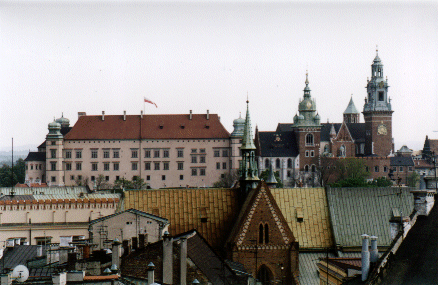
The history of Wawel Hill reflects the history of the whole of Poland. The earliest known settlements are from around 100,000 BC when this high rocky outcrop overlooking the Wisła river was occupied by a local tribe. The Wisła forms one of the major river routes in this part of Europe and so the town became more and more powerful. Kraków was founded – officially – by Krakus and Princess Wanda in the 7th Century AD. In the 10th Century Kraków became the centre of the emerging state of Poland.
The Cathedral was established in 1000, although construction was delayed until 1018 because of a conflict with the Holy Roman Empire. The original was destroyed around 1040-1080.
Around 1039 Casimir I “The Restorer” returned to Poland and made Kraków his seat. It seems likely that the first castle-like structures date from this period.
Everything was destroyed by fire once more in 1305. In 1320 reconstruction began at the behest of Władysław I “The Elbow-High” which forms the basis of today’s cathedral which was consecrated in 1364.
Casimir III “The Great” built much of the castle that we see today in the mid-late 14th Century. The last of his line, Sigismund I “The Old” massively rebuilt Wawel Hill into the palace complex that we see today, expending lavishly on the building work.
In 1595 a fire, the great enemy of Wawel Castle, took down much of the north east of the castle and it was rebuilt once more under the direction of Sigismund III Vasa. Sigismund, however, is responsible for the end of Wawel’s glory days. In 1609 he moved his capital to Warsaw. Over the next 100 years the Castle and Cathedral began to slowly decay.
This decay was aided by Swedish troops who stayed here in the 1650s and again in 1702 and by the Prussians in 1794. Throughout this time Wawel Cathedral remained the place of coronation of Poland’s Kings, but the Castle became increasingly derelict and ruinous.
In 1795 Poland was partitioned and Kraków came under the influence of Austro-Hungary. Wawel Hill became a barracks. The people of Kraków rebelled but were put down brutally by the Austrians.
The tide began to turn in the early 1800s when Wawel began to take on its position as “heart of the nation”. A number of national heroes were buried here and when Casimir III “The Great’s” tomb was accidentally opened he was re-buried with great pomp. This reignited Polish interests in the Wawel and renovation began.
In 1905 Franz Josef gave orders for the Austro-Hungarians to leave and serious restoration began under the aegis of Zygmund Hendel Adolf Szyszko-Bohusz.
After World War I the newly independent state of Poland decided that Wawel Hill was to be a representative building of the Polish Republic and it would be the residence of the President of Poland. Sadly, this did not last long and during World War II the Nazis occupied the Castle and many important works of art vanished forever.
Today this fascinating set of buildings holds all the contradictions, turmoils and stubbornness of the modern Polish state and really does represent the country in stone.

© Text copyright - Raving Loony
Productions and
Andrew J. Müller
© Photos and Artwork - Andrew J. Müller
© Web Design and Layout - Andrew J. Müller
2019


