
PRAGUE CASTLE
Czech Republic
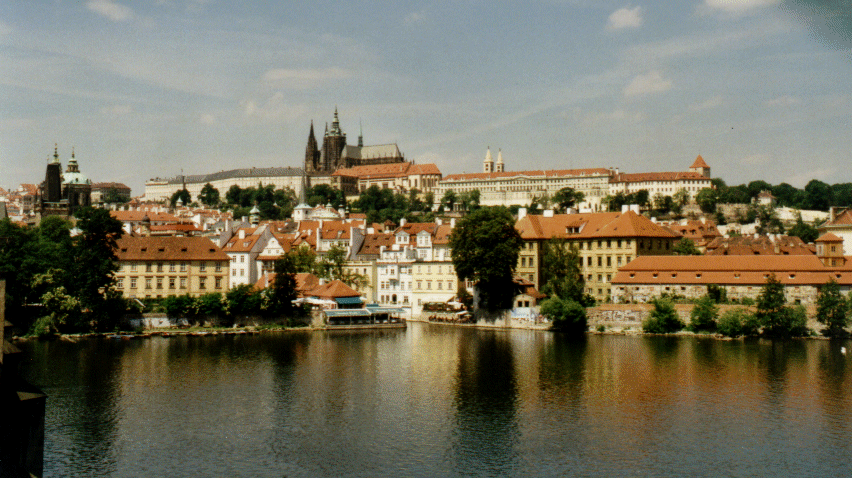
Although not a great deal of Prague Castle as it stands today suggests fortification, the dominating site alone makes it the most noticeable building, even in a city like Prague. The first fortification was believed to have been founded around the year 990 AD by Prince Borivoj of the Premislydes, the founding family of Prague. The first stone building constructed on the site being the Church of Our Lady.
The oldest surviving part of the Castle today is the Church of St. George, founded in the 10th Century. St. Vitus Cathedral was also founded at this time, but was subsequently heavily rebuilt in the purest of Gothic styles, and added to over the ensuing centuries.
In 1041 the Emperor Henry III attacked the Castle and destroyed it utterly. It was then rebuilt as a massive fortress by Prince Břetislav I. It was around this time that St. Vitus Cathedral was rebuilt as a larger church. Subsequent rulers of Bohemia continued to greatly increase the size and structure of the Castle. The Holy Roman Emperor Charles IV (1346-1378) and his son Wenceslas IV (1378-1419) are two of the key figures in Czech history and both made huge additions to the Castle, including the complete rebuilding of St. Vitus Cathedral as a gothic structure. It was also during this time that buildings inside the Castle began to move away from pure fortification towards palacial construction. The historic and beautifully preserved Gold Lane dates from this period and is one of the best preserved sections of the whole Castle area.
The Hussite Wars struck in the early 15th century and in 1421 the Castle was captured. For around 50 years it lay unoccupied and began to fall into disrepair. Under Vladislav Jagiello and his son Ludvík the Castle was refortified and reoccupied once more, some of the main fortified structures that remain today date from this period - noticeably the Powder Tower, Daliborka Tower and Black Tower.
When the all-powerful Hapsburg family took control of what was to become the Austro-Hungarian Empire they made Prague Castle one of their major seats of power. Ferdinand I and Maximillian II began to rebuild the Castle as a massive and magnificent Renaissance palace. In 1541 a massive fire broke out which destroyed the first Royal Palace and badly damaged St. Vitus Cathedral. Under Emperor Rudolph II (1576-1611) the Castle went through it's final massive phase of rebuilding when most of the Palace buildings we are left with today were constructed.
In 1620 the Hapsburg's lost control of some of their Bohemian lands and retreated to Vienna where they built their great Baroque capital. As Prague Castle had become considerably less important to them, the Baroque style is hardly represented amongst the buildings (some might say fortunately). Emperor Joseph II moved more and more power to Vienna and although his son, Leopold II, was crowned in Prague Castle it was the last time the Hapsburg Empire would centre on the City.
World War I finished the Austro-Hungarian Empire and the Hapsburg's in one fell swoop and an independent Czechoslovak state was founded with Prague Castle chosen to be the seat of government. Some modernisation was undertaken during this period and St. Vitus Cathedral's post-fire rebuild was finally completed. When the Nazi's arrived in 1938 they also choose Prague Castle to be the centre of their local administration. Prague's position so far from the the Allies and the centre of the War allowed not only the City, but the Castle too, to escape the kind of ruination that befell Dresden, Cologne and Frankfurt (not to mention Coventry and Liverpool). A small fire did break out in the Ball House, but otherwise the Castle escaped World War II unscathed.
Then the Communists arrived and turned the Castle into a cultural museum. Fortunately they restrained from destroying the atmosphere of the City of Prague and have left us with one of the jewels in Europe's crown.
Today, in a post-Communist independent Czech Republic, Prague Castle is both the symbol of the great history of the City and of the future which the new Republic hopes to build. It is also a dominant landmark in a City of landmarks.
Back to Castles of the Czech Republic
© Text copyright - Raving Loony
Productions and
Andrew J. Müller
© Photos and Artwork - Andrew J. Müller
© Web Design and Layout - Andrew J. Müller
2019


