


Dublin,
Meath,
Wicklow,
Kilkenny,
Tipperary,
Cork,
Kerry,
Clare,
Galway,
Offaly
and
Kildare
- Andrew - 1995
Antrim,
Derry,
Donegal,
Fermanagh
and
Armagh
- Andrew -
2001
Dublin and Newgrange
- Roy and
Sarah - 2001


Click here for a more detailed map
***
Ireland, England's close neighbour to the west, still bears the scars of British occupation with the divide between the North and the Republic. In more recent times the Troubles have abated a little, although the recent departure of the UK from the EU has threatened to open up old scars..
The Republic of Ireland was formed in 1923 when the Provinces of Leinster, Connaught and Munster plus three of the Counties of Ulster became independent from Great Britain. Dublin became this new country's capital city. The remaining six counties formed Northern Ireland with Belfast as it's capital..
For simplicity's sake both the Republic and the North are included in these Travel pages.
Ireland is famed not only for the beauty of it's landscape, but also - perhaps more so - for the Irish people who are without doubt the friendliest, most welcoming people in Europe.
***
Dublin to
Kerry and Back - Andrew -
1995 (Travelogue written
in 1995)
DAY ONE
Like many holidays this one started in the dark in the middle of the night, struggling out of bed and lugging heavy hold-alls into my Father's car. Then there was the remarkably brief journey to Stansted - arriving there at the same time as the sun showed itself over the unhilly horizon.
Having hung around for the usual hour or so, it was off through customs (no passports required) and onto the monorail which takes you from the Terminal building (such an unpleasant term) to the Departure Gate.
The journey took less than no time, no sooner had we stopped climbing than the familiar ear-popping sensation announced to me that we were heading downwards. I peered eagerly out of the window, but the clouds were not green and looked much like the ones I had passed through as I left Essex.
However, I am glad I was looking out of the window because when we did finally break through the cloud cover a nigh-on magical sight greeted us. I had expected to emerge over fields, but no, the view from my little porthole was of Dublin Bay; the Howth Peninsula jutting out into the Irish Sea and the Wicklow Mountains glowering darkly in the background.
Necks all around craned to get a better view as the plane descended into a chilly, but bright Irish morning.
Having passed once more through customs it was off to the bus stop to get a bus into Dublin's fair city. Thus, one of my first encounters with people on Irish soil was with the bus driver who - like bus drivers everywhere - was a demonic lunatic once behind a steering-wheel. By the time I actually got off the bus, I had discovered that this was a national characteristic.
Having dumped all my un-needed baggage at my B&B, I set off to discover Dublin or as they call it Baile Átha Cliath.
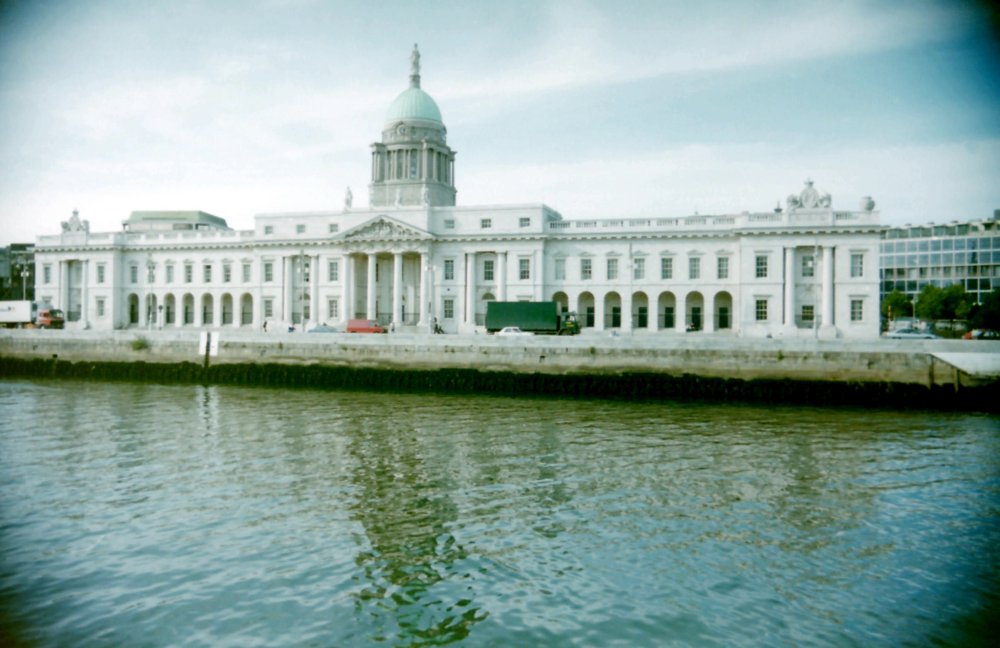
Custom House, Dublin

The General Post Office, Dublin

Another view of the General Post Office, Dublin
The first of its more famous sights I found was the Customs House - a huge Georgian building (like all of Dublin's buildings!), with great stuccoed pillars and a brilliant green dome (copper I presume, not just patriotism). I then, quite by accident, found myself in O' Connell Street, Dublin's main thoroughfare. Here is the General Post Office with bullet wounds from the Easter Rising. Here is the modern statue of a woman sitting in a fountain which Dubliners call "The Floozie in the Jacuzzi".

Anna Livia sculpture - "The Floozie in the Jacuzzi", Dublin

The Ha'Penny Bridge over the Liffey, Dublin
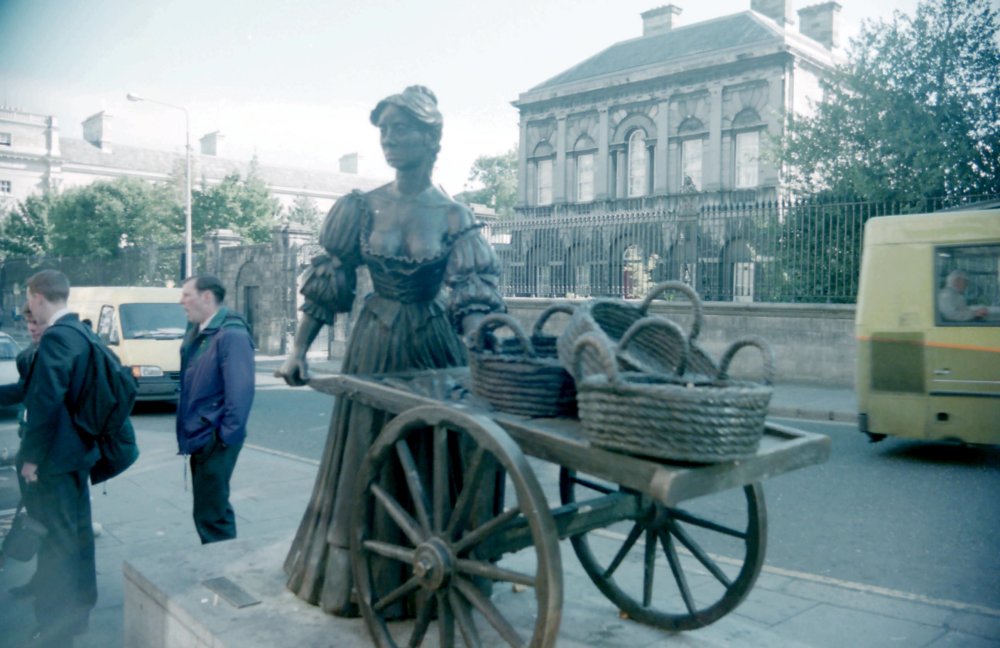
Molly Malone - "The Tart with the Cart", Dublin
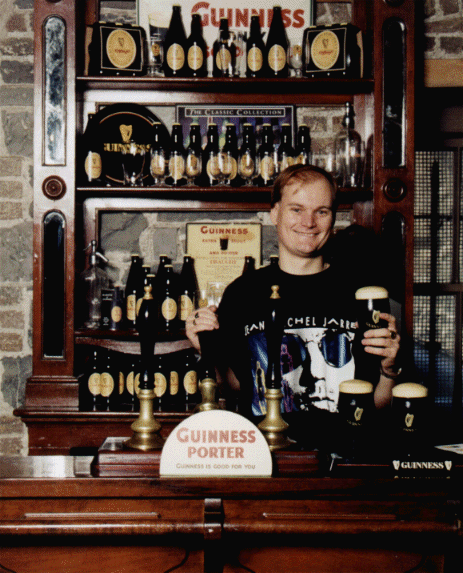
Andrew behind the Bar at
the Guinness Hop Store, Dublin

The Famous Guinness Doors, Dublin

Inside Dublin's Guinness Hop Store Experience
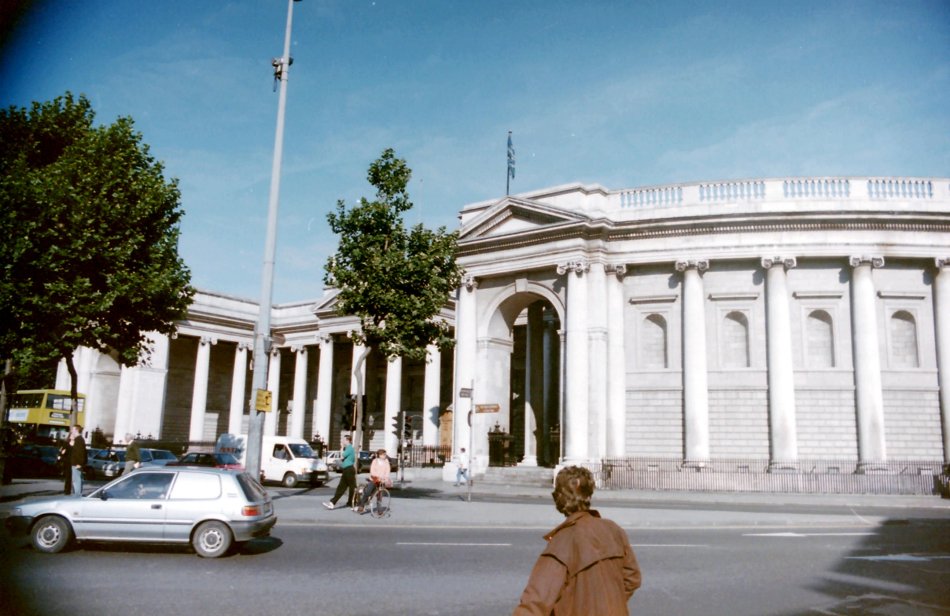
Bank of Ireland, College Green, Dublin
Onwards, I determined to find the Liffey. Quite easy, as it turned out. I was off across the famous Ha'Penny Bridge and heading for Grafton Street. After a detour which found me back at the River, I eventually found Dublin's best-known shopping street. At the end of the street stands Molly Malone, or as they call her here "The Tart With The Cart" - a buxom wench. I wandered up Grafton Street for a while and then decided it was time to start sight-seeing. First port of call was, of course, the Guinness Hop Store. Here I tasted my first of the black stuff - or properly the very very very dark red stuff, as this is what colour it actually is. Then, slightly shakily, it was back towards the centre of town and the Dublinia exhibition which led on to Christ Church Cathedral, Dublin's Protestant Cathedral and a quite graceful building with an arch across the road modelled on the Bridge of Sighs. Having been to one, it was off to the other Protestant Cathedral called - not surprisingly - St. Patrick's. (The Catholic Cathedral, oddly, was the one I didn't get to.)
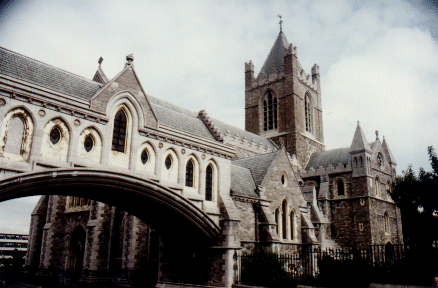
Christ Church Cathedral,
Dublin
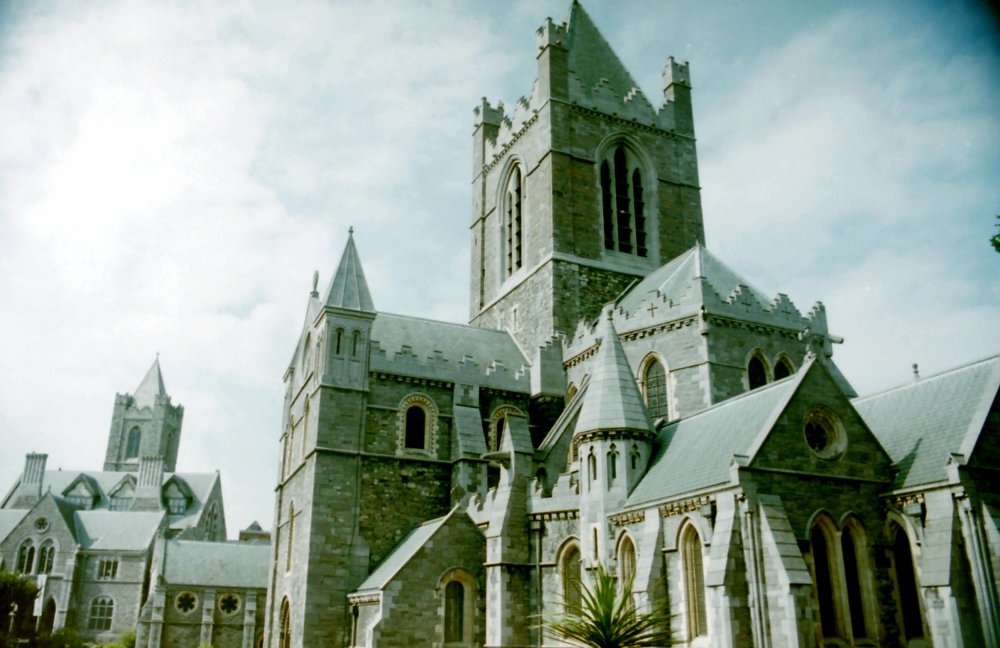
Another view of Christ Church Cathedral, Dublin
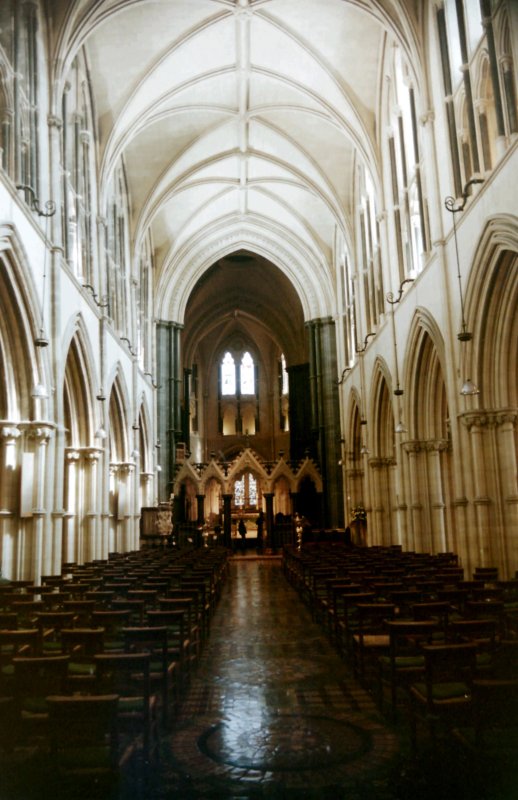
Interior of Christ Church Cathedral, Dublin

Approaching St. Patrick's Cathedral, Dublin

St. Patrick's Cathedral, Dublin

Interior of St. Patrick's Cathedral, Dublin
St. Patrick's was a nice Cathedral, but unremarkable really. Then on to Dublin Castle. My first Castle of the trip. It would, on first appearances, be a disappointment. Not very Castular, it looks like the Maritime Museum in Greenwich. However, having been around the State Apartments, the tour takes you down to the foundations of not only the Norman Castle, but the Viking fortification which predated it. All moist and dripping with the underground River Poddle (I kid you not) flowing around it's ancient stones.

Dublin Castle

Another view of Dublin Castle

The Bedford Tower, Dublin Castle

The Campanile, Trinity College Dublin
My day in Dublin - where the weather was very kind to me indeed - began to draw to a close. I wandered the Liffey for a while, and went to write some postcards in St. Stephen's Green. This place reminds me of Paris. Then I went back to my flea-pit B&B and settled in for my first night on Irish soil.
Morning broke in a moist sort of way. I had expected as much and had been surprised that the weather had been so good yesterday. First things first, I had to pick up what was to be my transport for the next week. It turned out to be a Ford Fiesta, Wine Red, with the registration 94 D 23096, the "D" I later realised meant it was registered in County Dublin. I would soon come to recognised the "OY" from Offaly, the "MN" from Monaghan and the "KY" from Kerry amongst others.
It seemed a little peculiar but I started my journey heading for Belfast, although I knew I was going to get nowhere near. I was heading for Newgrange, probably the greatest Burial Mound in the World. It is in County Meath, but to get there I had to go through Drogheda (Droichead Átha) in County Louth. It was in Drogheda that I got lost for the first time. Having found myself heading out of town in all the wrong directions, once going along the wrong side of the River Boyne I could see the road I wanted to be on but couldn't get to it. Eventually I found my way and got to Newgrange. A wonderful place, mystical and mysterious. This is the place where the sun shines into the tomb on one day a year - the Winter Solstice - and no other.

Newgrange, County Meath
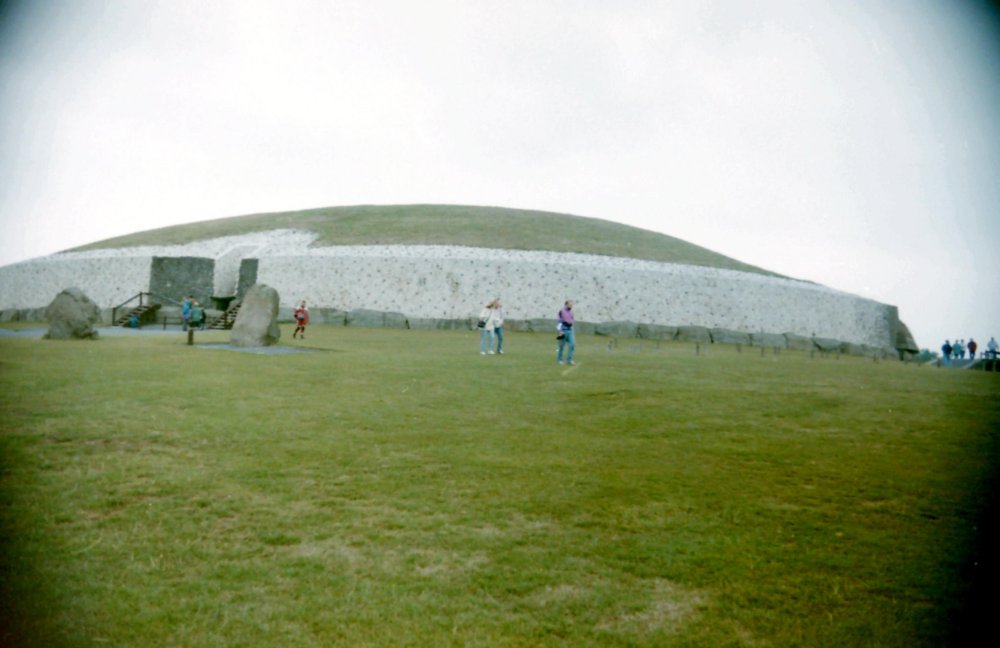
Newgrange Burial Mound, County Meath
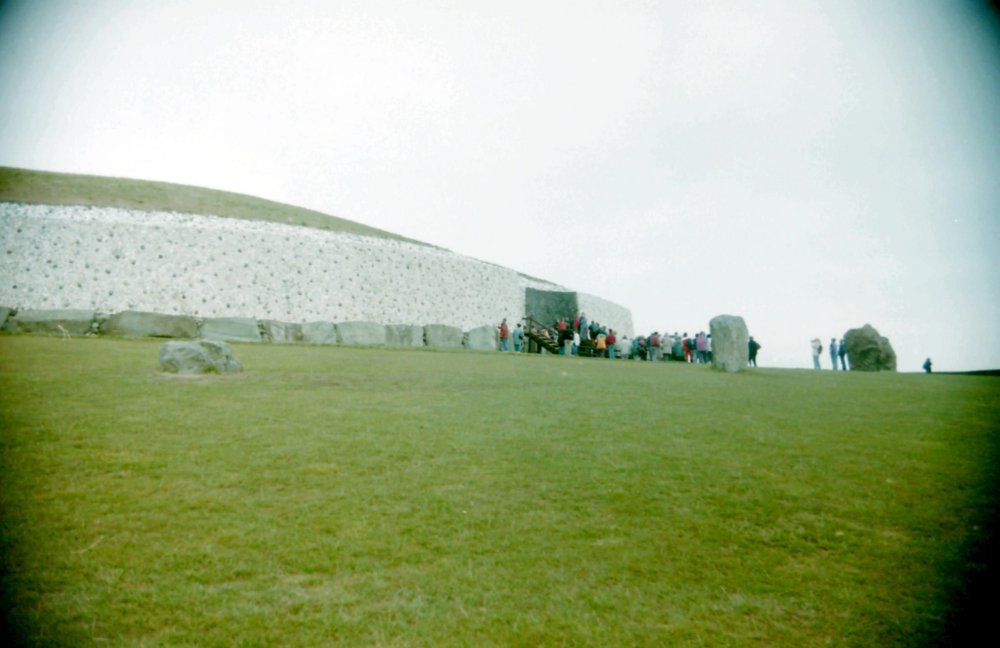
One of Ireland's Premier Prehistoric Monuments, Newgrange, County Meath
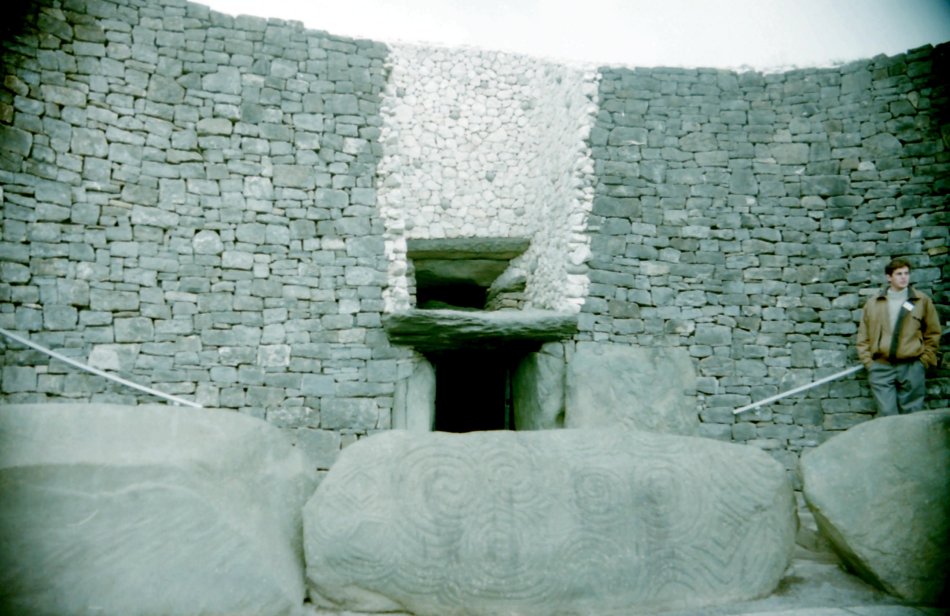
Entrance to Newgrange, County Meath
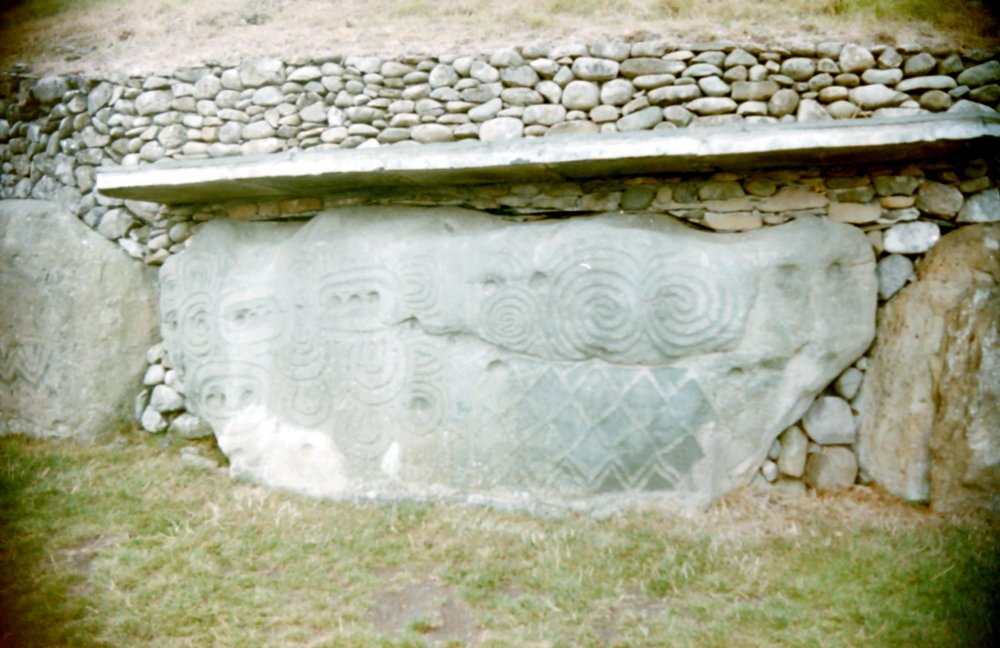
Celtic Carving, Newgrange, County Meath
Newgrange was considerably out of my way, so now I had to head back past Dublin into County Wicklow. Against my better judgment I decided to head across the hills towards the Wicklow coast. I began to discover at this point what true Irish roads are like, having thus far been on nice smooth major by-ways.
Irish roads are not straight. In fact, legend has it that they are based upon the famous inter-twined Celtic designs. Irish roads are definitely not smooth. Never again will I complain of English roads, I am glad it wasn't MY car's suspension! And, as I travelled across the Wicklow Mountains, these particular Irish roads were ..... well, nigh on invisible in the thick fog.
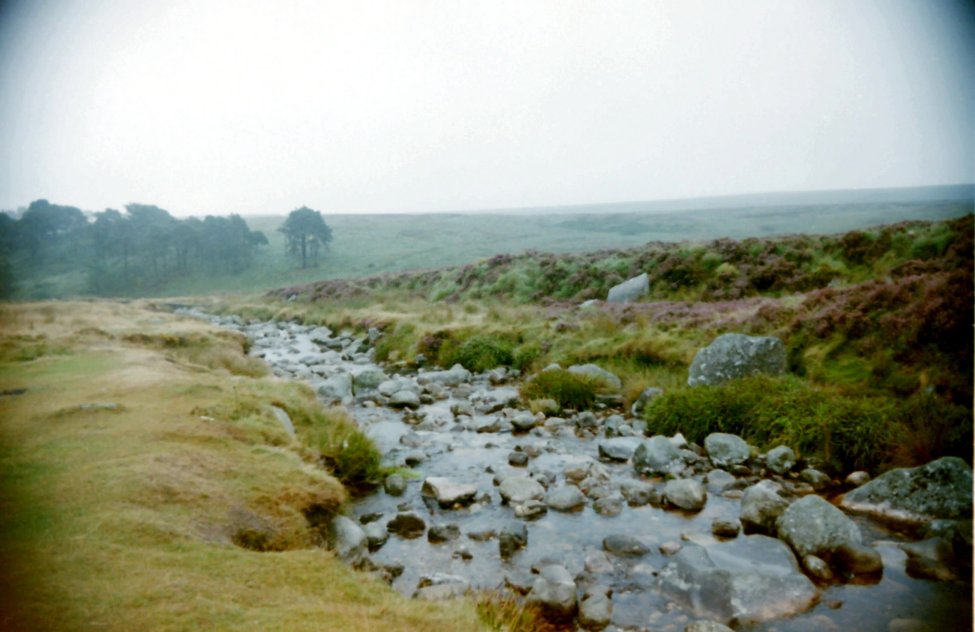
Middle of Nowhere, County Wicklow
The fog denied me my wide views of Wicklow, but it did plunge me into the deep end of Irish driving. At one point I stopped by a picturesque little trickle of a stream, only to discover that this was the wide and majestic River Liffey, which just a few miles away ran through the heart of Dublin.

Greystones, County Wicklow

The Grey Stones of Greystones, County Wicklow
I came down the other side of the Mountains to the little town of Greystones (Na Clocha Liatha), home of one Shenda Taylor, in many ways the progenitor of this trip. It is a pleasant enough little place, with a little row of shops and a nice wide but stony harbour. Not so Wicklow town (Cill Mhantain) which is where I stopped next. A most disappointing town with nowhere to eat and little to see. Nevertheless I walked down to the "seafront" - a row of houses and a road which happen to be at the water's edge and looked out across a bleak and unfriendly looking Irish Sea.

Wicklow Church, County Wicklow
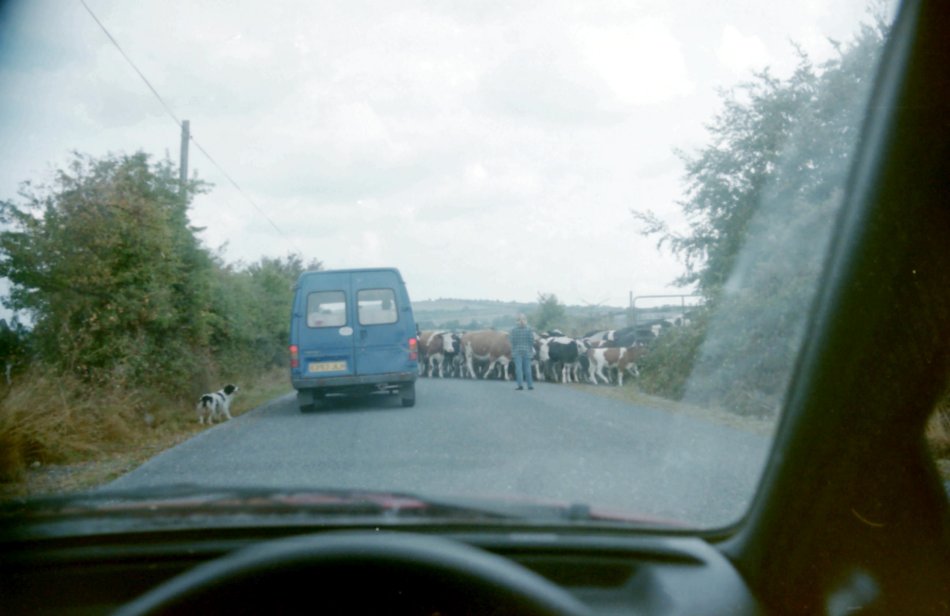
Traffic Jam in County Wicklow
Leaving Wicklow, still having not eaten, I headed towards my camp for the night in a place called Redcross. Having not eaten, my dinner on this my first night of camping turned out to be some bread and butter, crackerbreads, two raw carrots, a pint of milk and a nectarine. It was windy and cold, but as it was my first night I managed to put up with it magnanimously, although as I lay in the cold trying to get to sleep I did begin to wonder whether I would be blown away that night.
DAY THREE
Well, I'm still where I was last night. Having packed away the tent and eaten some more bread and butter, it was time to set off once more. My first stop was to be the beauty spot of Glendalough. But the Irish roads had other ideas and it took me somewhat longer to get there than I wished. The weather at this point was changing its mind every second, but when I finally arrived at Glendalough it was dry - grey, but dry. This place was my first inkling of the Ireland I had come to see. Monastic ruins and a superb round tower reached up into a misty sky with mountains and lakes behind it. As if to confirm its Irish-ness, I met up with my first coachload of Americans.
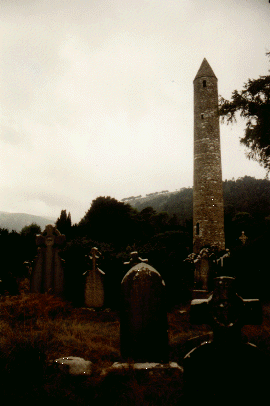
Glendalough, County
Wicklow

Celtic Cross, Glendalough, County Wicklow

St. Kevin's Church (or St. Kevin's Kitchen), Glendalough, County Wicklow

The Round Tower, Glendalough, County Wicklow

Glendalough in the Wicklow Mountains
Onwards once more and off to Kilkenny. The idea was to go via Carlow (Ceatharlach) - once more the Irish roads had other ideas and I went via Arklow (An tInbhear Mór), Shilleleagh, Carlow and Port Laoise. (Port Laoise (pronounced Leesh) is about as far from the sea as you can get in this country.) Eventually though I did arrive at Kilkenny (Cill Chainnigh).
Kilkenny is a beautiful medieval town after the fashion of, say Lincoln, and quite English-looking (dare I say it). However, there is nowhere to park! After a frustrating half an hour trying to find somewhere to park I ended up in the shadow of the Castle, which was what I had really come here for.
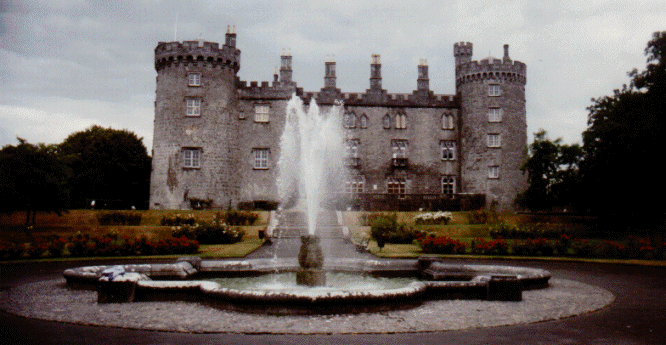
Kilkenny Castle

Kilkenny Castle in County Kilkenny
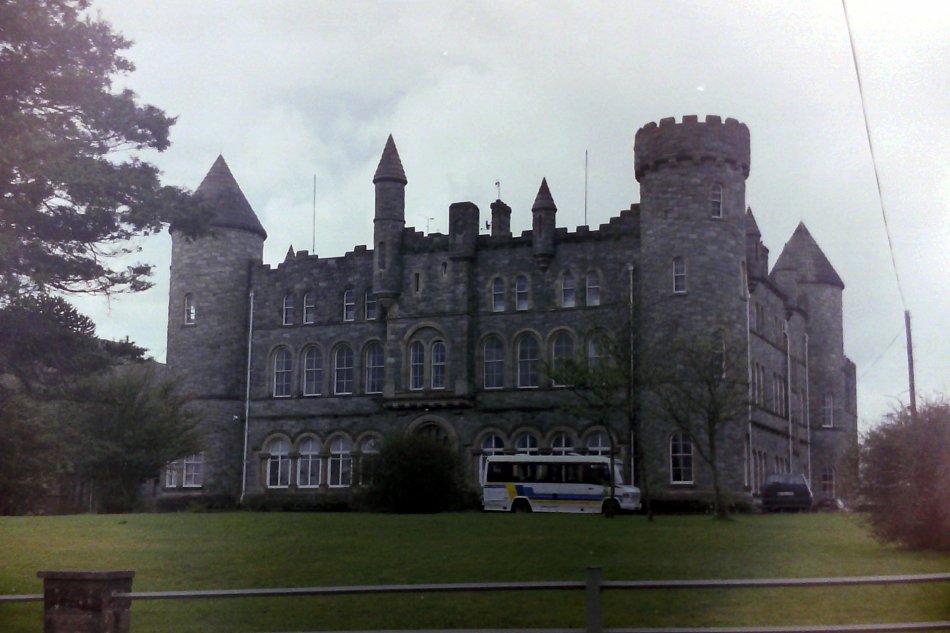
Another Side of Kilkenny
Castle
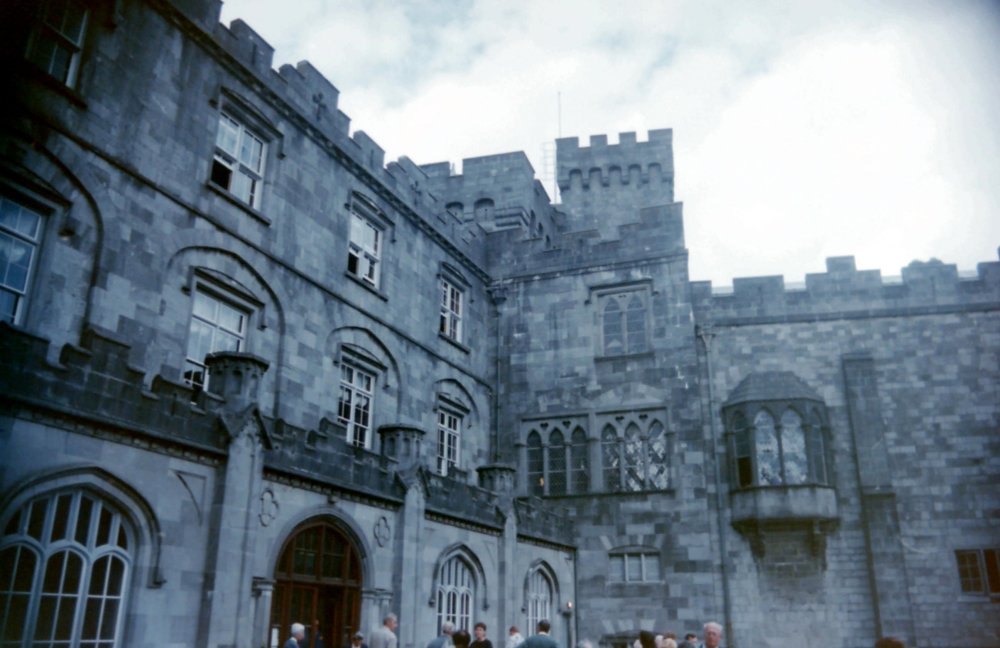
The Walls of Kilkenny Castle
Having been guided around the Castle - quite an interesting tour, including a cursed table which is unlucky to touch - which an inebriated George III slept on one night when he couldn't find his way to the bedroom. It was then farewell to Kilkenny, for now I had a long way to go.... to Tipperary (Tiobraid Árann).
I actually managed NOT to get lost between Kilkenny and Tipperary, although the road was scarcely what we would call direct. I went via Clonmel (Cluain Meala) and Cahir (An Chathair) (nice Castle). It is indeed a long way to Tipperary - and the town sign as you approach informs you that "You Have Come A Long Way"! I was going to eat in Tipperary, but after a big struggle all I managed to find was a kebab takeaway. They did chips, so I once more sat in my car and ate.
I then headed off through a not so fine rain and ended up staying at a camp site on an orchard between Tipperary and Cashel. Here I sat waiting for the rain to ease off, and watching a rainbow over the apple trees. It seemed vaguely idyllic, but somewhat moist.
DAY FOUR
Moist. That was the first thing I noticed. It had been an awful night. It was freezing cold, my teeth were chattering and I had had little sleep. Sometime in the night it had rained quite hard and the rain had (inevitably) found its way into my tent. I was wet and cold and not too pleased. Bugger this for a game of soldiers, thought I, and packed my tent away never to emerge again.

The Rock of Cashel,
County Tipperary

Atop the Rock of Cashel, County Tipperary
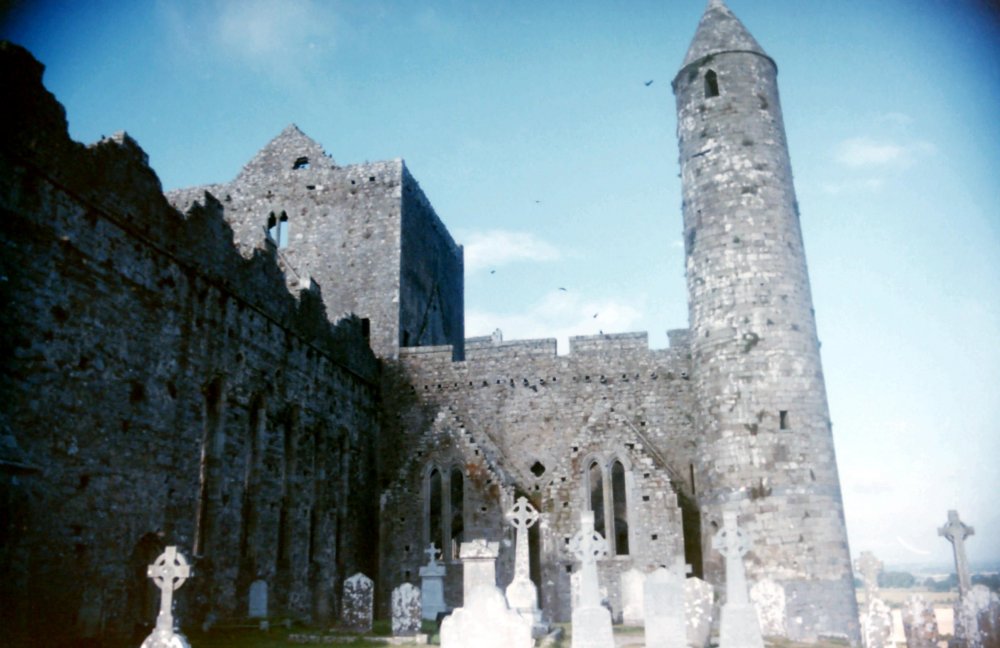
The Round Tower and Cathedral, Rock of Cashel, County Tipperary
Almost as if this decision was a turning point, the Rock of Cashel, my first stop, was an impressive and amazing sight. Rising on its own little rock above the otherwise quite flat Tipperary plains, this Irish Acropolis is topped off with a Cathedral, a round tower, a couple of churches and a Castle. Up here, high above the town and looking west, I finally felt like I was really in Ireland.

The Rock of Cashel in County Tipperary

The Amazing Rock of Cashel, County Tipperary
Back down to the car park and, avoiding a coachload of Italians this time, I set off once more to head for County Cork.
My first stop in Cork was at the Jameson Whiskey Heritage Centre in Midleton (Mainistir na Corann). This is a superb place, well presented, a big LONG tour and a free whiskey tasting. I volunteered to be put through the whisk(e)y test. This involved tasting four Irish whiskeys (Jamesons, Powers, Paddy and Bushmills), one Scotch (which turned out to be Johnnie Walker) and a Bourbon. In my mind there was no doubt as to which one was the winner. It was Paddy for me. I was then treated to a free measure.....this measure was huge to say the least - about four or five times an English measure! I staggered happily away towards the nearest restaurant to have something absorbent to eat and a strong black coffee - not my usual tipple by any means.

On The Tour, Jameson Whiskey Heritage Centre, County Cork

The Jameson Whiskey Heritage Centre, County Cork
Feeling capable of driving once more I headed off for the island port of Cobh (pronounced Cove). This place is beautiful. Houses stacked up the cliff-side are crowned by the glorious Cathedral (albeit somewhat scaffolding clad) in which I lit a candle for a friend of mine who had requested me so to do. Down in the town is "The Queenstown Story" which mainly concerns itself with Cobh's role as the departure point for many thousands of Irish bound for America, fleeing from the Great Famine and other deprivations.

Cobh with it's Cathedral on the Hill, County Cork
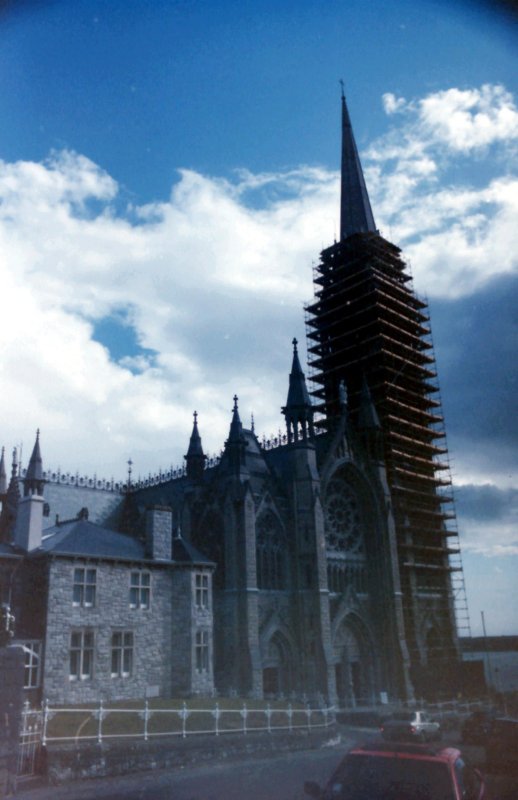
Cobh Cathedral, County Cork
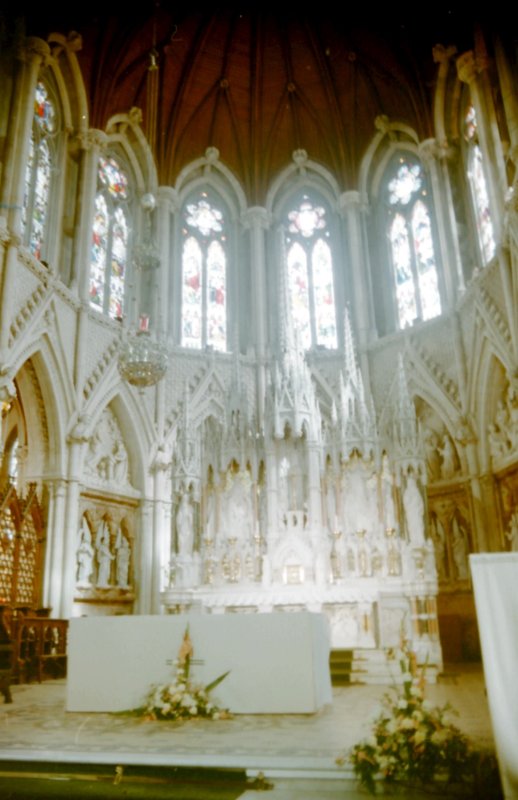
Interior of Cobh Cathedral, County Cork

View of Cobh from outside the Cathedral, County Cork
I liked Cobh.
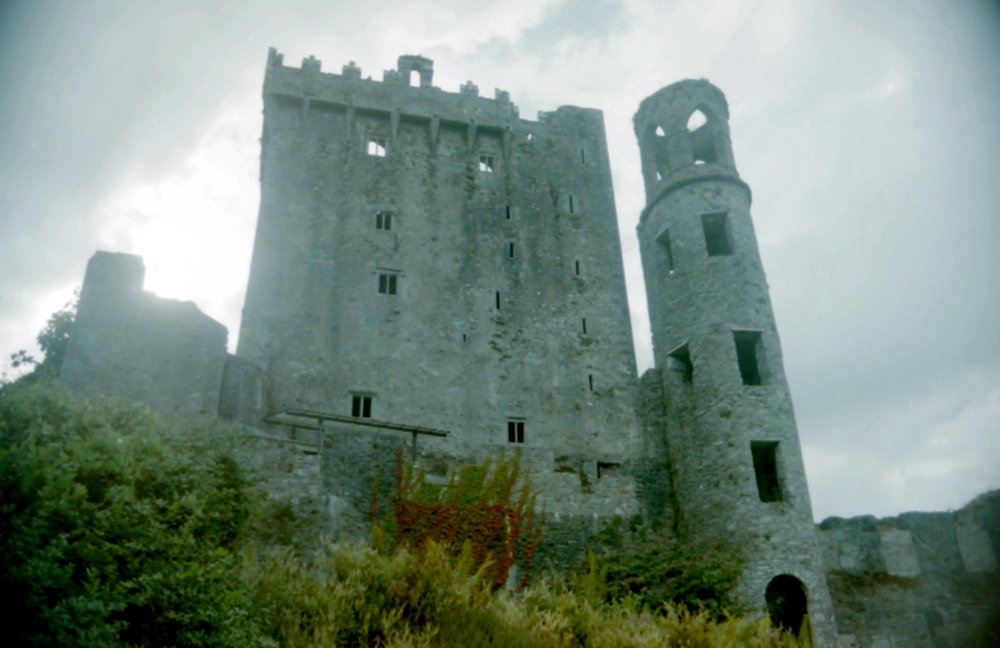
I decided that Cork City was for another trip and so my next appointment was at Blarney Castle. I thought I wouldn't get there on time, but in the summer Blarney is open until sunset. Something I think perhaps our National Monuments could learn from. And so, at about six o'clock in the evening I sat above a one-hundred plus foot drop and leant backwards as far as I could being gripped firmly by an Irishman in order to kiss a piece of saliva-worn shiny stone set in the battlements of Ireland's most famous Castle.
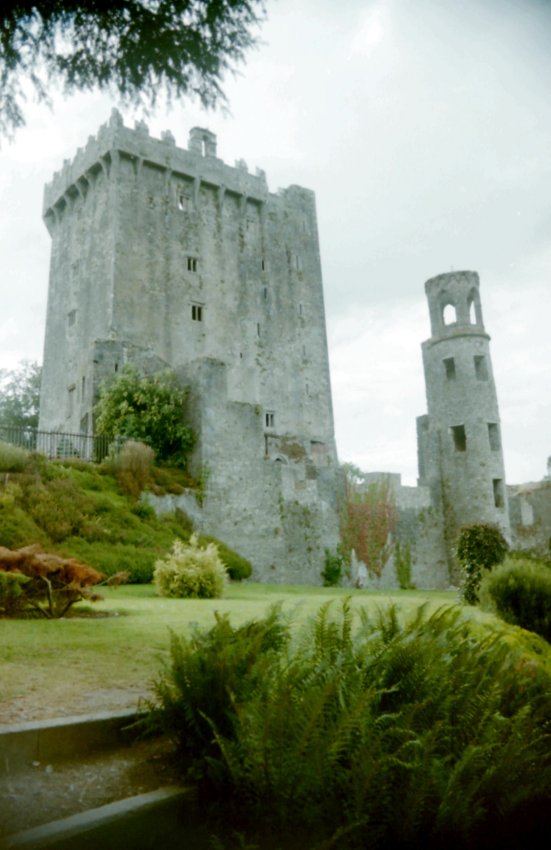
Blarney Castle, County
Cork

The Keep, Blarney
Castle, County Cork

Looking up to the
Blarney Stone, Blarney Castle
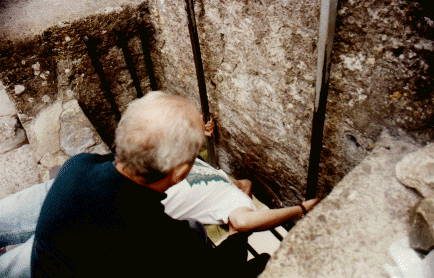
Kissing the Blarney
Stone, County Cork

At the top of the Keep,
Blarney Castle, County Cork
On returning to an upright position - having looked down - my only comment brought out the Irish in me "Jaysus", said I.
Back Down on Terra
Firma, Blarney Castle,County Cork
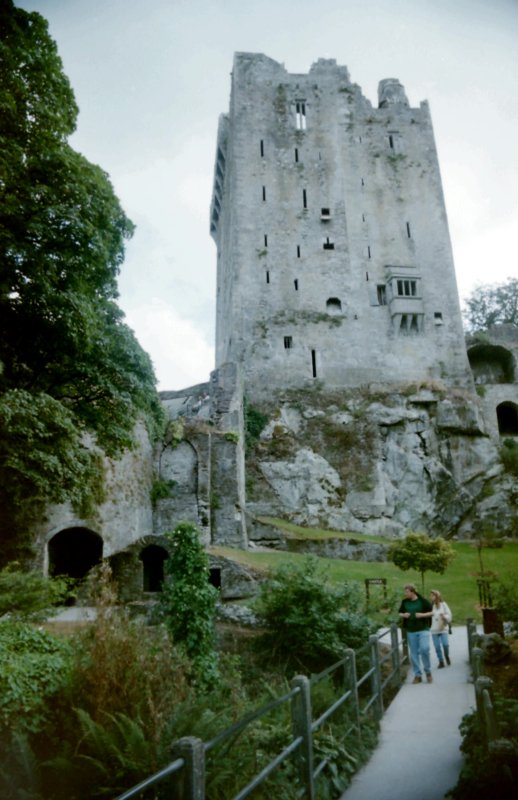
Another view of Blarney
Castle, County Cork
I liked Blarney.
As this day was beginning to close I thought perhaps I should head towards Killarney (Cill Airne) to stay. I actually didn't quite leave County Cork. I stayed near Macroom (Maigh Chromtha) in a little house standing on top of a hill with a fantastic view of the Mountains ahead of me and from my room I watched the sunset over them.
DAY FIVE
This morning I was glad I had chosen to forsake my tent for the comfort of B&B's. I opened the curtains to a glorious day. It was, perhaps, a good thing that I was in a good mood. My first act this Sunday morning was - yes, you've guessed it - I got lost. I drove around some of the most astonishing roads I've ever seen. One of them - straight as a die - had such a wide piece of grass growing down its centre that I actually stopped and photographed it!

Rush Hour in Killarney, County Kerry

Main Street in Killarney Town, County Kerry
Eventually, I did find Killarney. The town itself is nothing special. But head for the Lough area and you are in the Ireland of your dreams. Ross Castle overlooks Lough Leane and a more romantic setting is hard to imagine.
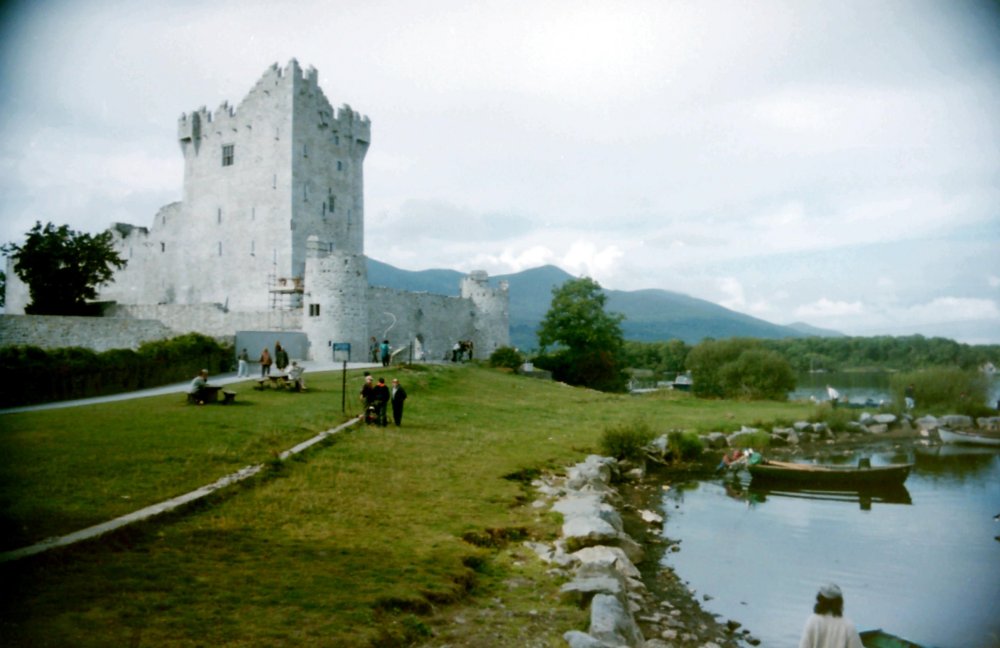
Ross Castle on Lough Leane, County Kerry
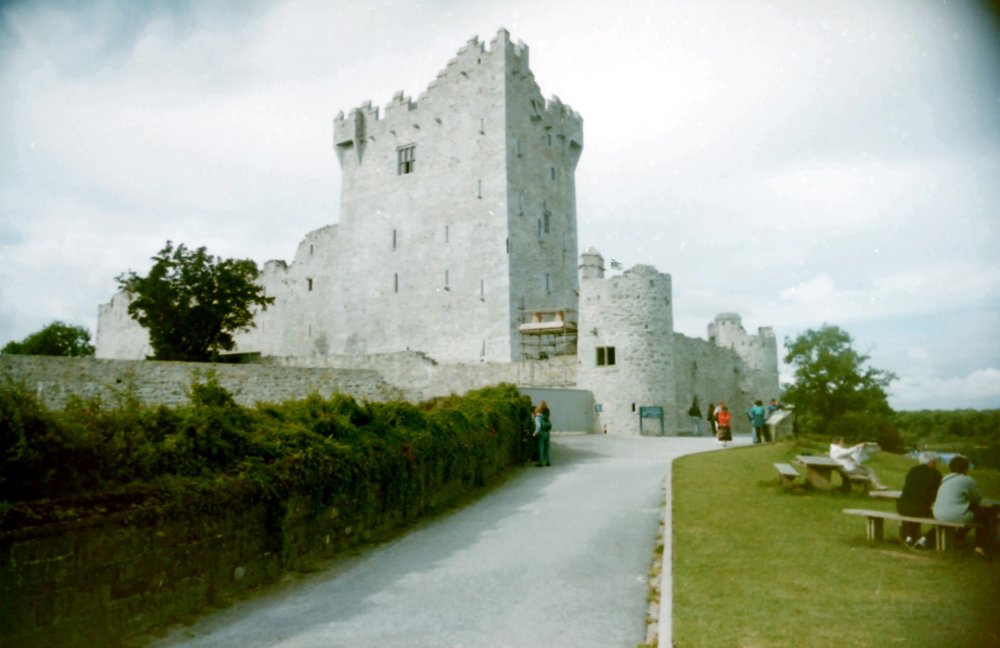
Another view of Ross Castle, County Kerry

Closer view of Ross Castle, County Kerry

Muckross, County Kerry

Lough Leane, Muckross, County Kerry

Muckross Estate on Lough Leane, County Kerry
From Ross I went to Muckross, the National Park Visitor Centre and the House. Here the rain came again, reminding me that I am in Ireland and that the weather is by no means predictable. I found it wonderfully amusing watching crowds of Americans running for cover, and felt good just strolling around in the rain, knowing that I was English and thus immune.

Queen's View, Killarney,
County Kerry
Happily, this rain was but a passing shower and by the time I got up to MacGillycuddy's Reeks - Ireland's highest mountains - the sun was glaring and it was T-shirt time. I stopped many times driving around the Ring Of Kerry to take in the views, especially at "Ladies' View", so-called because it was the favourite view of Queen Victoria's ladies in waiting. I can see why because it is breath-taking.
A Journey Around the Ring of Kerry
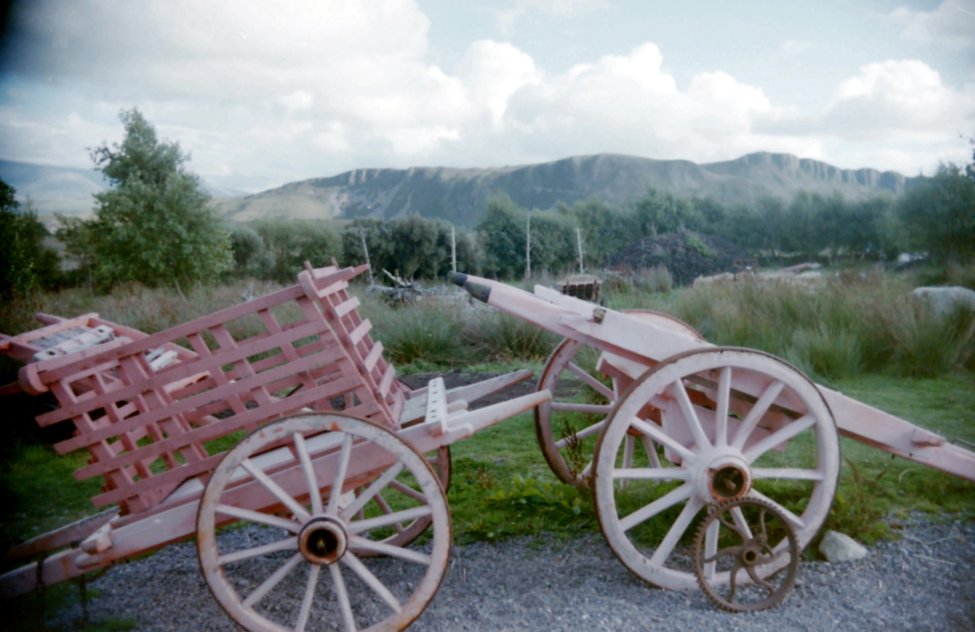
The Kerry Bog Village Museum, County Kerry

The Kerry Bog Village, County Kerry

Ballycarbery Castle, Ring of Kerry, County Kerry
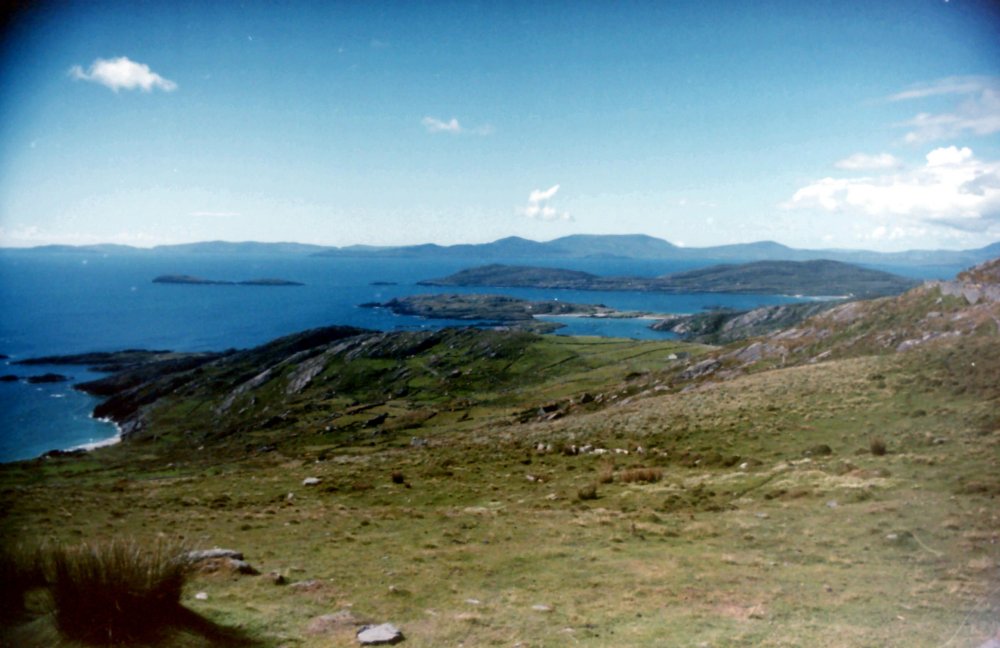
Glorious Coastal Views, Ring of Kerry, County Kerry

Staigue Stone Fort, County Kerry
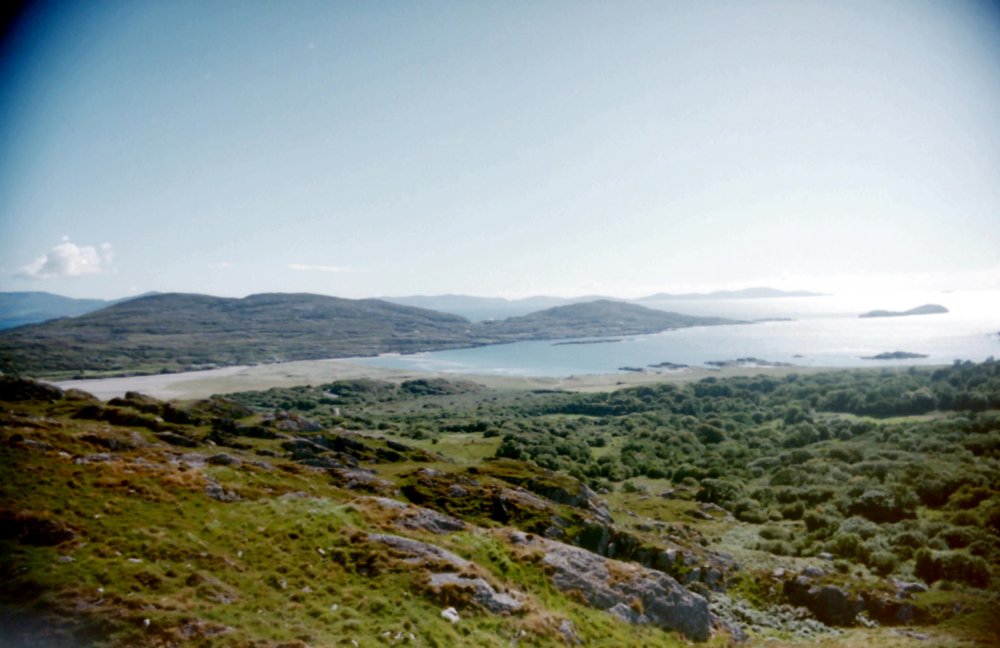
The Amazing Coast of County Kerry

Progressing Around the Ring of Kerry, County Kerry

Distant Mountains, Ring of Kerry, County Kerry

The Ring of Kerry, County Kerry
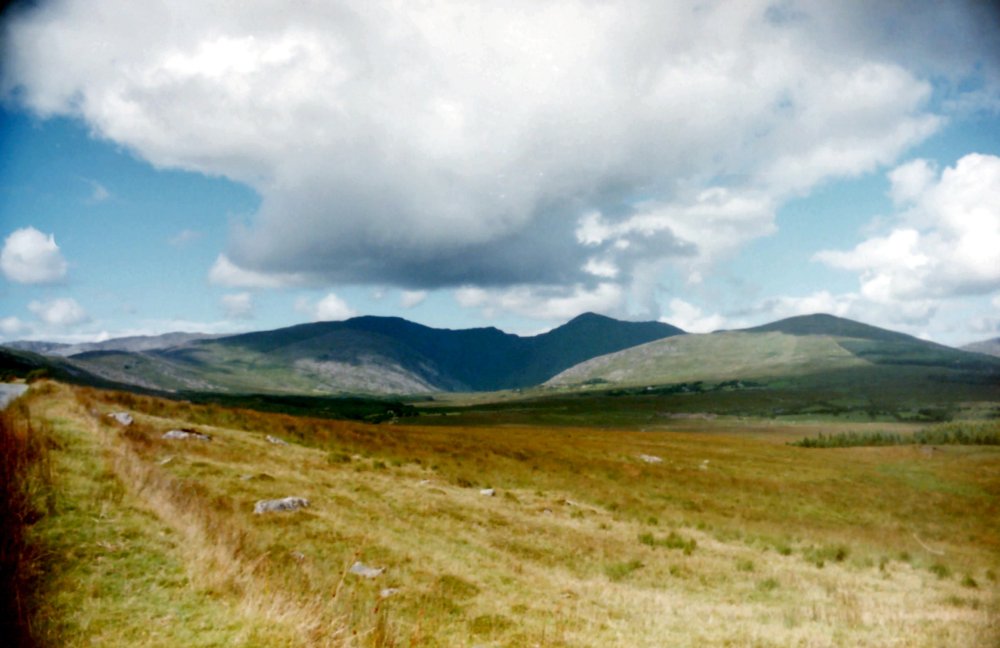
Another Ring of Kerry view, County Kerry
At the very western tip of the Ring Of Kerry sits Valencia Island and on it the Skelligs Experience. The Skelligs are islands, once inhabited by monks, but now inhabited only by seabirds. There should have been a boat trip too, but they had cancelled it because of lack of people - at £15 a time I am not shocked. A bit annoyed I headed back for the mainland and got caught up in an Irish day out. Some teams of boatmen were racing up the sound between Valencia Island and the mainland. This was all very picturesque and exciting, but I wanted to get through the crowds and parked cars. The problems were compounded when a huge camper van decided to attempt to get through a gap which it quite clearly would not fit through. Much cursing and scratching of heads went on and in the end it was me who had to back up until I found an awkward but just about large enough gap to squeeze into. I then had to sit there and fume whilst rows and rows of cars passed in either direction.

Dramatic Views, Ring of Kerry, County Kerry
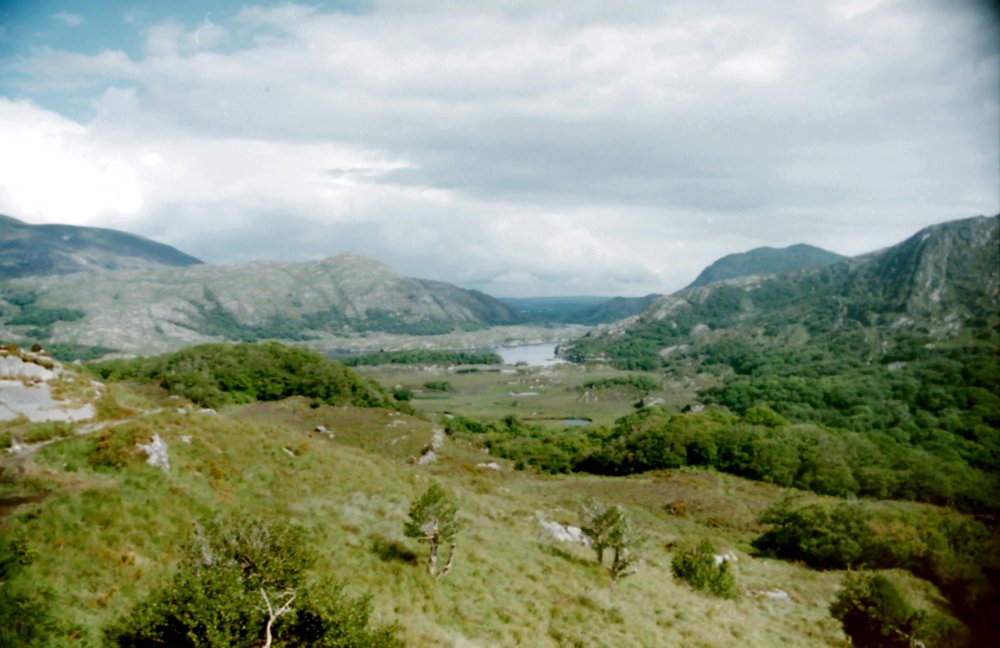
The Queen's View, County Kerry
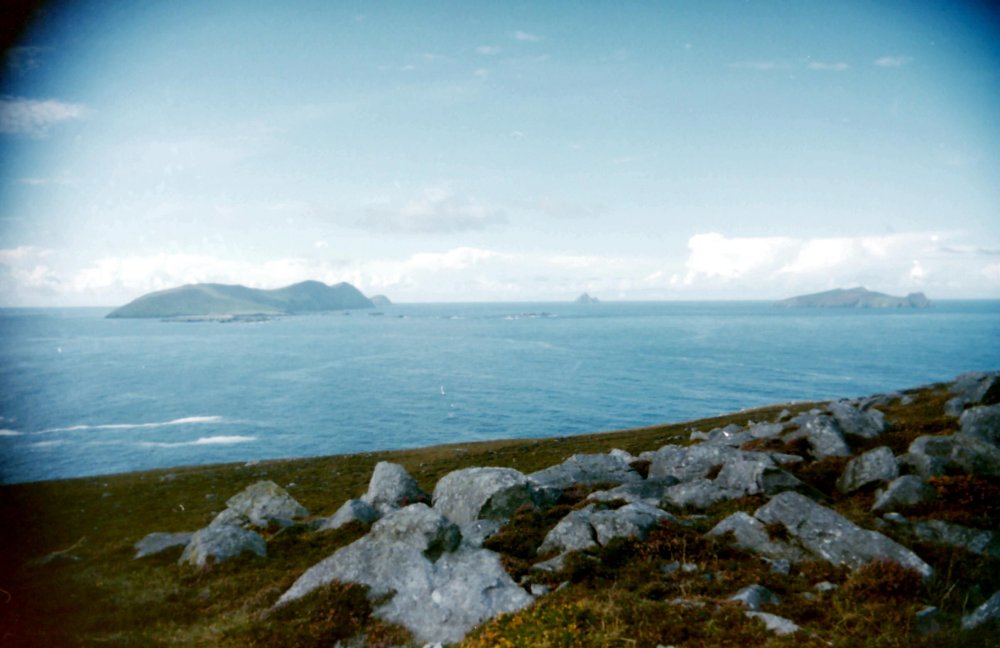
As Close As I Got to the Skellig Islands, County Kerry
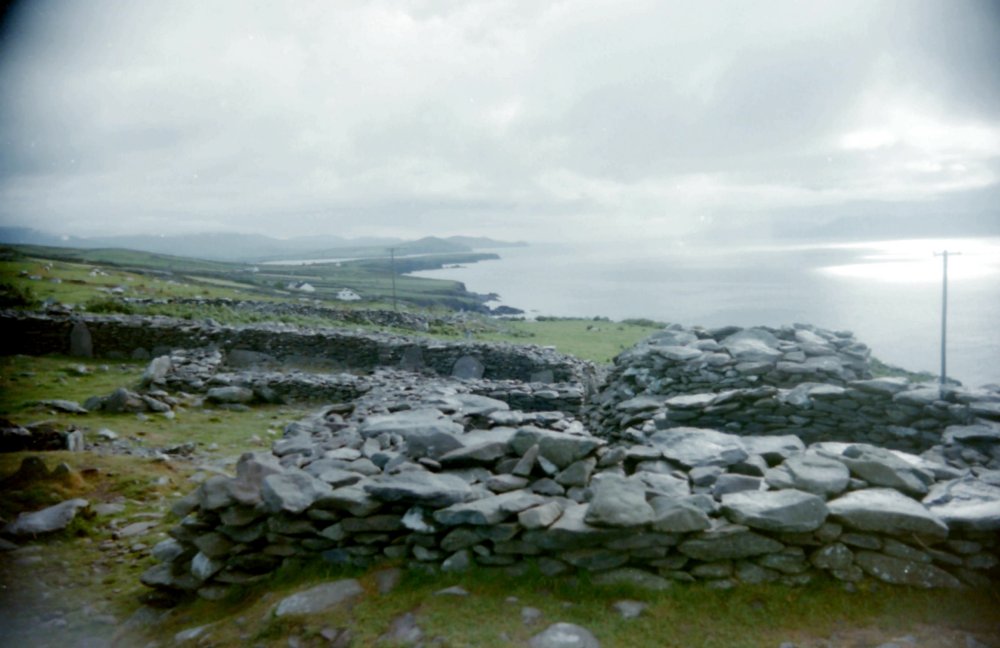
The End of the British Isles - The Ring of Kerry
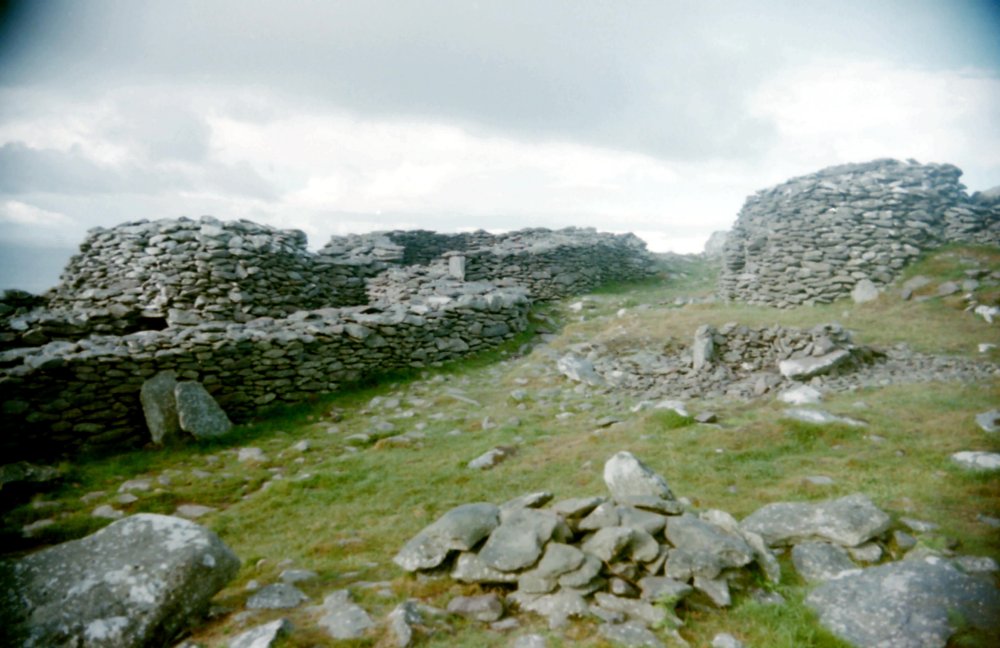
Beehive Huts on the Dingle Peninsula, County Kerry
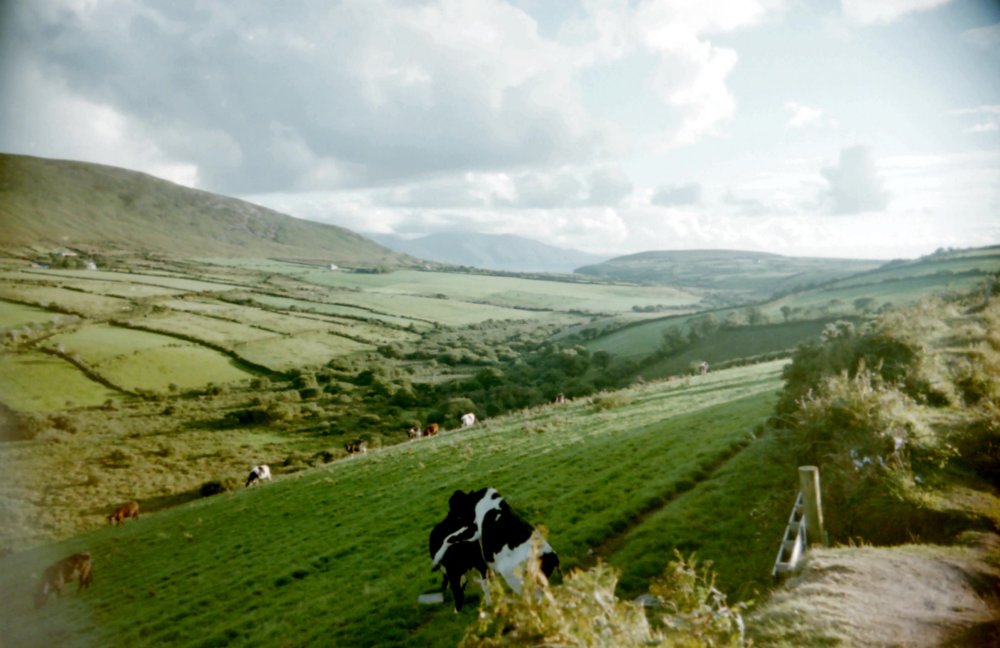
A Farewell To The Ring of Kerry, County Kerry
All in all the lack of boat trip and the lunacy of the traffic had done little to calm my nerves. I was pleased to reach the Dingle Peninsula, the western-most point of the mainland British Isles. Here I stayed in Dingle town (An Daingean), a lovely little place, nestling against brooding mountains, and slept in a small house twixt pub and church.

Dingle Town, County Kerry
DAY SIX
I woke up calmer than the day before and set off around the Dingle Peninsula. This is another wonderful place. At the most westerly point are the Blasket Islands, deserted now like the Skelligs, but more visible and with a decent visitor centre. Scattered ancient remains dot the mountainous and dramatic land, most famous of which is the Gallarus Oratory - a place too popular in my mind with one particular coachload of French people. It was then back to Dingle for my real reason for coming here.

Gallarus Oratory, County
Kerry
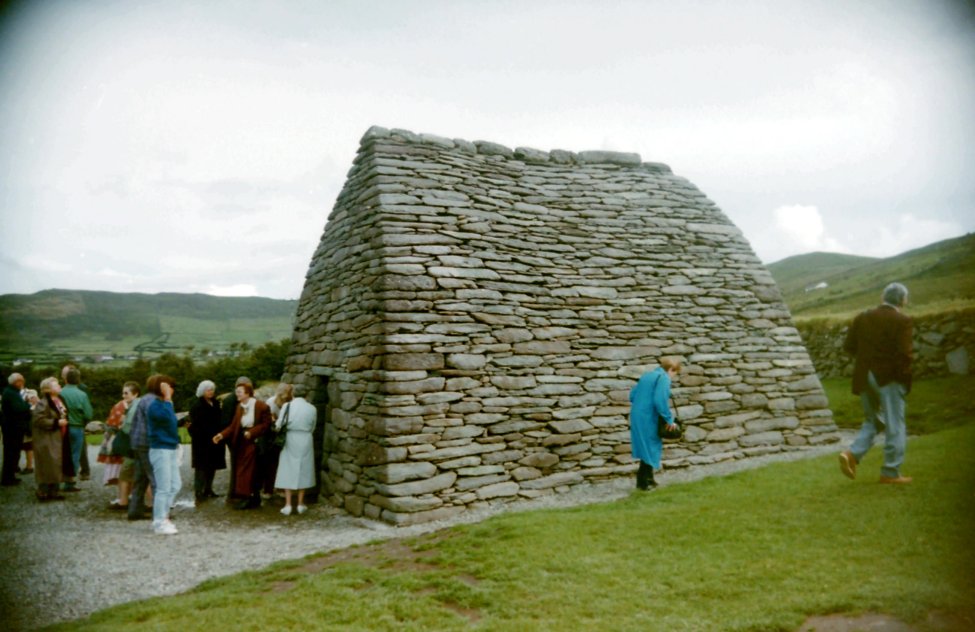
Crowds Arriving at the Gallarus Oratory, County Kerry

Dingle Harbour, County Kerry

Finding Fungi, Dingle, County Kerry
For the last 12 years Dingle Bay has been blessed with the presence of Fungi. An effusively friendly dolphin who will happily entertain boats full of tourists.

In the Waters off Dingle, County Kerry
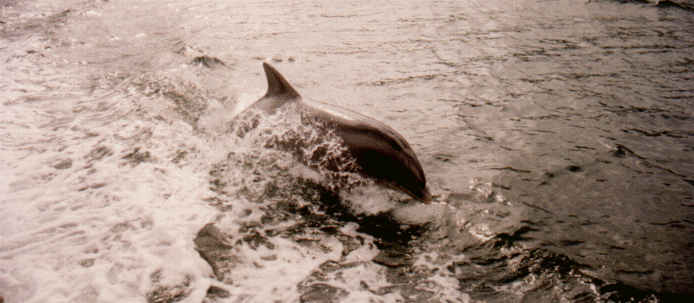
Fungi the Dolphin,
Dingle Bay
I am delighted to say that Fungi performed well for me and our boat got a good view. It was very exciting being out on this small boat (although we were not alone) and rushing from side to side as Fungi showed himself. As we headed back for Dingle town after an hour on the water, the clouds rolled in from the Mountains and cast the place in a misty and mysterious vein. It is one of the views which will stay with me. Also in Dingle I was happy to buy myself a bodhrán, one of those flat Irish drums, something I had wanted to buy. All in all I left Dingle with its straight roads and cheerful people as a very happy bunny.

Dingle under approaching
storm clouds, County Kerry
As I approached Tralee (Trá Li) the heavens really did open. There is a theory that the Irish weather system works like this. Firstly, the sun evaporates water over the Atlantic. Then wind blows the clouds over to the Hills of Kerry. Then the Atlantic falls out of the sky. At this point I could present no argument to this theory.
I pressed on, I can visit Tralee sometime when it is a bit dryer! I pressed on into County Limerick and Limerick City (Luimneach) itself. I found Limerick City a bit disappointing. True, I was not there long and didn't explore fully, true the weather was not too grand, but apart from a quite nice Castle and the wide River Shannon it could be Anytown.

Limerick City from the Shannon, County Limerick
At Limerick Tourist Centre I got a leaflet which informed me that Bunratty Folk Park was open until 7. Surprised, but pleased, I headed off to Bunratty to be told by the people there that they had closed at 5.30.
I evidently must have looked crestfallen because the lady behind the desk took pity and let me through to have a quick look around the Park whilst it was shutting down and charged me nothing! Although I would have liked to have seen the place open properly, this at least convinced me that the Irish really were kind to strangers, even English ones.

Bunratty Castle, County
Clare
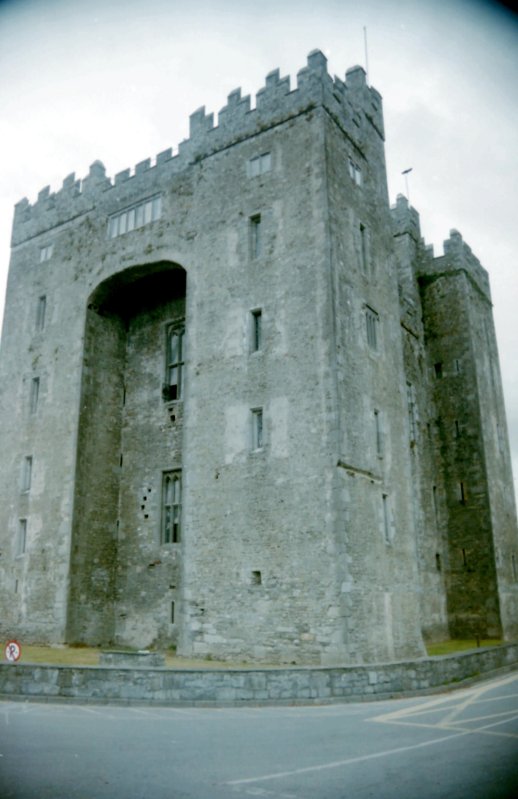
The Keep at Bunratty
Castle, County Clare
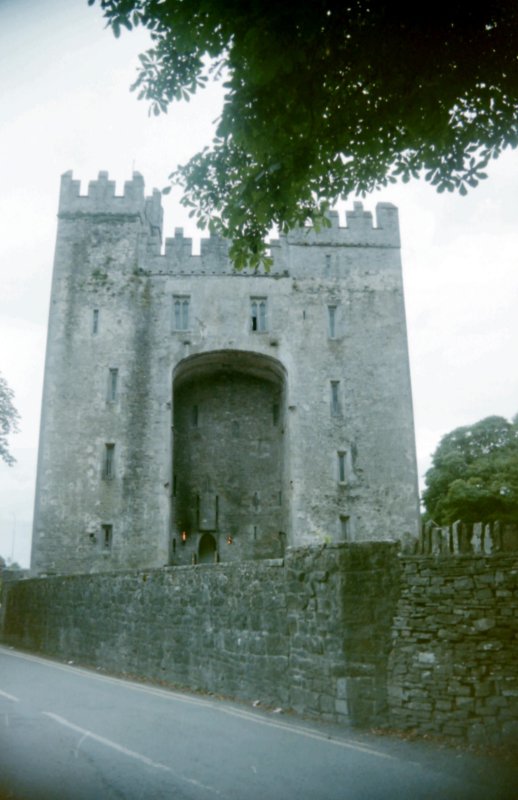
Another view of Bunratty
Castle, County Clare
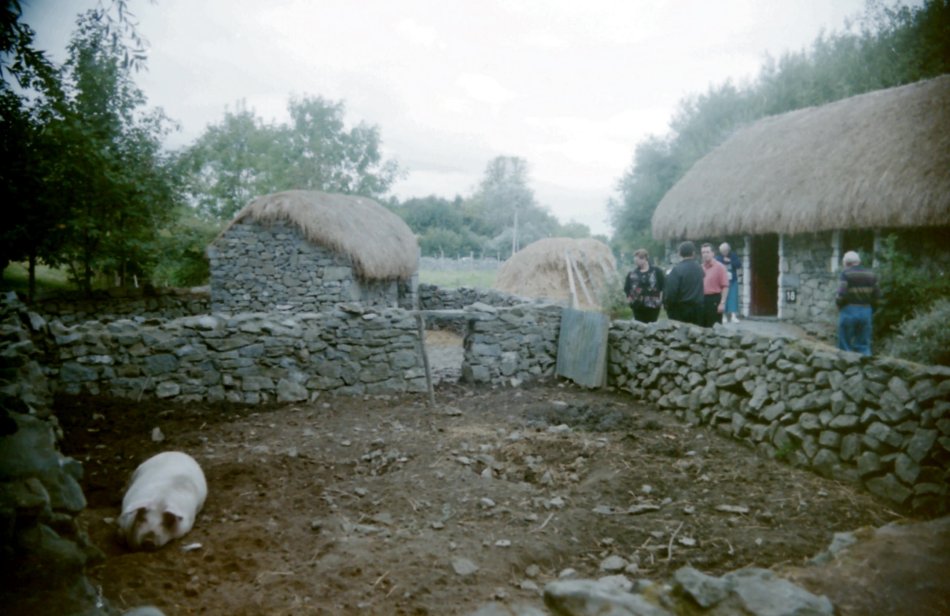
Bunratty Folk Museum,
County Clare

Traditional Cottages,
Bunratty Folk Museum, County Clare
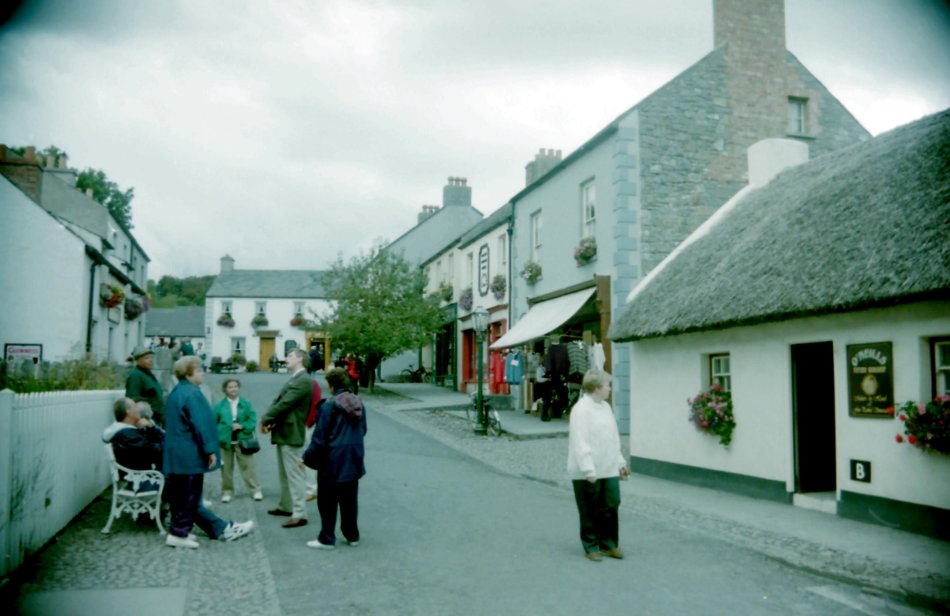
Bunratty Village, County
Clare
That night I stayed in Ennis (Inis), capital of County Clare. Ennis has a brooding ruined Friary and a nice but not mind-blowing Cathedral. I stayed in what can only be described as a total dump, complete with peeling wall paper and shadeless lights. But it cost just £10. That night I went into the pub across the road and got my taste of Irish pub life, with a not-quite-traditional group who were actually rather good. Ennis, despite my lodgings, was a place I quite took to.

Damp Day in Ennis, County Clare
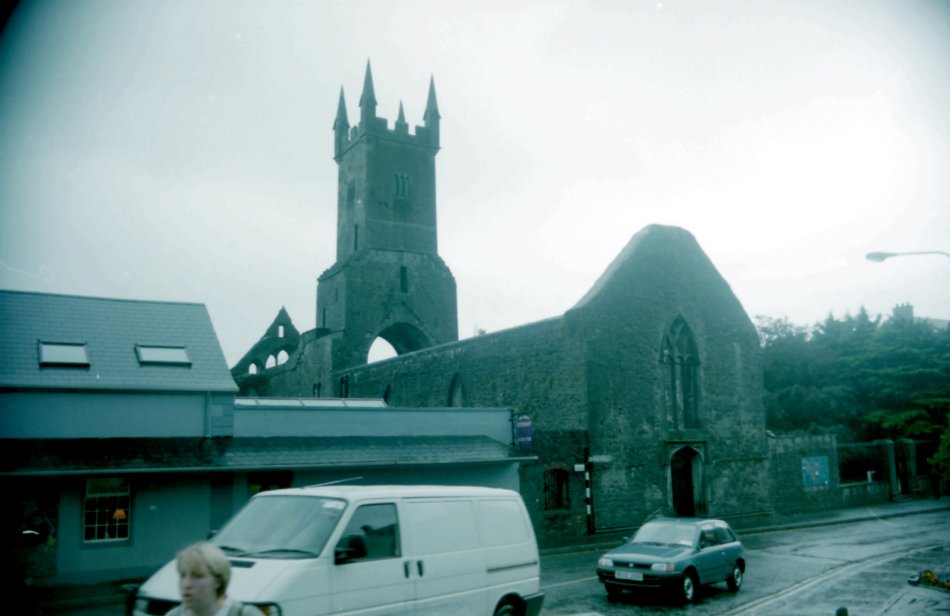
Ennis Friary Ruins, County Clare
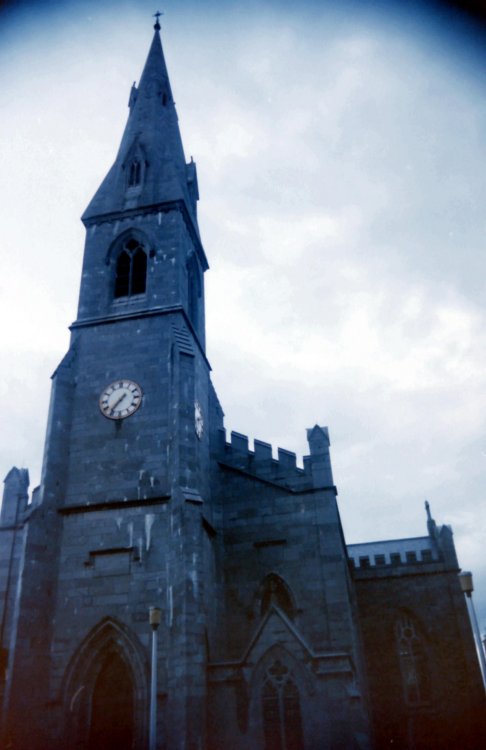
St. Peter and St. Paul's Cathedral, Ennis, County Clare
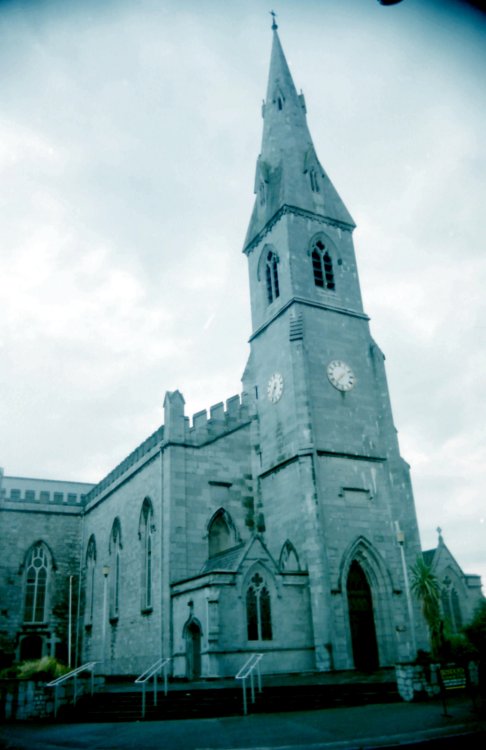
Another View of Ennis Cathedral, County Clare
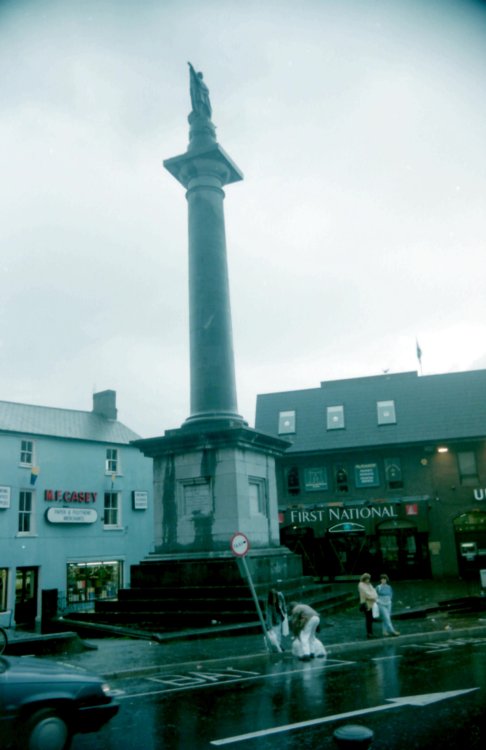
Daniel O'Connell Monument, Ennis, County Clare
DAY SEVEN

The Cliffs of Moher,
County Clare
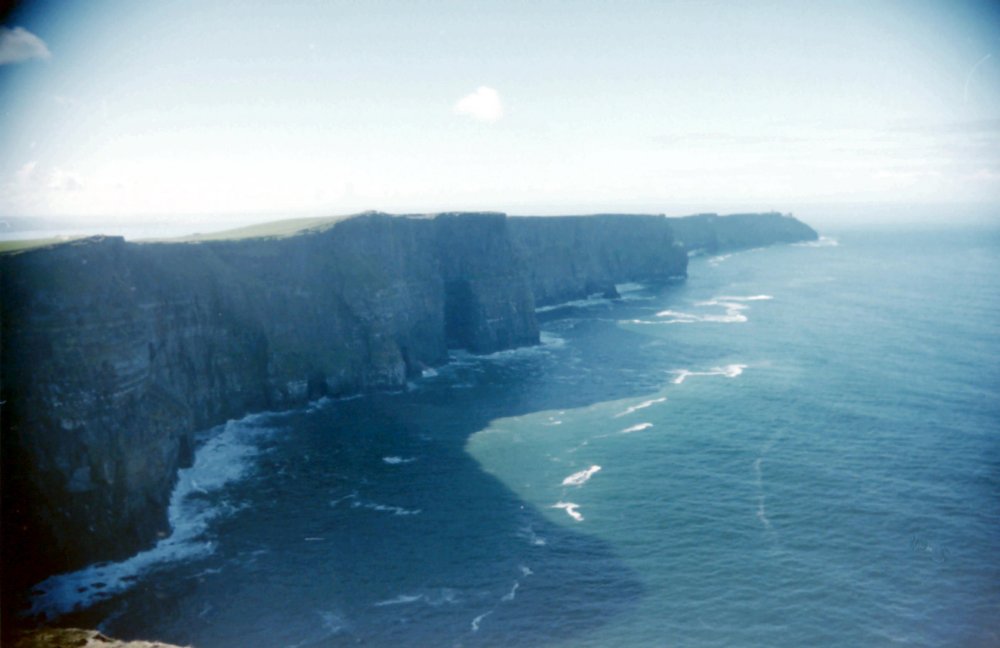
Another View of the Cliffs of Moher, County Clare
Today I awoke knowing it was my last full day in Ireland. As if to make this poignant the first thing I did was get lost. I took the road heading west from Ennis when I thought I was heading north. So I got to see a lot more of County Clare than I had bargained for. But I was pleased, it was a nice place and I got to travel along the coast road towards the magnificent Cliffs of Moher. These startlingly high and angular cliffs stand 250 feet above the crashing waves of the Atlantic. The highest point is marked by a tower which you can climb for views across Galway Bay to the Aran Islands and Connemara beyond it.

The Little Tower on the Cliffs of Moher, County Clare

The Dramatic Cliffs of Moher, County Clare

A Last View of the Cliffs of Moher, County Clare
From the Cliffs of Moher it is not far to Lisdoonvarna, a pretty town which is Ireland's only Spa town - and oddly enough is quite reminscent of Tunbridge Wells or Bath!

Andrew on the Burren,
County Clare
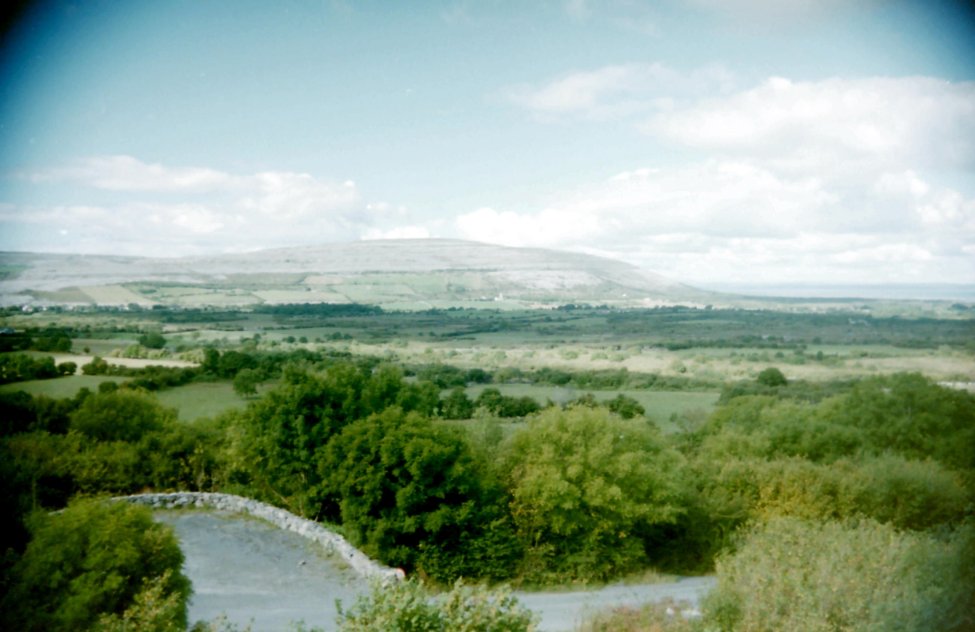
The Burren Rising in the Distance, County Clare
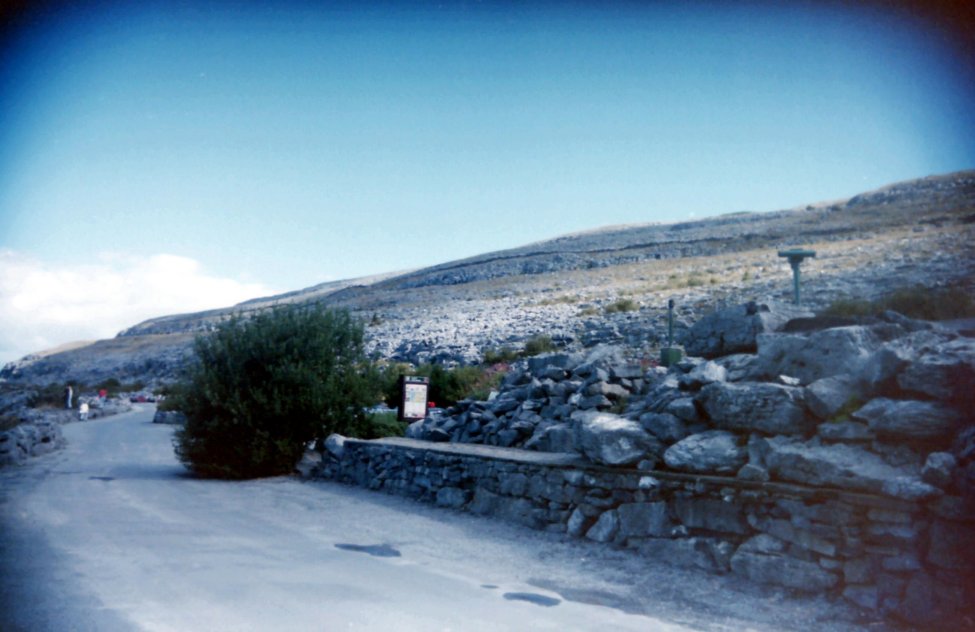
The Weird Landscape of the Burren, County Clare
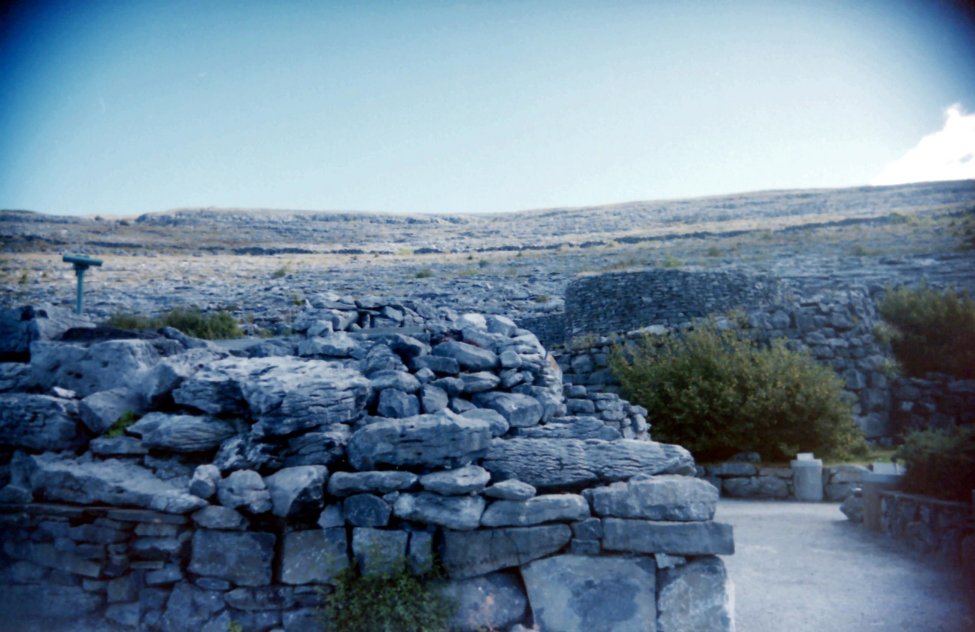
Weird Rocks of the Burren, County Clare

Strange Limestone Pavements, The Burren, County Clare
I had seen pictures of The Burren. But they had not prepared me. Nothing could prepare you for this indescribably strange place. Rising from the green fields are huge grey "blobs" of mountains. They aren't sharp, but rather from a distance have the appearance of hardened lumpy porridge. When you get closer you find out that this is made up of huge great chunks of limestone, long square runnels of the stuff. There is no water on The Burren. No Rivers, no Loughs, no puddles even. When it rains all the water drains straight through the limestone within about half an hour. The upshot of which is a lunar-like nearly plantless landscape riddled with hugh cave systems, one of which, Aillwee, I went down.

Aillwee Cave, Burren, County Clare
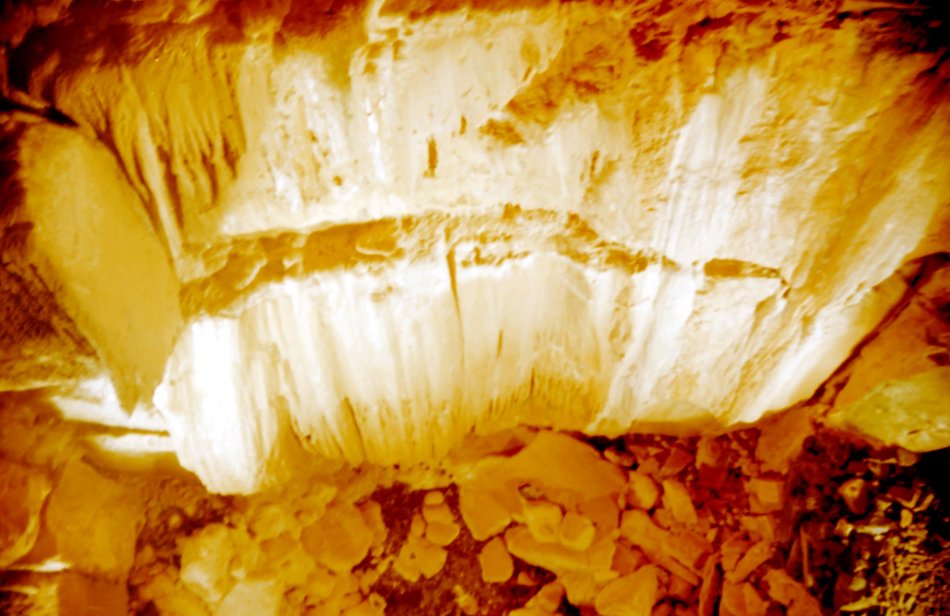
Still inside Aillwee Caves in The Burren, County Clare
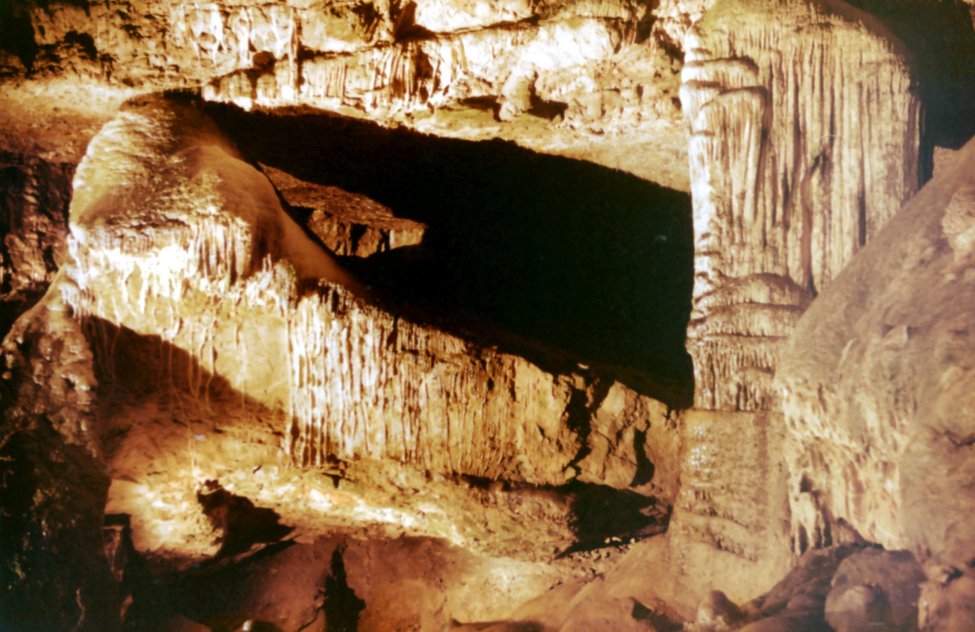
Another view inside Aillwee Caves, County Clare
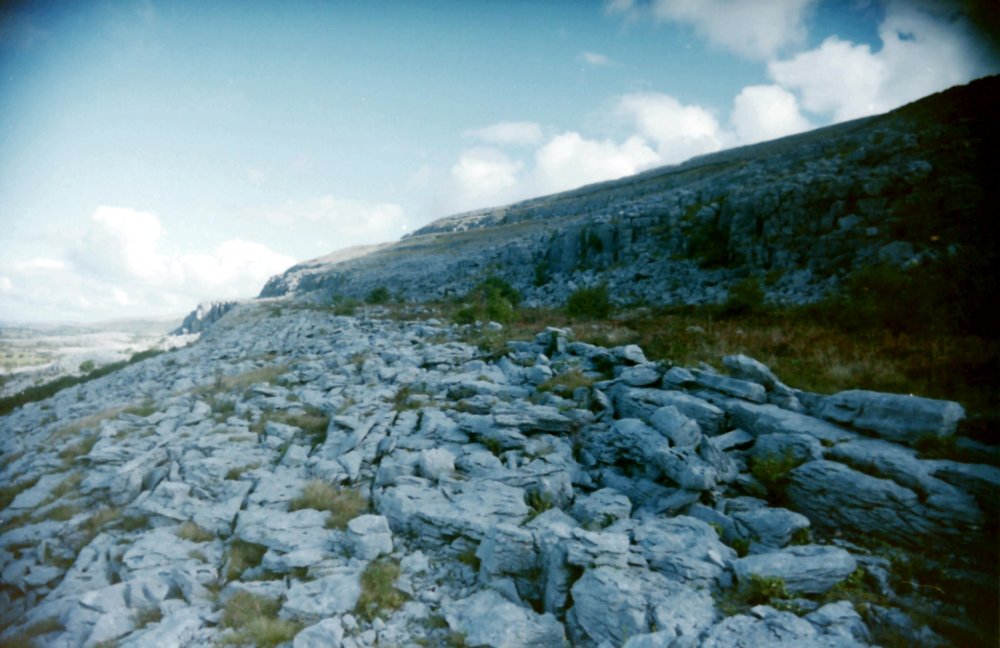
Back to the Oddest Landscape in Ireland - The Burren, County Clare

Wide View of the Burren, County Clare
There really is nowhere else like The Burren. You can only see this in Ireland.
My last full day was turning out well. The weather was brilliant once more and I headed for Galway City (Gaillimh), which I was expecting to be my last major port of call. Galway City is thriving. It is cosmopolitan, hectic and colourful. Most of its ancient buildings are long since gone, but somehow this City doesn't need them. I liked Galway City.
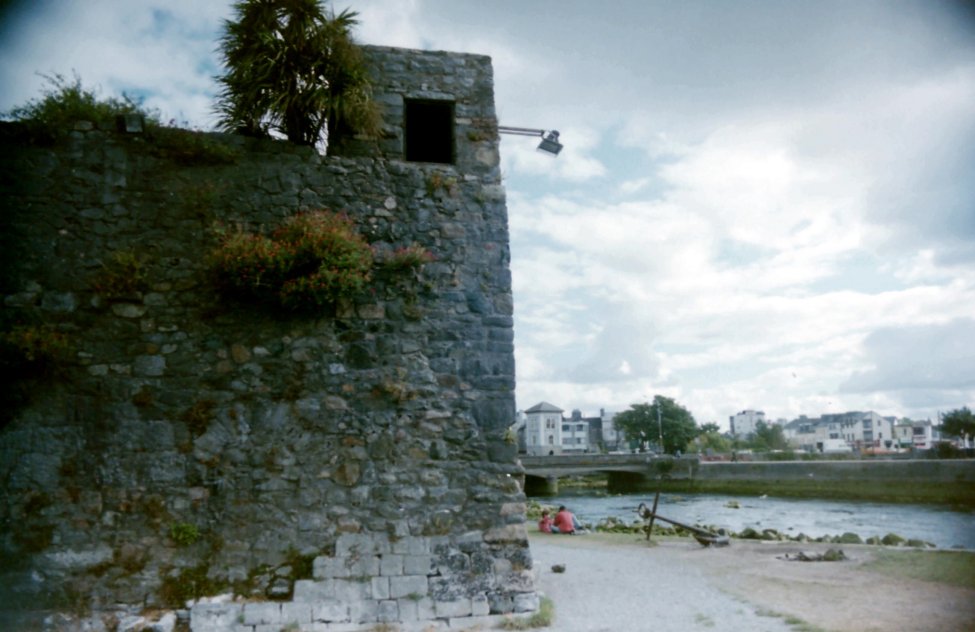
The Spanish Arch, Galway City

Looking Across to the Claddagh, Galway City
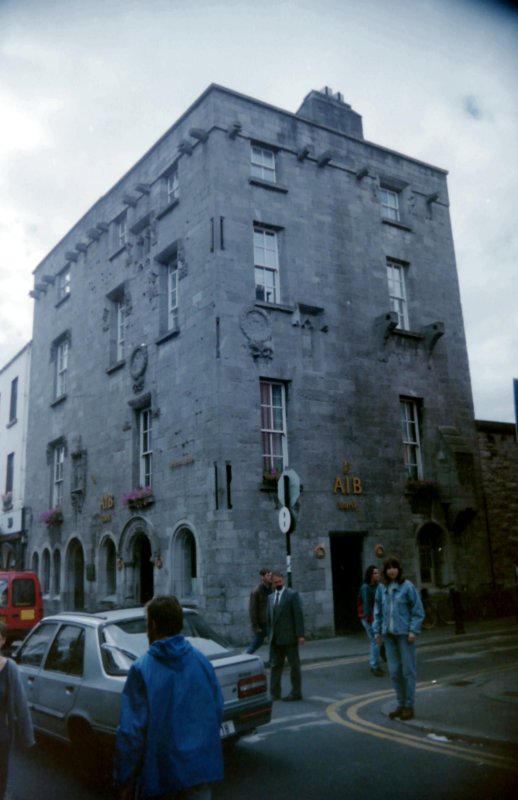
Lynch's Castle, Galway City
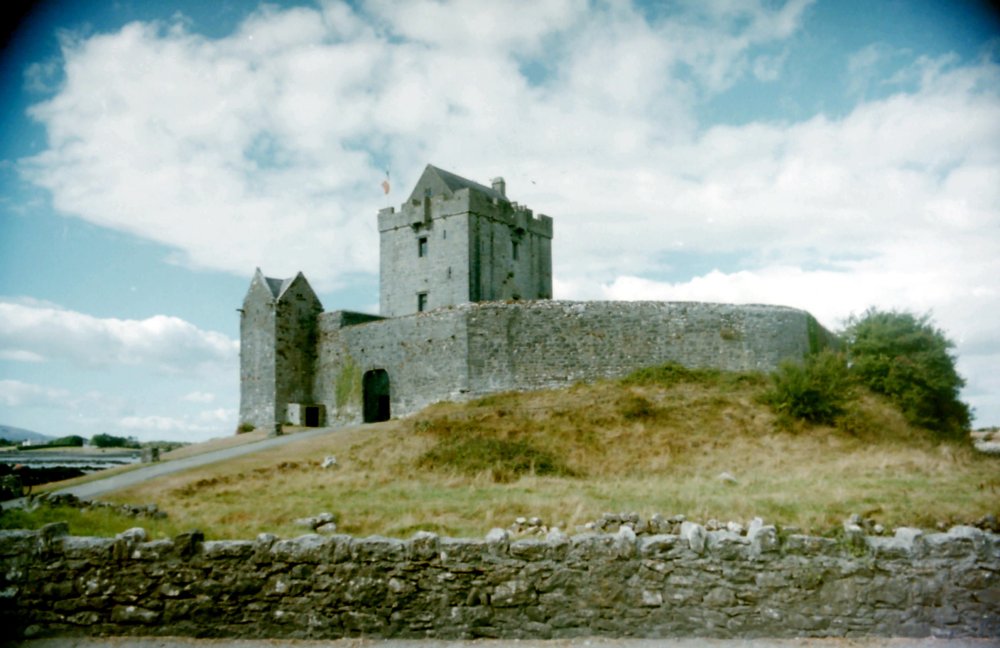
Dunguaire Castle, County Galway
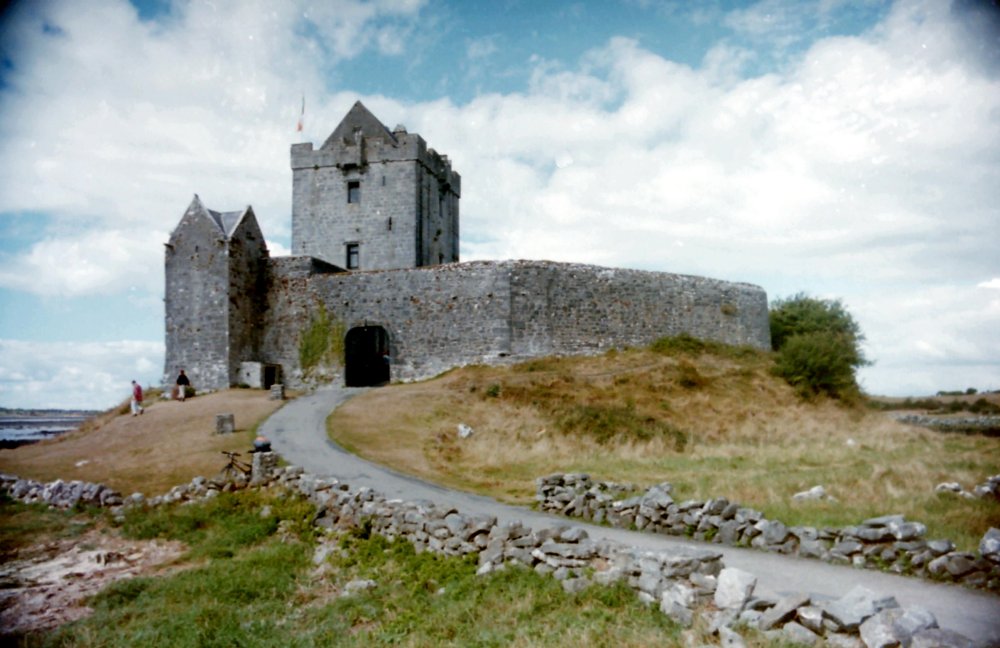
Another view of Dunguaire Castle, County Galway
I had two choices now. Head out into Connemara to take in the scenery there, or head towards Dublin and be on the safe-side for getting back to the Airport in time. I opted for the safe-side, as I knew how the Irish roads could be slow by now. It turned out I could have seen some of Connemara, but then I have saved that for my next visit - what more incentive could I need?
I stopped off in Loughrea (Baile Locha Riach) on the shores of Lough Rea, and stayed at the Lough side for longer than I might normally. I was aware this could be one of the last great views I have of Ireland on this trip. It turned out I was wrong there too!
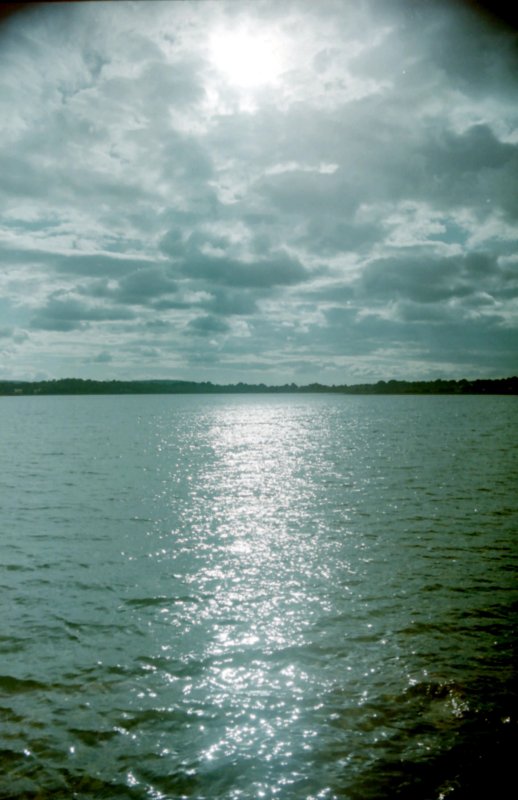
Sun going down over Lough Rea, County Galway

Lough Rea, County Galway
Eventually, I got to Ballinasloe (Beál Átha na Sluaighe), just in County Galway, where I stayed the night at a place with an effusively friendly landlady, who seemed to be interested in everything. I was made to feel hugely welcome, and it made me a bit sorry to be leaving the following day.
In a way, when you get to the end of the holiday you start thinking of home. I thought that my last day would be mostly made up of travelling. I wasn't exactly right.
My effusively friendly landlady told me it would take about two hours to get to Dublin from Ballinasloe. I had allowed about eight. So I had time to kill. She advised me to head for Clonmacnoise, so I did.
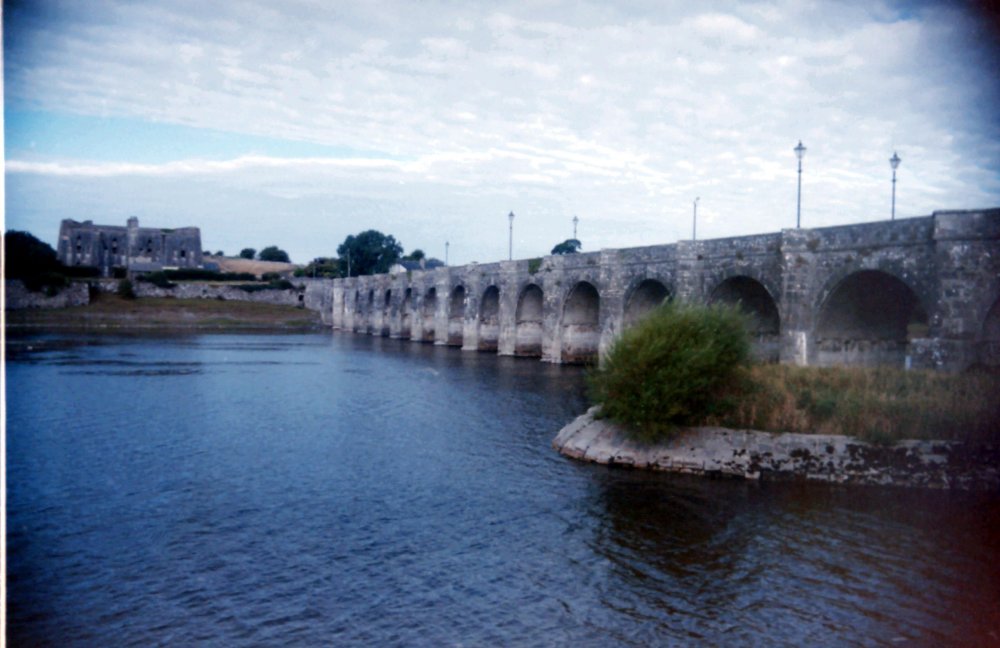
Shannonbridge, crossing from Galway to Offaly
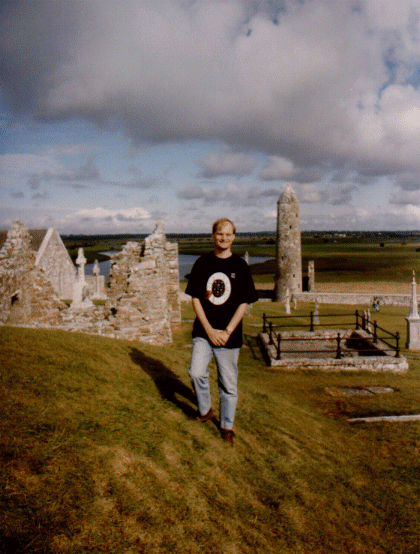
Clonmacnoise, County
Offaly

Clonmacnoise Castle, County Offaly
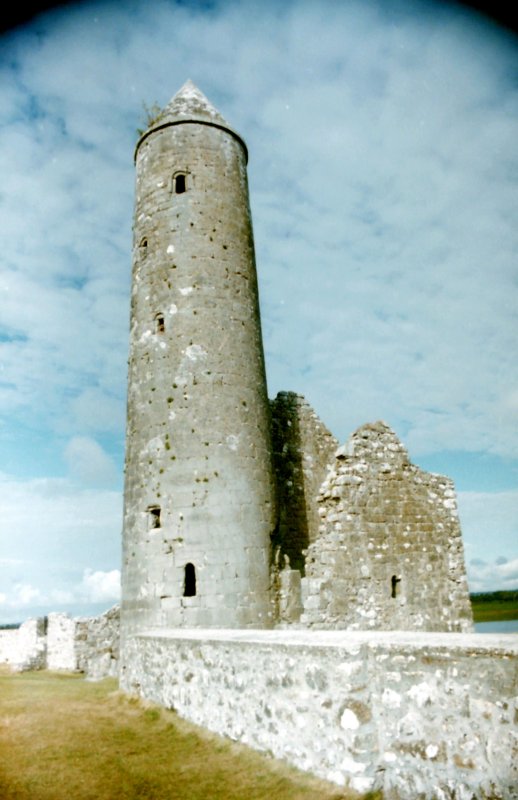
One of the Round Towers at Clonmacnoise, County Offaly

Monastic Complex, Clonmacnoise, County Offaly
On the way I stopped briefly at Shannonbridge on the border between Roscommon and Offaly and had another look at the River Shannon. It turned out that Clonmacnoise was also on the Shannon. This was, for centuries, the most important monastery in Ireland. It has two round towers, many churches and the inevitable visitors centre. There is also a Castle next door! I was very glad to have seen this place, it turned out to be one of the nice places and one of the most interesting....somewhere I might have missed had I gone to Connemara.

View over Clonmacnoise, County Offaly

The Ruins of Clonmacnoise Monastery Complex, County Offaly

Cell at Clonmacnoise, County Offaly

Clonmacnoise and the Shannon, County Offaly

Celtic Cross in the Musuem, Clonmacnoise, County Offaly
Onwards, and within a few miles of Dublin I stopped at the little town of Maynooth (Maigh Nuad) in County Kildare. This really was the last port of call. I found myself a Chippy, at long last, something which turned out to be rare in Ireland. I also had a Castle to myself as it is accessible only by getting a key. It was absolutely peaceful inside that Castle, only the pigeons made any other noise.

Maynooth Castle, County
Kildare
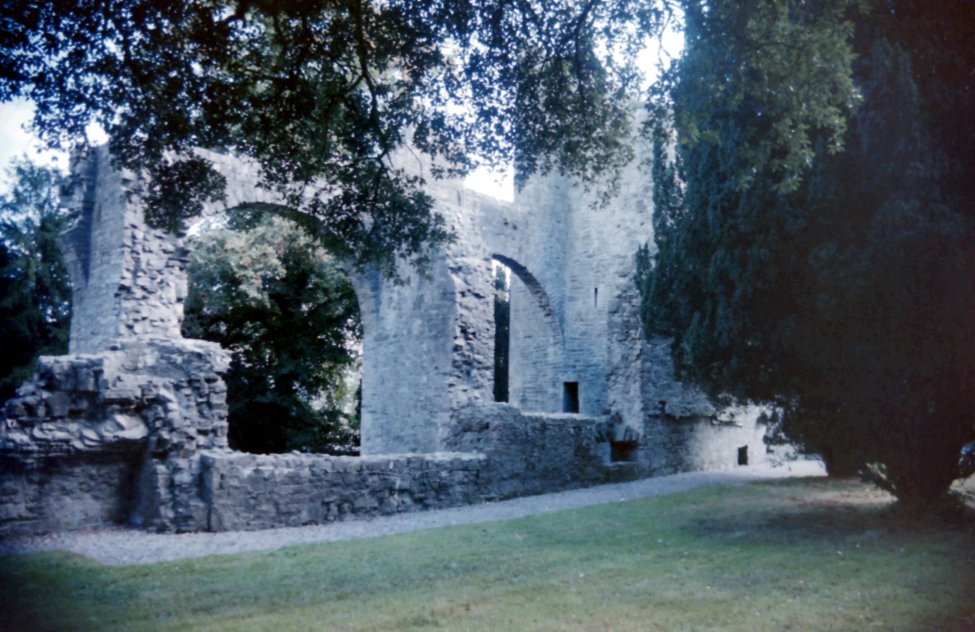
Inside Maynooth Castle, County Kildare
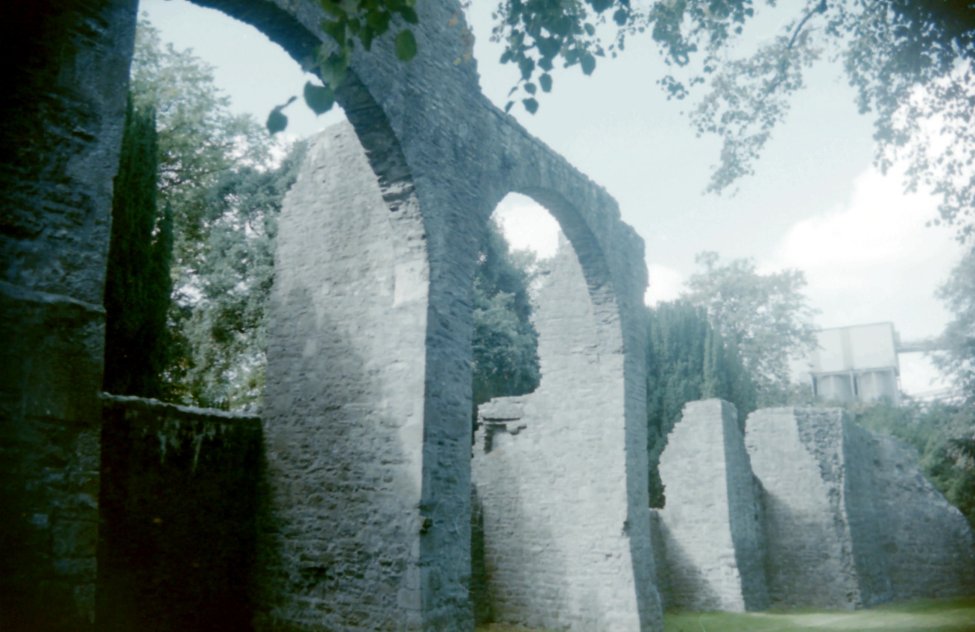
All On My Own in Maynooth Castle, County Kildare
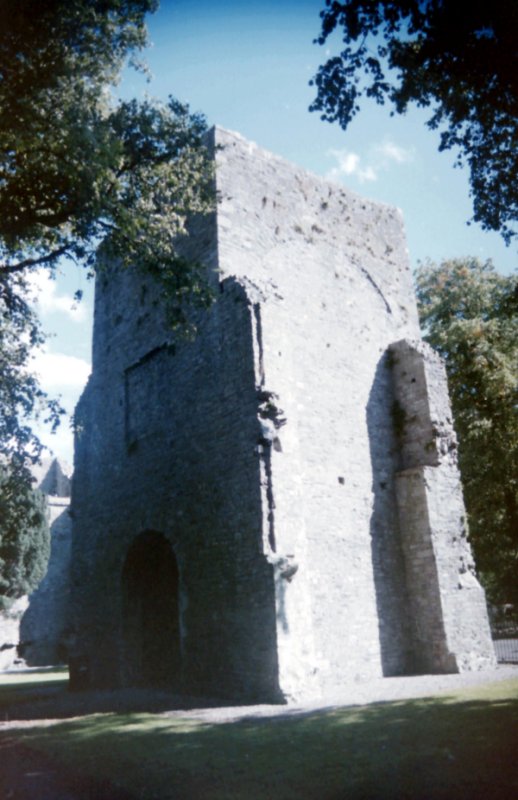
My Last Stop in Ireland - Maynooth Castle, County Kildare
Then it was back to the Airport, stopping very very briefly at Swords. I said a sad, but fond, farewell to 94 D 23096 and checked in.
As we travelled back across the Irish Sea the sun set and we descended over Luton in the darkness with the lights of Luton, Stevenage and so on glittering below us. It was totally totally night time when I arrived back at Stansted. A quick monorail journey back to the Terminal and then it was back to my Dad's car and the drive home.
I was tired, totally broke, but I was happy and satisfied.
GO TO IRELAND PAGE TWO
GO TO IRELAND PAGE THREE


©
Text copyright - Raving Loony Productions and Andrew J. Müller
© Photos and Artwork - Andrew J. Müller
© Web Design and Layout - Andrew J. Müller
2026


