
CONISBROUGH CASTLE
West Riding of Yorkshire
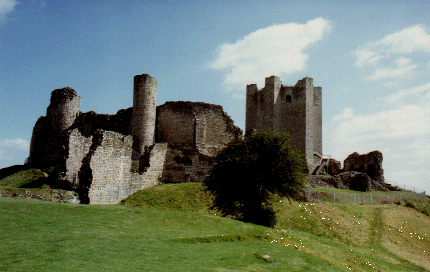
Without a doubt Southern Yorkshire's most important and most impressive Castle, Conisbrough stands in a rather unlovely suburb of Doncaster.
The first Castle was built here by William de Warenne, Earl of Surrey, shortly after the Conquest; but nothing remains of his Castle. Like Sandal Castle, it passed to Hamelin Plantagenet, Henry II's half-brother by marriage.
The Castle was constructed before 1202 (when Plantagenet died) and probably well before he moved onto Sandal Castle. As such it was well ahead of its time, featuring as it does a circular keep - albeit one stabilised with buttresses (only Chilham in Kent and Orford in Suffolk feature the same device). The curtain wall and barbican were added later, but still within Plantagenet's lifetime. The curtain wall is probably the earliest example of one with towers at regular intervals - an idea not seen since Roman times.
Conisbrough's excellent condition is probably due to the fact that the only action ever seen there was domestic. In 1317 John de Warenne abducted the wife of Earl Thomas of Lancaster and took her to Conisbrough. Earl Thomas laid siege and captured the Castle relatively easily. The Castle later passed into the Duchy of York and was abandoned when the House of Lancaster won the Wars of the Roses. By 1538 it was a ruin and for once took no part in the Civil War.
Sir Walter Scott made the Castle famous by fictitiously making it the residence of Thane Cedric in "Ivanhoe".
The Castle is today owned by a joint English Heritage/Local Authority Trust and is one of the best presented ruins in England and one of our favourites.

Back to Castles of the West Riding
© Text copyright - Raving Loony
Productions, Andrew J. Müller and
Roy Barton
© Photos and Artwork - Andrew J. Müller and Roy Barton
© Web Design and Layout - Andrew J. Müller
2018


