
TYNEMOUTH
PRIORY
Northumberland
Benedictine Monks
In the medieval period the Priory at
Tynemouth was
Benedictine – and the remains standing today are from this
period. However, it
has a much earlier history than this.
Some Roman
stonework has been found
here, but it is unclear
if there was actually a Roman fortification on the site. The Priory was
definitively founded by Edwin of Northumbria early in the 7th
Century. In 651 AD the first of Tynemouth’s three Royal burials
took place
here, that of Oswin, King of Deira, who was murdered by soldiers of
Oswiu of
Bernicia and his body brought to Tynemouth. He later became St. Oswin
and his
burial place became a pilgrimage site.
In 792 the
second King to be buried
here was Osred who was
King of Northumbria for just a year and then deposed and murdered.
As the 700s
move to the 800s Tynemouth
Priory begins a long
series of destruction and rebuilding. If there was ever somewhere where
the
image of Viking marauders destroying innocent monks was true it was
here!
The Danes
first plundered the Priory in
800. Subsequently it
was fortified for the first time – but in 832 the Danes were
back, although
this time they only did a small amount of damage. In 865 the Priory was
destroyed entirely and the nuns of St. Hilda who had come here for
safety were
massacred. The Danes were back just five years later in 870 and once
again in
875, leaving only a small parish church standing.
Earl Tostig
refounded the fortress at
Tynemouth in the
1060s. By then St. Oswin’s burial place had long been forgotten
and it is said
that Oswin came to Tostig in a dream and told him where his remains
were to be
found. Tostig died at the Battle of Stamford Bridge in 1066 and never
refounded
the Priory as he had intended.
In 1074 the
last Anglo-Saxon Earl of
Northumbria, Waltheof
II, granted the land to the monks of Jarrow and St. Oswin was
transferred
there, but it wasn’t until 1090 that Tynemouth Priory was
properly refounded,
by Robert de Mowbray. It was briefly at the centre of a dispute between
the
Bishops of Durham and St. Albans.
In 1093
Tynemouth gained its third King
– Malcolm III of
Scotland who was killed at Alnwick. He was only briefly interred here
before
being moved to Scotland. Meanwhile, Robert de Mowbray was in open
rebellion against
William II of England who besieged and captured the basic earth castle
and the
Priory in 1095. Mowbray, surprisingly, was merely imprisoned for life
– a lucky
escape.
In 1110 the
new church – the one
of which remains stand
today – was built at the Priory and in 1296 the Prior of
Tynemouth was given
leave to fortify his land with ‘walls of stone’. This was
the birth of
Tynemouth Castle as we see it today. The gatehouse was added around
1390 and
this is now the largest structure at the site.
In 1312 Edward
II and his favourite
Piers Gaveston sheltered
in Tynemouth Castle
before fleeing by boat
to Scarborough Castle. Edward’s
illegitimate son, Adam FitzRoy, was buried at Tynemouth having died in
1322.
In 1538 the
Dissolution finally arrived
at Tynemouth and the
Priory buildings were dismantled save the Prior’s House and the
Church. The
Castle continued in active service until the late Tudor period, being
refortified with earthen bastions during the Elizabethan period.
The Priory
Church remained in use
parochially until 1668
when a new church was built in the town and subsequently has become one
of
those dramatic church ruins which dot the English landscape.
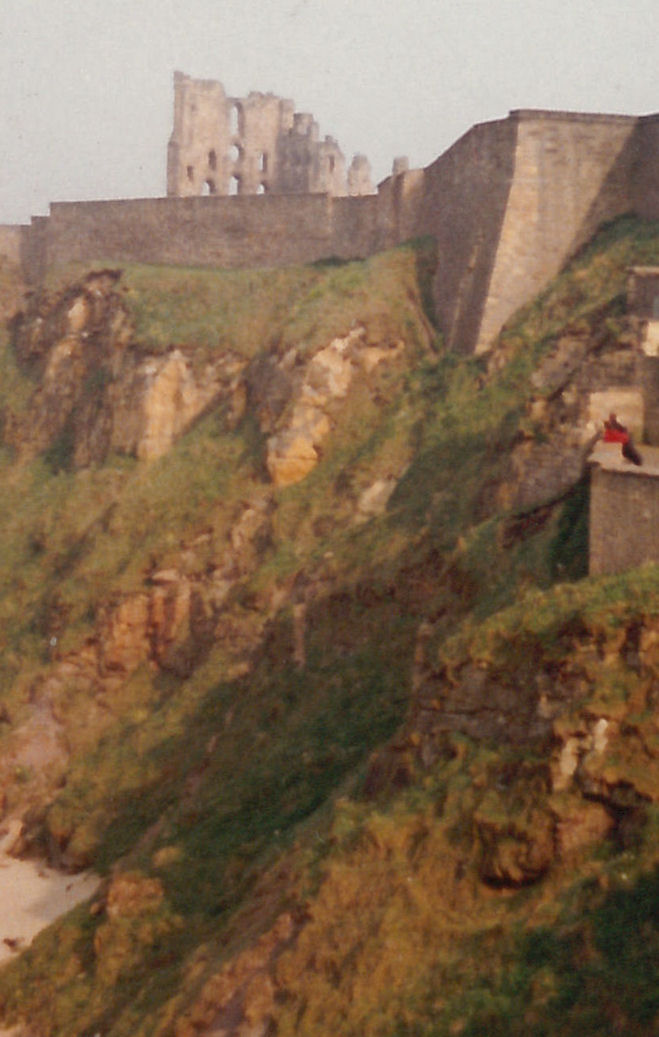
Today the
combination of Castle and
Priory standing high
over the beaches at Tynemouth is one of the defining images of the
Newcastle
area.
Photo
- Andrew J. Müller

Back
to Cathedrals, Churches,
Abbeys etc... page
©
Text copyright - Raving Loony Productions and
Andrew J. Müller,
Roy Barton
and Shaun Runham
© Photos and Artwork - Andrew J. Müller
© Web Design and Layout - Andrew J. Müller
2018


