
LA HOGUE BIE CHAPELS
Jersey
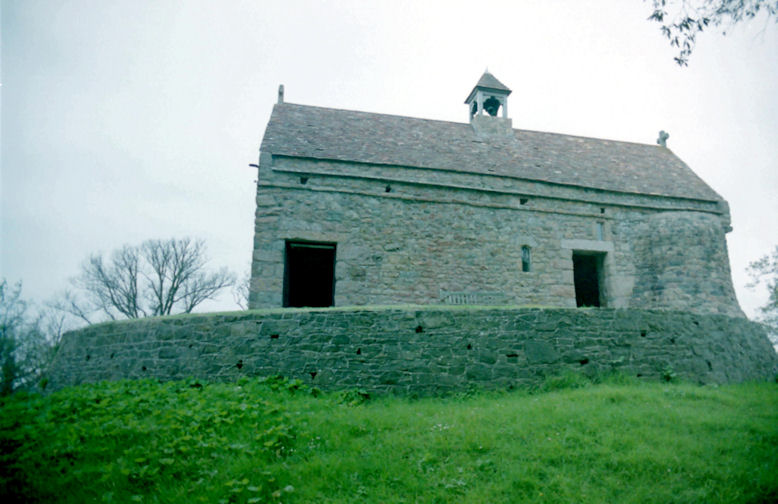
La Hougue Bie is more famous, rightly, for its 20 metre long passage grave encased in a 12 metre high burial barrow - by a long way the best preserved and largest neolithic survival in the Channel Islands.
The burial site dates to around 3500 BC, like many passage graves the orientation is aligned to the solstices which also implies that the mound had a ceremonial purpose beyond merely being a gravesite.
It is thought that a Chapel was first built on top of the mound during the 12th Century, but the structures that survive today date to no later than the 16th. Originally there was only one Chapel, but this was rebuilt as a gothic Castle in 1792 probably by Captain Phillipe d'Auvergne.
The conversion was extensive, a single storey crenellated section was added to the north and a tower was built over the east end of the Chapel. It was during this period that the chapel was split, the Notre Dame Chapel (the western end) was kept as a private chapel for the new building whilst the Jerusalem Chapel (at the eastern end under the tower) was turned into a library.
Around 1833 the tower and grounds were opened to the public as a visitor attraction and it remained as such until the early 1920s by which time the building was become ramshackle and in 1924 the tower and the extensions were all demolished leaving only the mediaeval chapel remains.
The Chapels were restored but kept as two separate entities.
The Chapels and the passage grave are now open to the public.
Photo - Andrew J. Müller

Back to Cathedrals, Churches, Abbeys etc... page
© Text copyright - Raving Loony
Productions and
Andrew J. Müller,
Roy Barton
and Shaun Runham
© Photos and Artwork - Andrew J. Müller
© Web Design and Layout - Andrew J. Müller
2018


